We received samples from john@sandstone. We received about 800mg of crude, 800mg of what he calls a final product and lastly, 1 gram of (1 S,4 R)-1-methyl-4-(prop-1-en-2-yl)cycloex-2-enol which he said was consumed in the process and therefore not present in the crude. To be sure everyone is on the same page, we are referring to the THCP synthesis as outlined in this article:
https://www.nature.com/articles/s41598-019-56785-1/
We started with the crude and injected in our mass spectrometer. We changed our method for further separation.
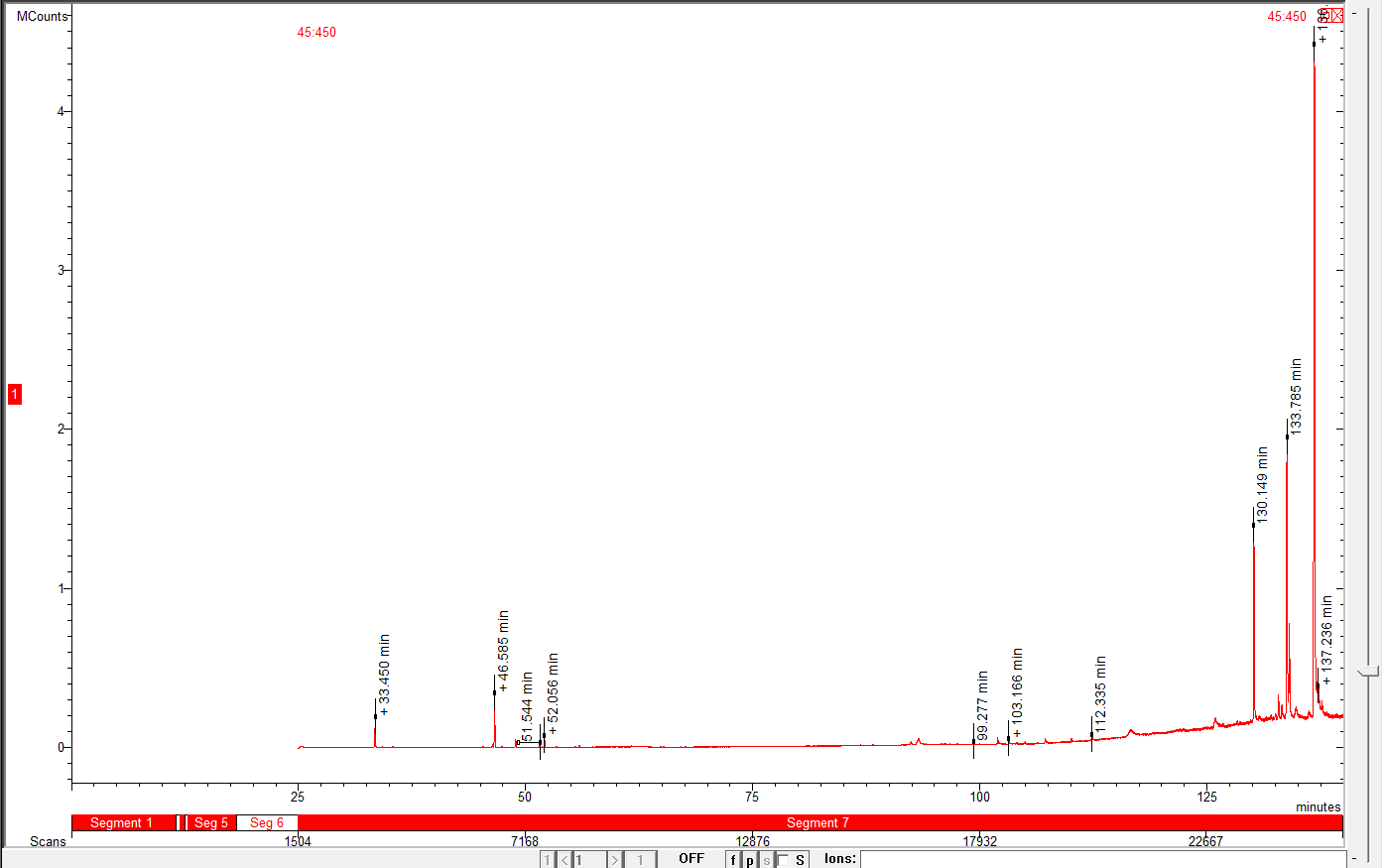
As you can see, the byproducts are very low compared to the CBDP and THCP after 130 minutes. We determined the byproducts to be identical, but less than what we had in our small synthesis of THCP. It’s obvious there has been a considerable amount of process optimization. As well, 5-heptylbenzene-1,3-diol was present in the crude. There was no olivetol, cbd, cbn, thc, or any other pentyl-chain products in the crude. The yield was above 80%, well beyond the 20+% in the study. There were no toxic compounds or PAHs in the crude so this was synthesized using good lab practices. It is obvious that they have made some changes to the Nature synthesis to yield more THCP. It was a pleasant analysis for a change.
The following picture is a zoom of the CBDP, isomers, and THCP.
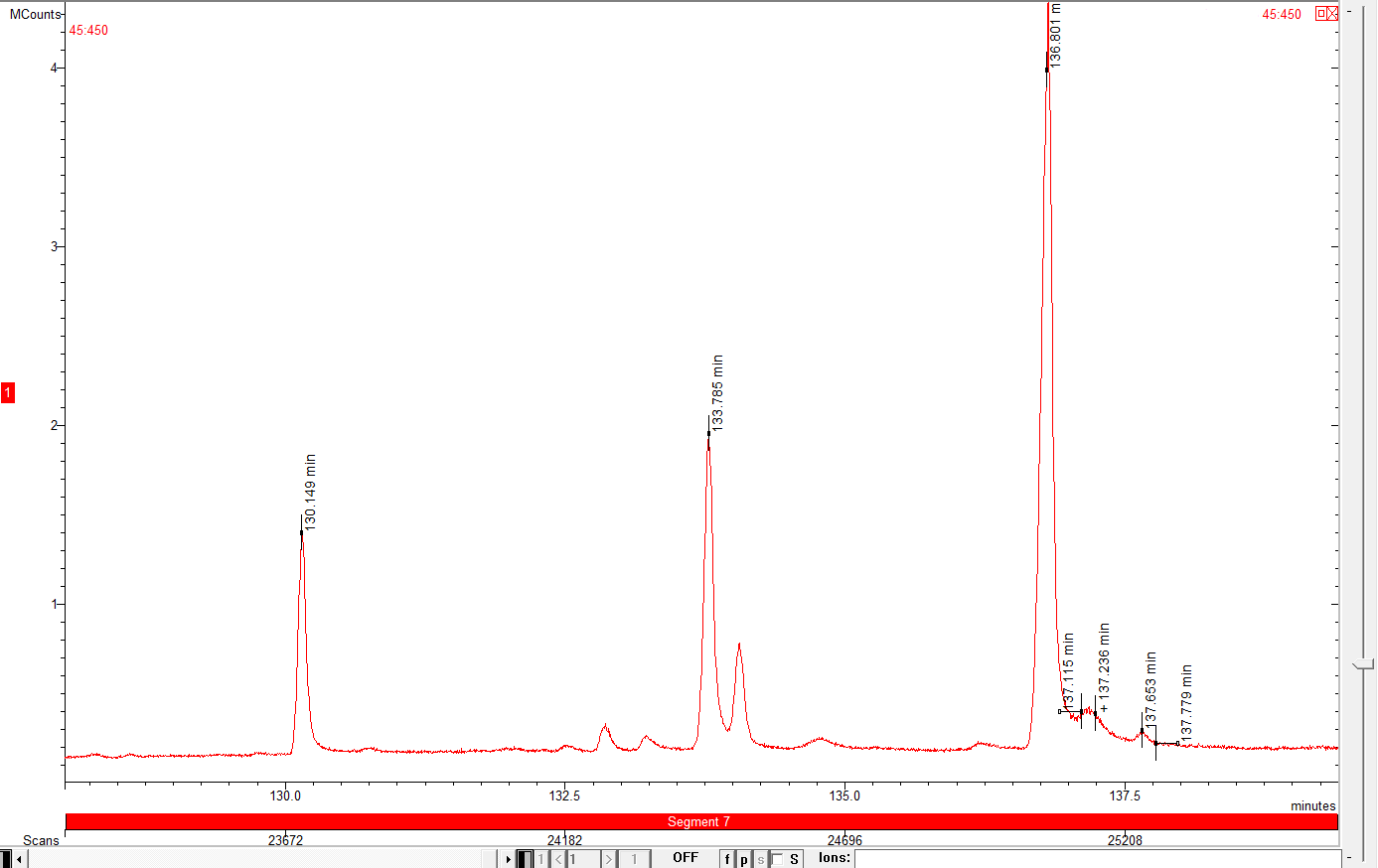
The CBDP is at 130.149, about 12%, the THCP is at 133.7 and 136.
The following is a zoom-in of THC-range through THCP. CBD, THC, appear at 121 minutes to 130 minutes. We detected no compounds of CBD, CBN, THC of any delta. We did detect a compound at 126 minutes (very small) but that was a high-boiling compound generally found in the seals of bottles. We ran the spectra to be sure.
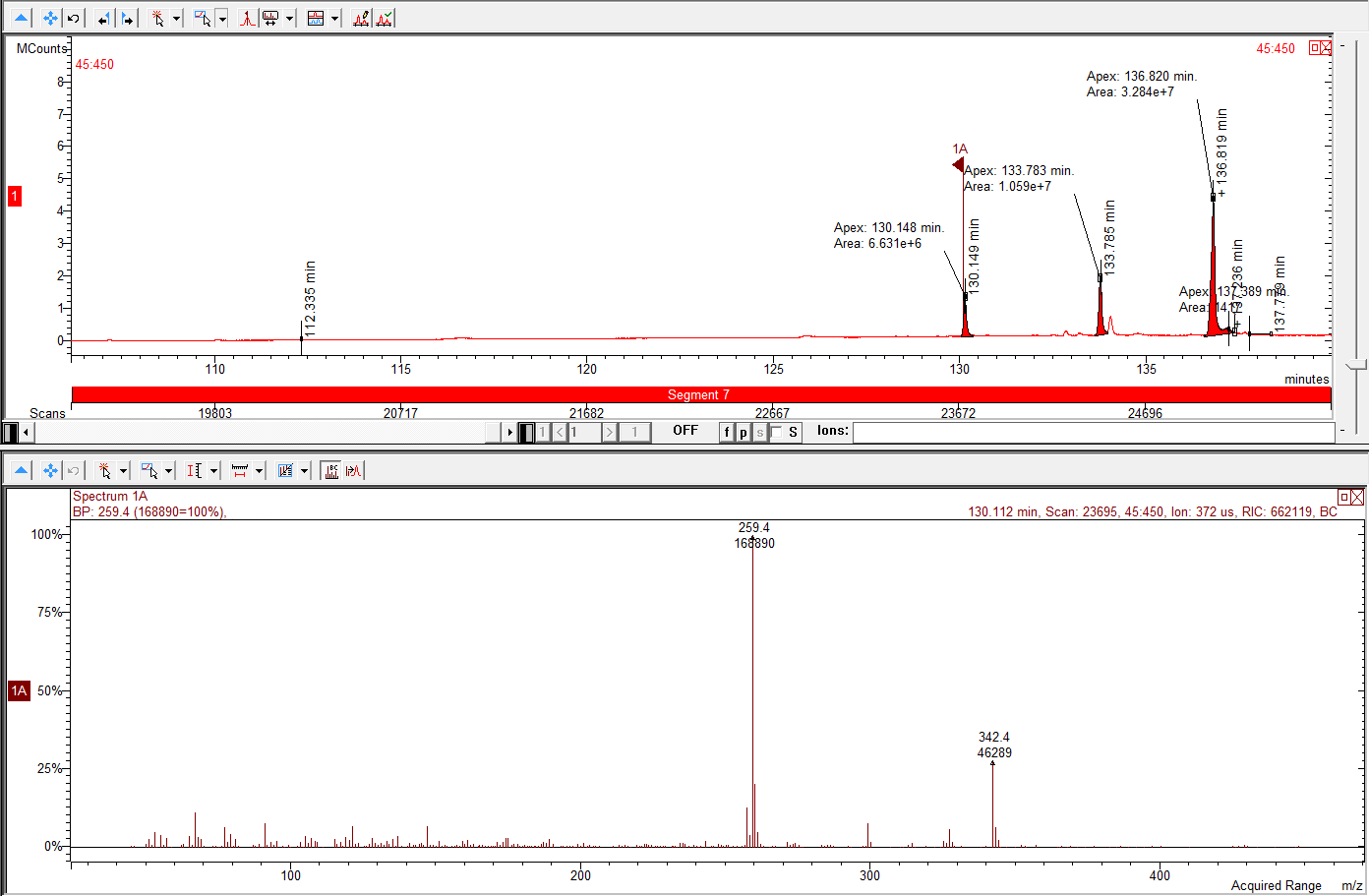
Overall, the product side was clean with no solvents, resorcinol, or toxic compounds. There were no THC, CBD, CBN, or Olivetol in the crude so I wouldn’t expect to find it in the final product.
My colleague called John this afternoon to discuss his process. It’s obvious he is in the middle of scaling production and explained “the pain” of scaling it. He described some of the challenges we had, albeit, ours were fewer as we were only making a couple of grams. As this synthesis uses pyrophoric catalysts, high vacuum (less than 3mm) and high temperature to make USP-grade precursors, this further makes the synthesis challenging. Lastly, a temperature-controlled and pressure hydrogenation eliminates most small-scale operations was something he explained and had scaled with their hydrogenation reactors. By the way he spoke, it was obvious the synthesis was a total pain in the ass and he advised he never would have set up for this if it wasn’t for the toxic “crap” you were sending him from a scam. It’s amusing how things work out.
I asked John if he felt if his process optimizations could be applied to D8 and D9 synthesis. He said it would but claimed to have no interest in that market as the products have lower value.
Unfortunately, most of my time on this board will be proving bad products. It was nice to see you have teamed up with a synthesis company capable of this complex synthesis and it’s not a scam. I rarely see that. It’s night and day from the garbage I was receiving from your clients a few months ago.
Good luck and I hope to be posting the analysis of some good and bad D8 products soon.
We prefer to test products we can buy direct from stores so that we know we are testing consumer products. Please advise me of a city and state where your products are available so we can test them and include in our product profiles.
