Need help and ideas on CBD tincture mixing for 7.5 liters

Hello,

I am getting ready to start mixing my own tinctures . I have been using a bottler for years and he follows my needs for tincture. I finally have the space and lab to start my own batches. I already started a small 100ml tests and they have been going well. I am running low on one of my tinctures and would rather buy equipment and do it myself now that I have the space,

My first big batch will be 7.5 liters. I have my own crude oil and distillate from a 1 acre grow we did last year but will need everything else.

My current plan and would love any and all feedback.’

CBD Tincture Batch Planning

1. Total Batch Volume

Number of tinctures: 500

Volume per tincture: 15 mL

Total finished volume:

500 Ă— 15 mL = 7,500 mL (7.5 liters)

Recommended overage (2–5%):

Target batch size: 7.7–8.0 liters

2. Heating & Mixing Equipment Requirements

Recommended Setup (Best Practice)

Heating: Hot plate or heating mantle sized for a 10–15 L vessel

Mixer

https://www.amazon.com/VISOSCI-Homogenizer-Emulsifier-2000-20000rpm-Emulsification/dp/B0F6T9VZ31/

Typical blending temperature: 40–60°C (104–140°F)

Mixing: Overhead stirrer strongly recommended

Motor power: 200–500 W

https://www.amazon.com/ONiLAB-8053100200-Overhead-Stirrer-Stirring/dp/B07HB59J8H/

Appropriate for viscous MCT + crude CBD blends

Magnetic Stir Plate (Minimum Option)

Plate size: ≥10" × 10" (12" × 12" preferred)

Must be rated for 10+ liters

Requires pre-warming oils to avoid stir bar stalling

3. Mixing Container Recommendations

Minimum vessel size: 10 L

Ideal vessel size: 12 L

Most comfortable handling: 15 L

Material: Food-grade or 316 stainless steel

Flat bottom recommended

Bottom drain or spigot highly recommended

Having a hard time finding one.

4. Production Summary

Batch volume: ~8.0 L

Mixing vessel: 12–15 L stainless steel

Heat source: hot plate or mantle sized to vessel

Mixing method: Overhead stirrer preferred

Also wondering what’s the best MCT to use or recommended.

Fun fact: MCT oil’s density is about .92 to .96g/ml

Something to take into account if you’re just weighing it. Would recommend going a little over due to the variance.

if your wanting to start small you can use the mct gallon container as a vessel to hold the finished product and put a pump top on it

Filling machine would work better but this is cheap and works for low volume

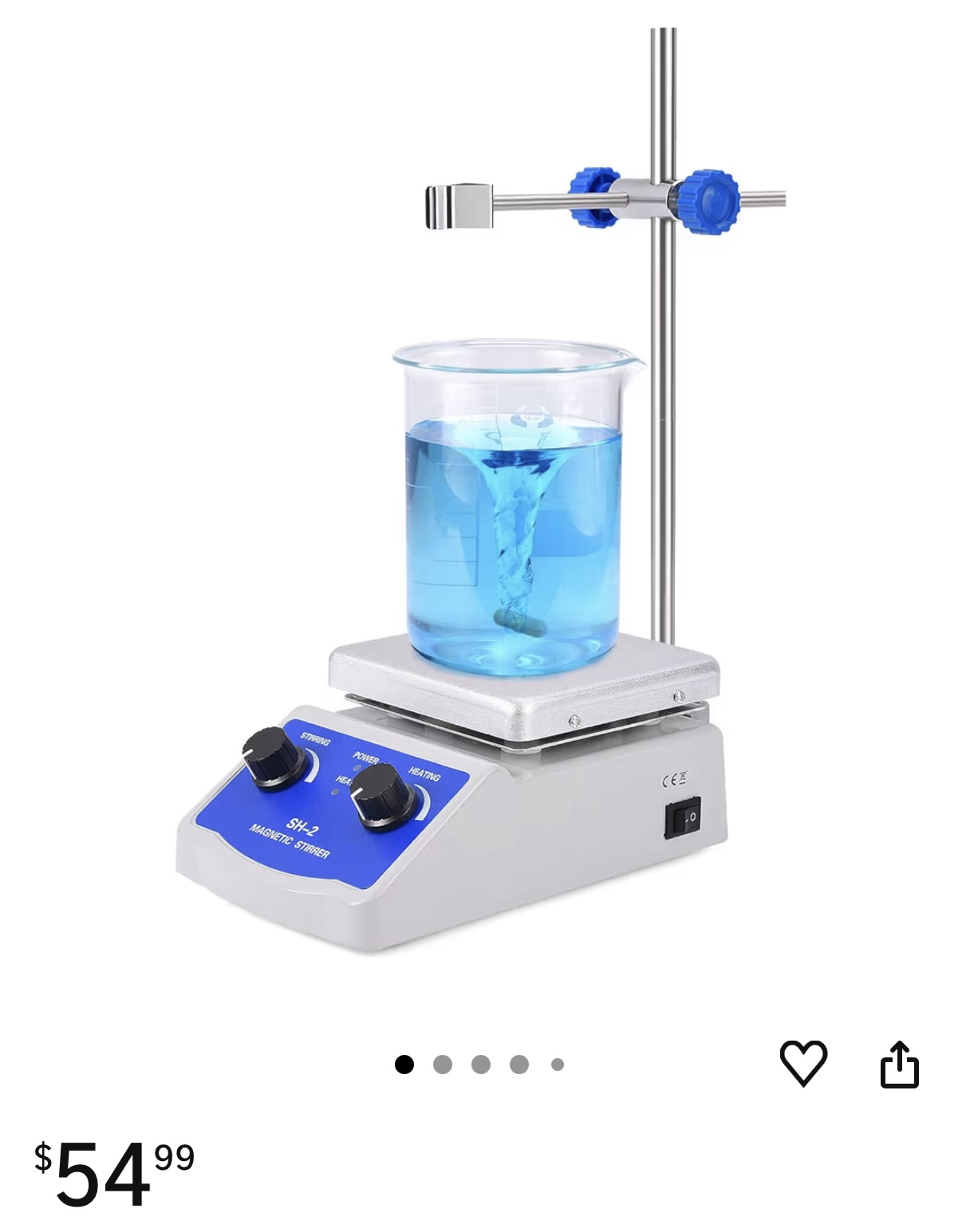
You should just get a magnetic hot plate stir thing and a gallon glass container to start, no reason to spend thousands of dollars on this. Just my 2c

4 Likes

The emulsifier you linked is a 20-1000mL volume, this task can be handled by a couple hot plates with stir bars and multiple flasks, you could formulate 8100mL in 45min on 3 hot plates with 1000mL flasks. (Mix all the small batches together into your larger container and homogenize them and use this as your sample material for Coa)

I 100% agree and would get a magnetic stirrer/hot plate, if you want to scale get multiple. I personally feel like larger batch sizes also increase your margin for error in your ability to create a homogenized tincture. Working with crude also makes this more difficult due to dark color (use a flash light to inspect)

The more tedious task is bottling the tinctures if you want to buy quality of life equipment.

If you want to use a large vessel still and overhead stirrer the same concept can be applied but get a mixer rated for your target volume, accommodate volume with larger batch processing times.


Here’s a cheap one on Amazon, I’d be interested to see what the heady hot plate recommendations are though.

1 Like

Hello,

Thanks for the response.

m not to worried about the price. I sell a lot of tinctures and want quality over saving some cash. I copied this from a chat I was in earlier but this is my business info.

Currently I go through 20 gallons every 9 months.

My base it 100mg CBD per ml

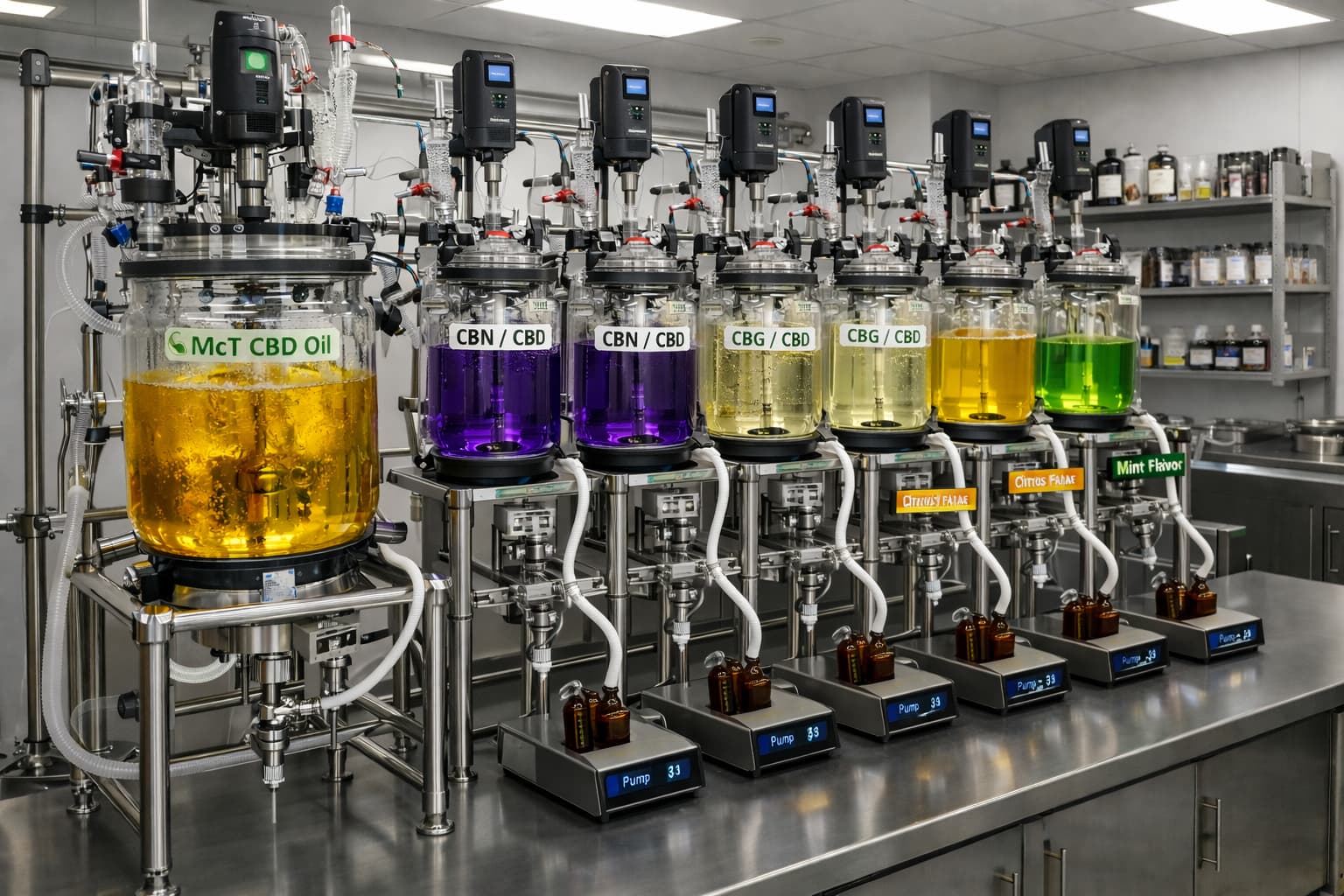
I have a natural in a 15ml and a 30 ml

3 15ml with the same base but in flavors

1 15ml with the same base but we add CBN and a few added terpenes

15ml and 30 ml with the same base but we add CBG and a few added terpenes

I just did my first 30ml test and im waiting for the results.

We currently have around 90kg of extract and some distillate so I do not want to buy anything.

We did a blend of 75% extract and the rest distillate. A few of our clients (dogs) did not like the taste of that batch so we went back to our 100% distillate. We are trying a new which iOS around 20 extract and the rest distillate.

Anyway I am creating my lab area and I’m looking for what the best options for me to purchase to mix at these sizes.

This was my last test ruin procedure. I didn’t have the right tools like a hot plate with thermostat so I used a heat gun. lol The test did come out pretty close.

Objective

To evaluate feasibility of dissolving CBD distillate into MCT oil using available equipment and to

observe mixing behavior, time, and temperature requirements.

Materials Used

• CBD Distillate: 4.10 g (Lot: BH-8489-01)

• MCT Oil: 25.7 mL

• Plastic mL syringe (for oil measurement)

• Butter knife used for distillate transfer (tool improvement noted)

Equipment Used

• 500 mL glass beaker

• Magnetic stir bar

• 79-1 hot plate with magnetic stirring

• Heat gun (used to monitor temperature)

• Digital scale (adequate but limited precision)

Procedure Performed

1. Measured 25.7 mL of MCT oil using a plastic syringe and added to beaker.

2. Weighed 4.10 g of CBD distillate and transferred into beaker.

3. Placed beaker on hot plate with magnetic stirring.

4. Applied heat gradually to initiate mixing.

5. Monitored temperature using heat gun.6. Maintained temperature below 140°F throughout mixing.

7. Mixed continuously for approximately 1.5 hours.

Observations

• Distillate required extended heat and time to fully incorporate.

• Initial mixing was slow due to distillate viscosity.

• Final solution appeared visually uniform after extended mixing.

Issues / Limitations

• Scale precision insufficient for high-accuracy formulation.

• Distillate transfer method inefficient and messy.

• Heat gun not ideal for continuous temperature monitoring.

2 Likes

This is my current distillate I am using.

Peak_Therapeutics_LNDO30422_Potency__Standard_Cannabinoid_Analysis (2).pdf (309.2 KB)

This was my first test. I was happy the COA was close to my 100mg per ml. I think having the right tools and adjusting to the mct to being .945g/ml will help me get to my target.

251222N009-001 CoA.pdf (335.2 KB)

1 Like

Thanks for your feedback. Will look into multiple hot plates. That wasnt really on my radar.

1 Like

Keg, paint mixer, drill, dosing pump.

Cheap, effective, scalable.

Eg start with say

…and well documented iirc

Eg (probably) Tinctures or maybe Need Cheap and Effective Solution for Homogenizing 50L of Distillate

A (20l?) jacketed glass reactor with a circulating heater/chiller is also a valid response, but is more expensive to scale when you discover you need to move from 7l to 50l batch size

This is what we decarb our isolate in. They do come in various sizes…just not as ubiquitous or robust as SS kegs imo.

Try here for Tincture Filling options

3 Likes

the chemtek ones are pretty nice for the price

2 Likes

Ok you got this

2 Likes

That’s a LOT of CBN if you didn’t deliberately spike it.

Do you always see this? If so, you might want to explore your storage/extraction/distillation processes.

(Mains at 215C?!?)

Yep! Certainly approaching the problem in an appropriate fashion.

So I just realized I based my calculations off the wrong COA. This is the correct COA. It still has a good amount of cbn

20260103_013358.PDF (327.9 KB)

1 Like

I’m suspicious thats not 9% CBC. (D10?**).

No analytical lab should be making that mistake at this point, but 9% seems way too high to me, and the elevated CBN accentuates the “hmmm, that’s not right…” that COA gives me.

Do you have any COA’s of your crude?

You might want to actually dig into your distillation process.

(Seriously!!)

How are you distilling? SPD? Vac level & temp please.

Too hot, because your rig is leaking, would be a reasonable explanation.

I’ll also repeat the part where CBDA might be a better medicine (ref up thread). (Better meds & less work. Why would you not at least consider it?)

** THC Imposters (Isomers)

The correct one looks to have 2.5% CBN (unusual).

However, I was apparently hallucinating (again) when I looked at the first COA and saw 8% CBN… it DOES have CBC higher than I would expect (7.4%), but CBN looks reasonable/normal

Caveats:

  1. It could absolutely be genetics, some high CBD chemovars do produce higher levels of CBC than others (which is why COA’s of the input crude and or flower would be useful).

  2. I’ve been out of the hemp game for 5+ years at this point, so I could be misremembering the spread for “reasonable” CBC numbers as well…

…but I would still advise comparing the CBD/CBC ratio on your crude vs distillate to confirm they make sense.

Thanks for looking at this. This is what we recieved from our extractor here in Colorado after we harvested our 1 acre.

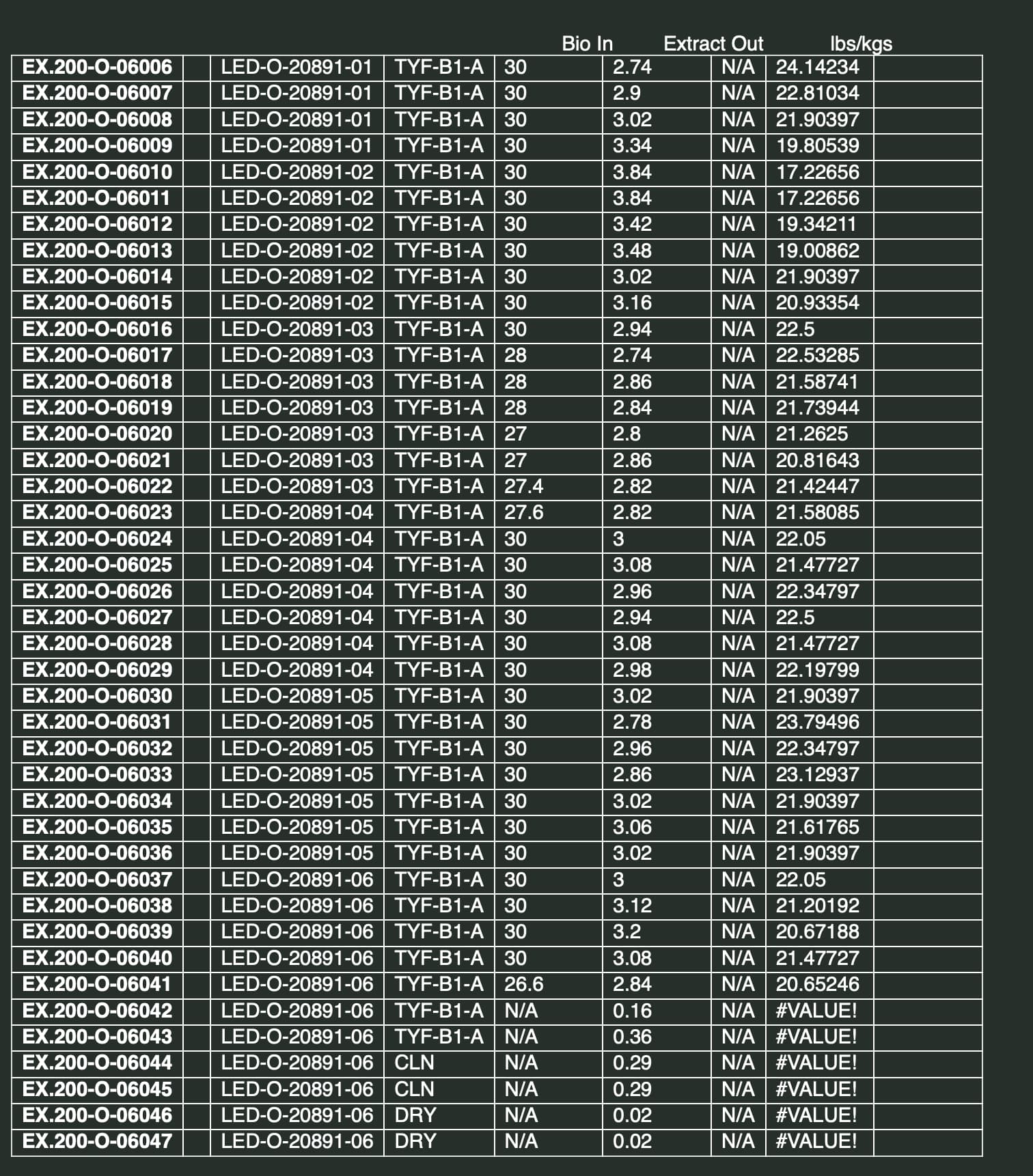
Please find the attached testing on the extract and non-detect distillate. You ended up with 109.88kg of extract(LED-O-20891), we took 12.06kg for remediation and distillation. You currently have 97.82kg of extract here in 5 separate containers. You ended up with 7.37kg of non-detect distillate(LND-O-30422). The extract and distillate came out great, I can get you samples if you need any. The material yielded well at 21.45lbs/kg for an overall average.

This is our first extraction and the distillate

PT Extraction 2024_EXTRACTION_SERVICES_LLC_LEDO20891_all_tests.pdf (369.9 KB)

Peak_Therapeutics_LNDO30422_Potency__Standard_Cannabinoid_Analysis (2).pdf (309.2 KB)

1 Like

Looks like it’s your genetics.

The extract (crude) has ~10:1 CBD/CBC ratio, which presumably reflects what’s in the starting biomass reasonably well (you might look at other chemovars).

Giving the yields in lb (input biomass)/kg output strikes me as bizarre, especially when they list the weights for the input biomass in kg on their spreadsheet. Seems deliberately designed to obsfucate imo.

Most would do the math as output/input. Such that 2.74kg output/30kg input => ~9.1% yield. Which is probably fairly close to your starting potency, but doesn’t give an accurate picture of how well the extractors actually did their job.

Those that understand the problem, would generally calculate extraction efficiency, which is cannabinoids out/cannabinoids in (times 100 to give a percentage). That requires potency data on the input biomass. Do you have those numbers?

If you handed them 8% biomass they got most of the cannabinoids. If you handed them 12% they did not.

30kg at 0.08 Total available cannabinoids = 2.4kg cannabinoids in input.

2.74kg crude at 0.75 TAC = 2.055kg total cannabinoids

Extraction efficiency = 2.055/2.4*100=85.6% which is generally considered acceptable (I’ve seen 99% achieved).

Going from crude at 75% cannabinoids to distillate at 85% cannabinoids isn’t particularly impressive, but if they managed to make the THC vanish in the process, it IS impressive.

I’m guessing they actually performed chromatography (they list “remediation”) before distillation, but could absolutely be wrong there. I certainly haven’t heard of anyone getting a clean cut between THC & CBD via SPD nor WFE (distillation).

Knowing what percentage of your TAC they lost during remediation and distillation would also be valuable information when evaluating how well they did the job.

2 Likes

2 Likes

I guess I keep the same distilled but add a bit more mct?

TEST 2 1-12-26.pdf (283.5 KB)

20260103_013358.PDF (327.9 KB)

CBD_Tincture_3000mg_30ml_Calculation.pdf (2.6 KB)

TEST 2 1-12-26.pdf (283.5 KB)

Thank you so much for all this info. Im recalling working on digging into it more.

The formula appears to only be in regard to CBD mg dosing and does not account for thc/compliance. A 3000mg CBD tincture made with full spec only has a thin line for compliance.

Using the formula that was linked and the distillate potency of 2.5% d9 the formula you used will give you a tincture bottle with 102.5mg thc and in a 30ml tincture you are at 0.34% thc.

Yes adding more MCT oil is a simple fix for the batch, but in regards for compliant hemp products you should always calculate the total thc that will be included in the target formulation. (Realize that this also changes all your %) a 30ml tincture 90mg is the cap.(rough estimate)

I think you are more realistically limited to 2550mg CBD bottles if only using that specific full spec material. I would not use more than 3.5g per.

we’ve been doing it for years. its just my first time now making them. I don’t want to change something my clients are use to.

coa 3.pdf (4.9 MB)

coa 2.pdf (263.5 KB)

coa.pdf (234.7 KB)

and now I have a 2nd test with the same oil but a different lab testing it and its all good. WTF. COAs are getting so worse these days.

DE60112021-001 (Original).pdf (324.1 KB)