Olfactory and the sense of taste are some of the most profound things to humans, you’re more likely to remember what your momma’s home cooking smells like, than what her face looked like. Olfactory sensations can make a man vomit, relax, tense up, vivid memory recall, it’s a profound sense we take for granted every day.
2 Likes
It’s always underestimated how powerful they can be until you remember a smell from a random event from decades ago
1 Like
“Smells are handled by the olfactory bulb, the structure in the front of the brain that sends information to the other areas of the body’s central command for further processing. Odors take a direct route to the limbic system, including the amygdala and the hippocampus , the regions related to emotion and memory.”
Taken from Google. Not a great description as there’s massive amounts of neuroconnections made.
Trying to save @bio_stimz the time. 
2 Likes
The Phylos Galaxy dataset is worth mentioning here.
This large collection of strain-specific cannabis DNA sequence data cluster into a single large group, presumably due to extensive inter- and intra-strain hybridization during breeding by humans.
If your buddy was wrong, this large collection of cannabis DNA sequence data would likely cluster into three smaller sub-groups, with the cluster of DNA sequence data from the hybrid strains falling between a cluster of DNA sequence data from all the indica strains and a different cluster of DNA sequence data from all the sativa strains. The fact that these three clusters of strain-specific DNA sequence data are not observed in the Phylos dataset is very informative.
4 Likes
I say gents, great convo.
3 Likes
Anything Phylos touches is confounded by a vested interest. Their data subset and methodologies are garbage.
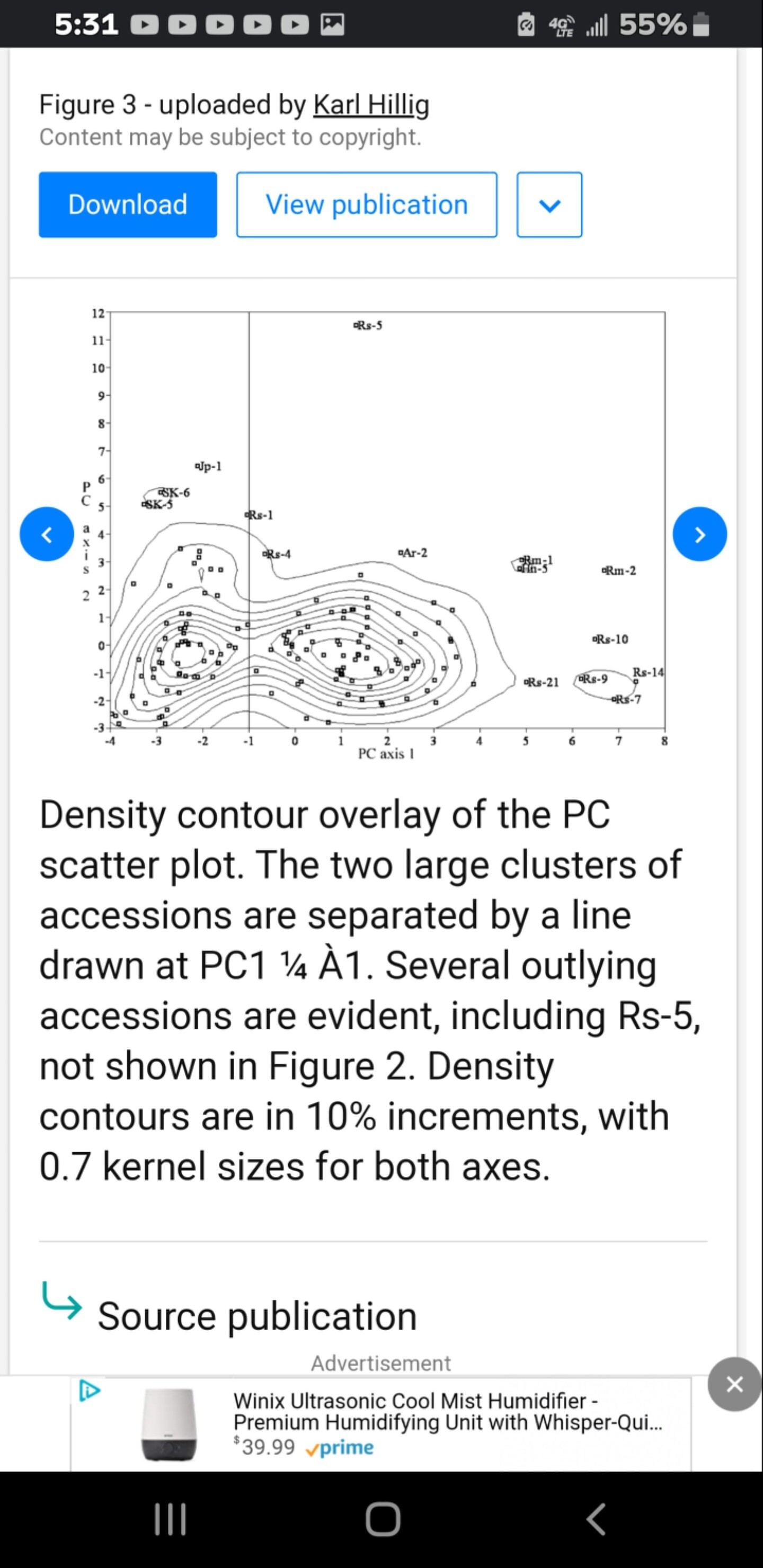
Hillig et al 2005 provided evidence for a three-species genus via DNA haplotyping with PCR amplification and Bakel et al 2010 also confirmed their separation via haploid genome sequencing.
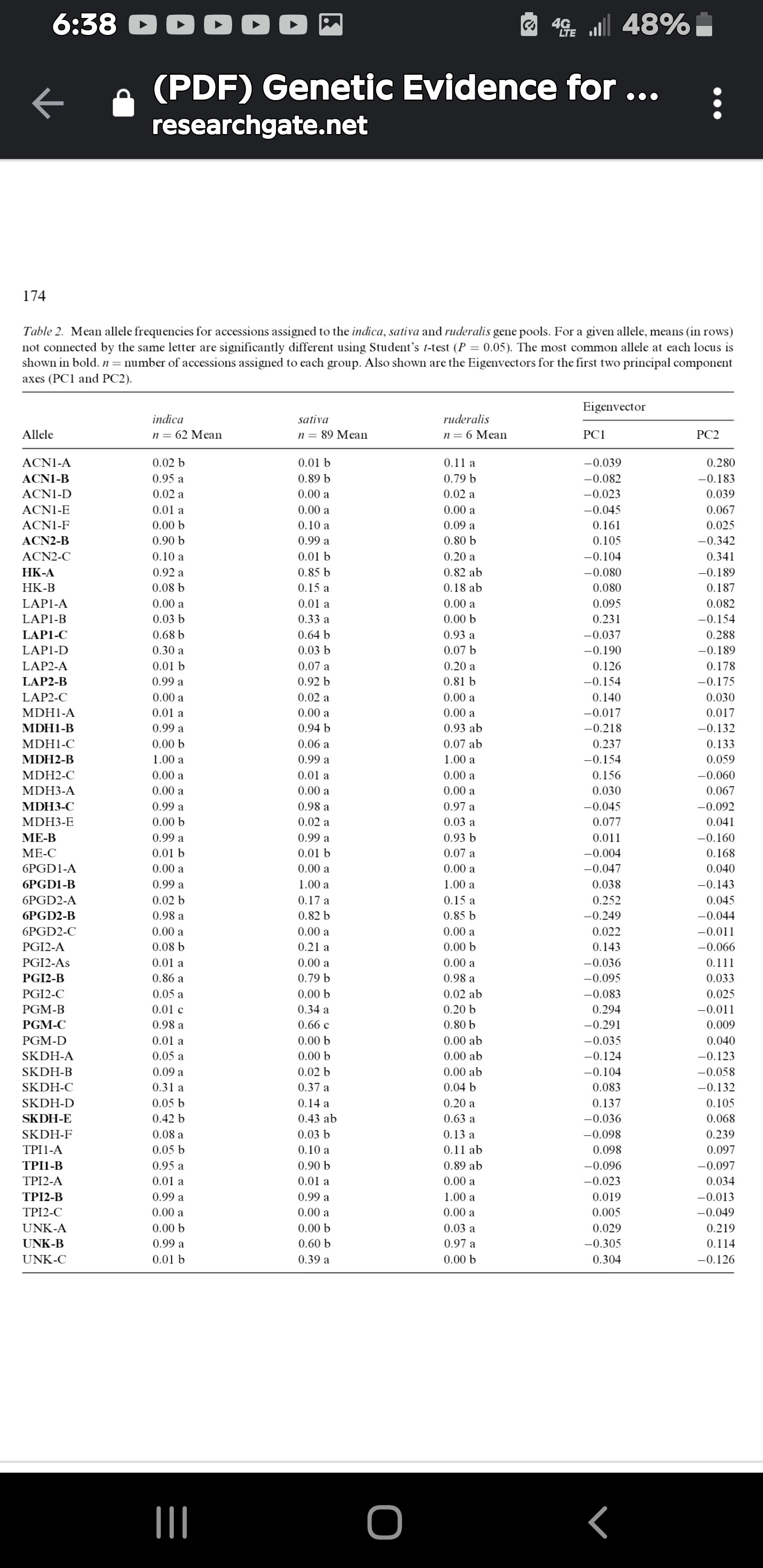
Here’s a couple of screenshots from Hillig et al 2005; Genetic Evidence for Speciation in Cannabis (Cannabaceae), where the accessions are clearly separated in a principal component analysis via allele frequencies;
Table 2.
Mean allele frequencies for accessions assigned to the indica, sativa and ruderalis gene pools. For a given allele, means (in rows)not connected by the same letter are significantly different using Student’s t-test (P ¼ 0.05). The most common allele at each locus is shown in bold. n ¼ number of accessions assigned to each group. Also shown are the Eigenvectors for the first two principal component axes (PC1 and PC2).
3 Likes
I never thought I’d see a thread less informed than Reddit. At least they understand that whatever possible entourage effect you might feel is coming from the minor cannabinoids found in the mix and not from terpenes which are mostly flavonoids anyways. There’s nothing to indicate that they impact how your CB1&2 receptors work and they don’t alter the way your body metabolizes cannabinoids, and virtually all double blind studies, including one I did myself, indicate that even the difference in cannabinoid profile makes little difference to the overall effect. Even the level of CBD content in the bud seemed to have little to no effect on the effectiveness of the bud in getting you high. Literally nobody could tell the difference between the strains just by interpreting their own experience. I kind of assumed “the industry” would be privy to its own marketing gimmicks but I see I stand corrected.
I mean for fucks sakes at on point I gave them a bowl of the same strain from the same bag, and they thought it was new bud.
The definitions of Indica and Sativa are outdated bullshit anyway.
Once we better understand the entourage we can better predict effect based on targeted cannabinoids and actives in the actual plant.
Indica and Sativa have never been a noticeable effect for me.
Always been a noticeable nug shape / length / leaves sized different.
I’ve never consumed and been like “damn this sativa hitting.” Or been like “couch lockkkk indica is life”
But today everything sold or traded for consumption is generally hybrid. You can find out of country landraces but I don’t believe they’ll have noticeable different effects.
3 Likes
Speaking for myself (in terms of the indica/sativa paradigm in relation to perceived effects), the sedative vs excitatory psychotropic effects of heavily indica-dominant vs heavily sativa-dominant hybrids are clearly evident and have been since I started on the scene in the early 90’s. My ability to discern between the two with ease and accuracy, has proven to be correct - time and time again. The psychotropic differences between my landrace sativa-dominants vs my landrace indica-dominants are quite profound and easily distinguishable.
3 Likes
“Anything Phylos touches is confounded by a vested interest. Their data subset and methodologies are garbage.”
This is a bold statement. DNA sequence data is a very useful approach to gain new insights about genetic lineage. Clustering DNA sequence data is straightforward and uses well-developed computational methods.
The fact that one does not like (or trust) Phylos does not render useless the data they have generated.
And yet despite it’s supposed utility, the findings of Hillig et al 2005/Bakel et al 2010, clearly demonstrate that the Phylos dataset is inaccurate and inconclusive.
2 Likes
Weed is weed. If you don’t get high from it it’s probably hemp. That’s my take on it.
To me there’s THC and CBD. I’ve had blue dream from dispensaries that was labeled Indica from one dispo while the other labeled it as a Sativa. So it’s definitely marketing.
Then there’s also the bullshit of when does it become a Sativa because it’s CBD? I’ve seen “THC dominant” bullshit at dispos be the same strain as their CBD counterpart and then one says the strain would be an Indica the other a Sativa.
I haven’t cared for a while but when I was tripping on LSD, I could feel the effects differently between vaping a hybrid, Sativa or an Indica because it’s all in the mind. Either way I was just getting high.
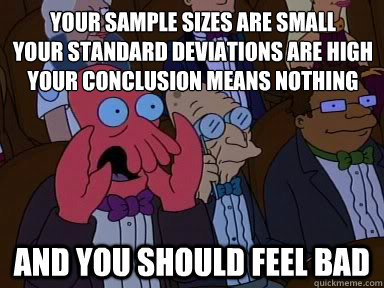
For me, one data set does not typically invalidate or prove inconclusive another data set. It is always possible that both datasets are (somehow) pointing to the correct answer. It is also possible that two datasets point to opposing answers because the data were obtained with fundamentally different experimental approaches, which somehow point to different answers. For example, two different experimental approaches could provide data a two completely different levels of resolution, with one level of resolution pointing to one answer and the other level of resolution pointing to another answer.
Ever consider these are two imperfect data sets, that are both miscarrying the data, because, you know, science. We need further refining and data.
4 Likes
Why would that be? The phylos data is more recent and based on a much larger dataset. If anything, shouldn’t it rather clearly demonstrate the inaccuracy of this paper?
3 Likes
To your point @MagisterChemist, the number of variable character states in the Phylos data type far far outweighs the number of variable character states in the data types used for the Hillig et al 2005 and Bakel et al 2010 papers.
1 Like
I agree with the not much difference idea although as a personal annecdote I always get paranoid from those really gassy/musty OG strains. all the ones I see lately are more earthy though and have been OK.
Calling edibles that are infused with 80% potency CBD or THC distillate being called indica or sativa is the real crime in my opinion.
3 Likes
My contention is that they WILL see a lot of difference – as long as they believe they should.
3 Likes