I have heard this as well.
Every time I start asking pointed questions the sales people stop talking to me though.
If you manage to make it work there’s definitely a place for them, even at $50k.
Especially when I’m about 98% they can be had for substantially less than that if one knows where to look.
1 Like
A good point. I designed our machines so that they could be run manually in a pinch. Every valve was hooked to a three-way switch that allowed it to be run automatically, be disconnected, or be run manually.
I also designed them so that I could change key parameters like time while the program was running, so I could add or subtract based on what I was observing.
5 Likes
what about making an API for the cannabinoid sensors that have already been made?
1 Like
You tried one that works?
Care to share which?!?
1 Like
If I ever find one that actually does what it’s supposed to do, I’d be more than happy to do so.
Hell, if someone gets me one that actually works, I’d write and open source an API/control module to connect with it (presuming that’s possible).
The arometrix has been pretty conclusively proven to not see cannabinoids. I’ve spent well over $10k on their gear and something in the range of hundreds of hours with no success actually seeing cannabinoids.
To my knowledge, the only tool that is presently available that actually can see/track cannabinoids in an online manner is a NIR sensor. And they’re fuckin expensive.
Everything else uses something else as a proxy for cannabinoids, which is fine in some situations, but not in others.
2 Likes
Have not. I generally sacrifice yield for quality. I honestly don’t understand the hype around low temps. Ive made on par live resin by hot gassing the tube and running through a small bed of pH 8 bentonite
What you using as a detector?!?
2 Likes
I’d like to know more too sounds neato!
1 Like
Thank you.
Memory lapse rather than lack of reading…
1 Like
raspi/arduino with uv vis nir sensor
we used ir and a yellow approximately saturated butane color led
shine led through a small flat sight glass to sensor on opposite and seal ambient light out
graph for instant saturation visualization
used after your material column you can tell when it’s done
spectroscopy is the buzzword
3 Likes
Hey brother, I’m finally going down the same route here about 15 years later making my own controllers just for my few patients and my friends and family! But I’m getting into engineering and doing the same exact shit, I want the same features and I can’t afford anything but learning and designing them myself, maybe I could pick your brain or something sometime! I started with the vacuum controllers and now here I am trying to automate the closed loop and shit
uv vis sensor huh! So that’s the one I’m looking for, I’m a little more familiar with adrinos than I was originally when I asked this!
1 Like
This approach makes a lot of sense. Gradual, data-driven automation is far more realistic than full turnkey systems. Starting with data collection to identify true bottlenecks before adding controls seems like the most cost-effective path forward.
2 Likes
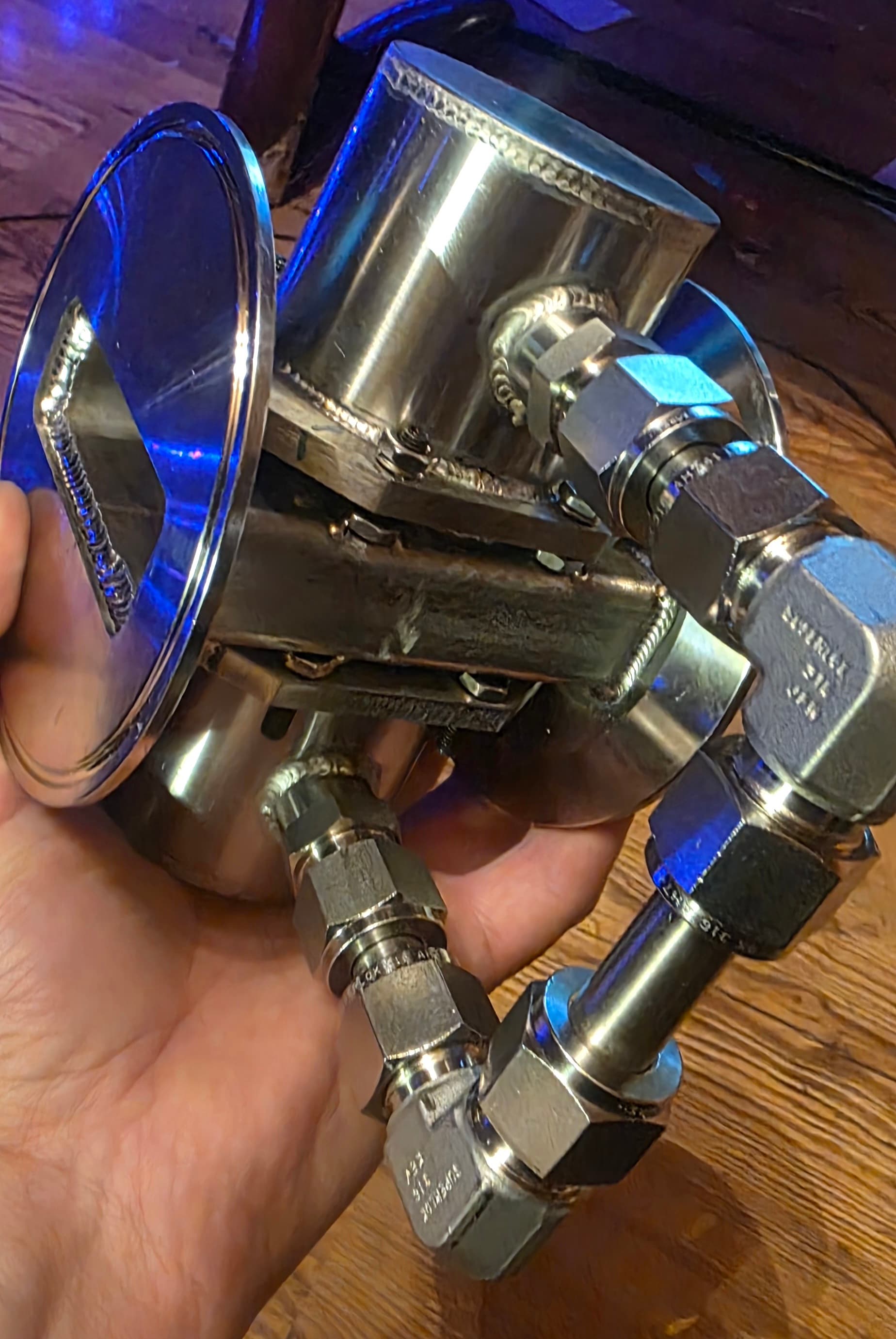
I’ve just built our latest extraction sensor design. 190nm to 850nm absorption spectroscopy with a third sensor for intensity calibration and solvent saturation detection.
Based on an esp32s3 and using hamamatsu detectors and a TCS detector with Wi-Fi. We are gonna use a c1d1 tablet to run the software, which will have a built-in AI for pattern recognition and product identification.
Two flat windows at about 10mm spacing so we can get accurate beer-lambert concentration detection.
Working on a v2 light source that will be a deuterium + tungsten combo.
Still in development mode but next up after my basic testing, validation, and data gathering we are getting the software revamped professionally and my custom circuit ETL listed more than likely before official release. Gotta pass PSI review then we are in there like swimwear. 
4 Likes
That just sounds soooo much like an ignition source…
How does one even begin?!?
4 Likes
Fully sealed metal enclosure…. Will likely have to make my own custom circuit for it as well. Have a spectrometer rated low voltage tungsten already, have an old deuterium bulb and now a new one otw (couldn’t turn down the price).
I have a 275 and I can get a 265 nanometer UV light but their LEDs and I’m trying to get something a little bit more broad spectra.
1 Like
Sounds like you’re just about there! It’s funny because once it’s all laid out, it’s so simple! But even a few weeks ago, it was a little more challenging, if you will! But yes, to learn in real time and make changes, is the ultimate of ultimates! Essentially adding that AI in there it’s game over! Can’t wait to see how this turns out! Honestly man, yall keep me alive! Can live vicariously thru you guys
1 Like
So does that mean that you’re gonna have the C12880MA and the C16767 MMA detectors in one unit! Consider considering one only covers so much of a range where the other kind of leaves off?
1 Like