Would tibal work in that 20%?.. That would make alot of interesting thougts in my mind…
If “vacuum refill with argon” practiced good - and tibal itself is transferred in syringe (which makes it impossible to self-ignite in syringe)…
Then it looks not that scary actually
(also small scale, (not reactor) should make it easy to deal if it does - make some concoction to put fire away, or even alot 10x of cold water will work and deal with exoterm temp rise)
Is there anyone who worked with TIBAL and can share some exp.? At least on how generally it’s dangerous or \ pain in the ass to work with.
The d8 method I developed was sulfuric acid in heptane. Can get high 90%. Think the highest I got was 97% but to push it upwards of 98-99% they switched to pTSA in toluene.
Figured it out before the whole d8 wave doing random a/b chemistry on various cannabinoids.
pTSA is essentially sulfuric acid reacted toluene anyway. People using fullers earth for d8 is just using sulfuric acid since that is how the earth was acidified to begin with so I figured why not?
First to run CBDa → d8-THCa, which I know is do-able as others have had success… Then from that I want to try taking the d8-THCa and pushing it to CBNa just for the fun of it. Though I have heard others have failed here, likely due to the heat required for the traditional CBN process…
I have also played with a lower temp CBN reaction that doesn’t gas out H2S from the heat, and is totally do-able… I tracked it with my GC, taking samples every 10 minutes until the d8 peak was completely gone and all that remained was the CBN peak. Did not have to deal with H2S evolution at all but was setup for it just in case. Just finish the reaction, push into heptane + quench → distill…
But since that CBN reaction was done under 100c, it did take longer, and for crashing THCa in a vac oven you can set to 130f (54.4c) and let it crash (doesnt decarb the THCa)… Then why not try pushing CBNa via a 50c reaction similar to my previous work?
Never got around to testing it but I have some pretty fire hemp I have been working with recently for terpenes, I have plenty of CBDa again. Might just give it a go.
Ultimately, all of the acidic version molecules are “100x” - “1000x” - “10,000x” more effective than their neutral counterparts in secondary products like lotions / salves / etc. as they say.
Water based CBDa crude lotion works way better than the same formula made with CBD isolate (we did some blind testing with people)… (terpenes could also be a part of it…)
So I know the acids are of more medicinal value, and CBNa has yet to be created… Curious to what its potential is as either a topical or ingest-able… ? But also research data…
Now for other novel cannabinoids… CBNd would be pretty interesting.
Have done a little work on it. CBD → CBNd in my previous work found what appears to be CBX (Cannabioxepane) and CBF (Cannabifuran) based on scripture. My GC data: GC Cannabinoids
I have gotten very small amounts of CBNd from CBN under UVc light + bubbled air + heat.
I have a pretty solid CRM set for my SRI GC covering cannabinoids, tepenes, and psychoactives… Need to finish the MS vacuum leaks and get it online. Have GC upgrade its going through right now so I can select 2 coils and TCD+PID → MS or TCD+PID → FID.Then I will have an inhouse GC-MS with TCD, PID, FID options.
Why are you so hell bent on trying these dangerous chemical processes in your apartment building? If you arnt in the situation to do it safely for everyone around you then you should not be doing it at all. It isnt something to just dip your toes into as a casual hobby.
To study it, and maybe found out that some of them are possible at low scale, or not that “impossible” envo to do at “Country house” (hope it’s right term, lang barier) in the forest so that no other people get hurt.
I’ve reed about TIBAL for some time now, and also chatted - and many people people say that TIBAL doesn’t (if vacuum and pressure managed and under control watch), it might catch on fire, “flash-fire”, but it’s not like you added water to it. That’s the scary part
What time would you recommend to run RXN room-temp with dry heptane + cbd and ptsa.
If high mixing speed is available (overhead-stirr, instead of magnetic stirr bar)
One master suggested 18 mins for best results.
Is it possible to accidentally do RXN so dry - that it won’t react? Remember seen somewhere on site that some acid reactions - if too dry, won’t do isomerization.
Solvent and CBD should be dried everytime and everywhere
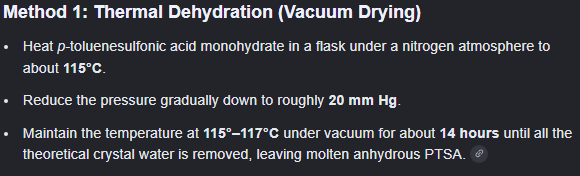
but should PTSA be dried? And how good this drying is:
(vacuum 115c, no toluene)
 stops at 20% and bellow…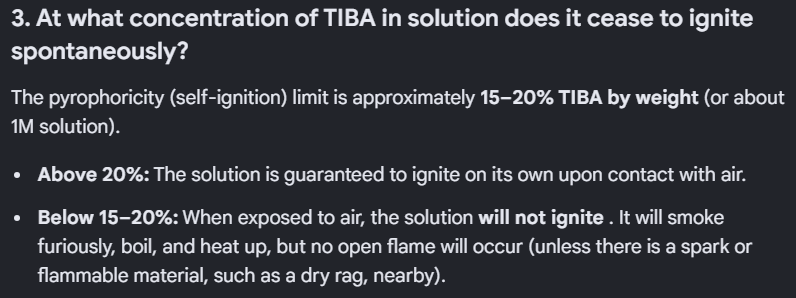


 flying everywhere