which micro mix are you guys using? i really only have a grow generation nearby, they green tax typical greenhouse nutes pretty good
1 Like
I have a ton of peters stem I could break u off some @square_root_pharms
2 Likes
We mix our own from Cu-EDTA, Mn-EDTA, Zn-EDTA, Fe-EDDHA and NaMO4.
3 Likes
ive still got a couple hundred pounds of jacks 5-12-26 left im burning through, i was just poking around for information really. it would be a hard sell for me to switch from jack hydro lol.
2 Likes
I’m talking about micros @square_root_pharms i have a bunch if you want some
@The_Lone_Stiller I busted out the whiteboard for that one. Lol
All masses are grams per gallon that I roughly converted to ppm. I figured everything at 1g just to make it easy to do a direct comparison…eg instead of 1g of this add 1.1g of this +plus that.
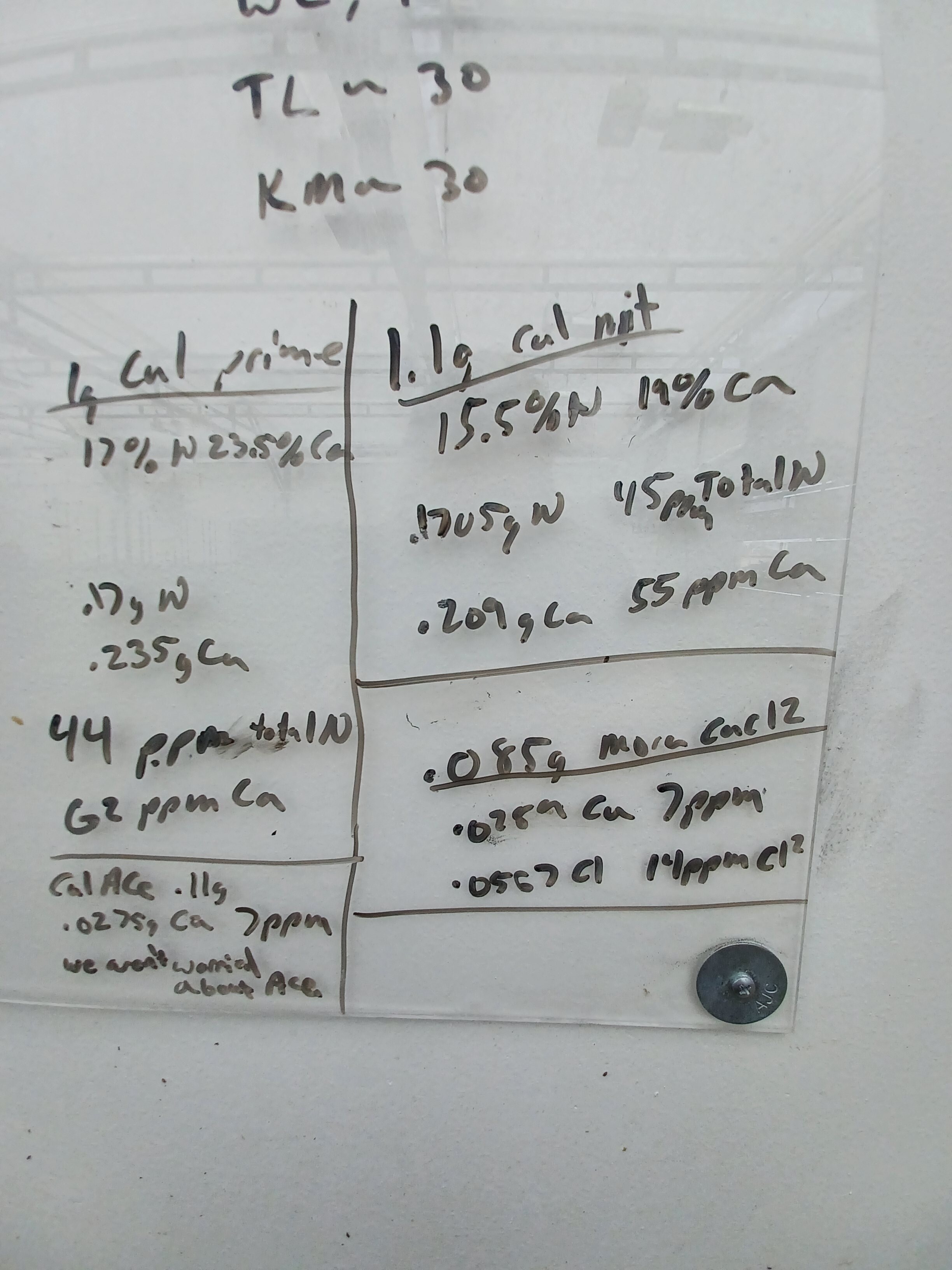
Starting with cal prime at 1g per gallon we get 44ppm total N, and 62ppm Ca.
To make up for the concentration difference I went to 1.1g standard calcium nitrate to get the total N roughly equal. With that 1.1g we get total N at 45ppm and 55ppm of Ca.
So now we are missing 7ppm of Ca and considering 2 options to fix it.
My preferred method would be cal acetate, but I have some cheap bastard clients that want the cheapest option possible.
With cal acetate if we run .11g per gallon we get our 7ppm of Ca plus a little acetic acid to help our beneficial organisms and plants.
So my preferred method for a direct replacement for 1g of cal prime would be 1.1g cal nitrate + .11g cal acetate.
Using Cal chloride, we will still be looking for 7ppm of Ca, but we need to at least account for the chloride.
.085 cal chloride gets us 7ppm Ca + 14ppm
chloride.
Now we need to acknowledge that cl2 is antagonistic to other nutrients, mainly N. So, we will bring the numbers up to working solution by tripling. With the cal nitrate + cal chloride combo we get 135ppm N, 186ppm Ca, and 42ppm cl2.
If you have minimal other ingredients contributing chloride to your solution, IME this works fine. If you have other additions of chloride, a high level of chloride will usually manifest itself as an N deficiency and if you were to continue using cal chloride, you would want to increase N since it is what is mostly antagonized by cl2.
To pull it all together in layman’s terms, the chloride causes some degree of “lockout” of N. Increasing the N in relation to the chloride can overcome that lockout.
I’ve personally seen tap water with 45ppm sodium and 75ppm chloride can be made to work pretty well…
11 Likes
Thanks @emdub27 i bought yara. I’ve got a little cal acetate left over from @AgTonik flowering cal mag recipe. Thing is, I forgot to label the leftovers and there sitting in a cup loose. Calcium acetate is super lightweight right? I remember it being super fluffy compared to the other ingredients…
The distributor wants $160 for a 25LB bag of calcium dihydrate… wtf!!
5 Likes
Yes acetate is super light and typically has a vinegar smell.
3 Likes
Yeah that would be me lol
Awesome write up @emdub27
3 Likes
Thanks @emdub27 ill report when I mix up a res. Should I modify my base 5 12 26 and mag sulfate or?
1 Like
Frugal @SidViscous. It was an awesome write up weren’t it! I’m excited to mix up a res and try it out…
1 Like
I bet it’s taken on some h20 I just have it sitting in an open solo on a shelf…
With the 5-12-26 I personally would keep the cal nitrate the same and add .15-.2g of cal acetate per gallon.
2 Likes
Ok so I’m using 2.4g of calnit and the .15 of cal acetate will report back…thanks @emdub27
2 Likes
I’ve got an older med patient who wants to grow his own. To keep it simple, I’m going to do a water only soil for him.
The base soilless mix is 2:1:1 coir:worm castings: rice hulls. Add 1.75 lb. cal phos and 2.5 lb. greensand per CY.
For the nutrient charge, 1 lb. of DTE BioLive is added to 2 gallons base mix. This goes in the bottom 1/3 of the pot and is topped up the rest of the way with base mix.
This is the fool proof way we used to do super soil when I ran the hydro store. I hope he gets the enjoyment and satisfaction of growing his own.
10 Likes
I’ve fed and havnt noticed any big changes yet either way will report back in another day or so. So far so good w the addition of the acetate…
2 Likes
I can only dream of doing this level of testing, without give out to much of your IP can you maybe answer a couple general questions?
Did you see much if any changes in composition between cultivars? For example 5-10% variation
Did you see any variation from environment? Example indoor,outdoor, greenhouse, late season, light DEP ECT
When you did have significant deviation for example one cultivar utilizing more Ca was there a corresponding increase of say Mg maintaining a ratio between the two?
Thank you
@Rompaswompa Nutrient composition greatly influences all cultivars. For example changing nutrient ratios on MAC1 V1 can make it grow leaves with anywhere from 3 to 9 fingers. I like to play with MAC1 because she is picky.
Any side by side I have done is controlled environment literally side by side. Unless a nutrient has wildly weird ratios I match them, so that they are equal on nitrate, that will be at approximately 130ppm-160ppm nitrate depending on the season. It would not be fair if it tested one nutritional at 1.0ec and another at 3.0ec in a side by side. My facility is hps assisted light dep. Environment is going to be exactly the same because I have 5×45 benches next to each other in a common room with the same cultivar. I have done them a customer facilities, that is generally half a room, but always the same room. Typically done when a customer asks me to clone their existing bottle store recipe using salts.
Tissue and sap analysis generally follows Mulder’s chart. Understanding antagonism and synergism between nutrients is very important. Understanding that environment greatly changes nutritional uptake is very important. (I’m referring to changes seen in tissue analysis as a result of different fertigation regiments)
6 Likes
I’ll say it
Rectum for the frogs is trash if you are an organic grower…it’s not organic
Maybe some chemists here can agree with me.
The mono potassium phosphate, magnesium sulfate and a couple orhers(I think we counted 4 salts on 5 or 6 products)
And no, Scott doesn’t just “use stuff to stablinze the chicken livers” those are chemicals and their bone, blood, chicken livers etc are not from organic animals.
I believe there is a finite amount that will be spent on organic shit, because it’s better…
If you sell stuff as organic and it is not, that is theft.
And someone said that “hemp is fine with calcium nitrate” or something… and that’s why that particular hemp is worth a lot less than organic grown or even naturally grown hemp
Awesome thank you so much for your response
That Mulder’s chart I had not seen before the first thing tht does appear to jump out at me is something that I had noticed and presumed was effective which is regular foliar application of supplemental nutrition specifically Ca, I have had great success with CaCl2 but would like to try something amino chelated I don’t have my notes on what I was specifically looking at I will have to report back later
I was asking primary from the angle of how much variation in tissue and sap analysis is there between cultivars, I lot of people can say from experience that oh this cultivar is a heavy feeder or that cultivar likes a extra boost of this or that but how is that reflected in the testing tht you have conducted?
2 Likes