I love growing in hydro. I used Cultured Solutions for years and now Athena. The big difference was clean roots using hypochlorous acid and the perfect mixture of air, water and nutrients.
It’s not compatible with fulvic acid due to the organic matter, but we did something related on our human health side of business. We had the ORP tested so that we can make structure/function claims with the FDA as an antioxidant.
@DIYGuy Thanks for sharing your results! So your most successful results were as follow:
Start with 100mL of DI water
Add 33mL of Grotek
Add 22mL of Glycerol
Add 25g of Carnitine
Add 13mL of sulfuric acid (which concentration?) to lower the pH
Has this been stable so far? This is probably around 1.5% Si in the end. Please let me know if the above procedure matches what you did and how it is behaving so far.
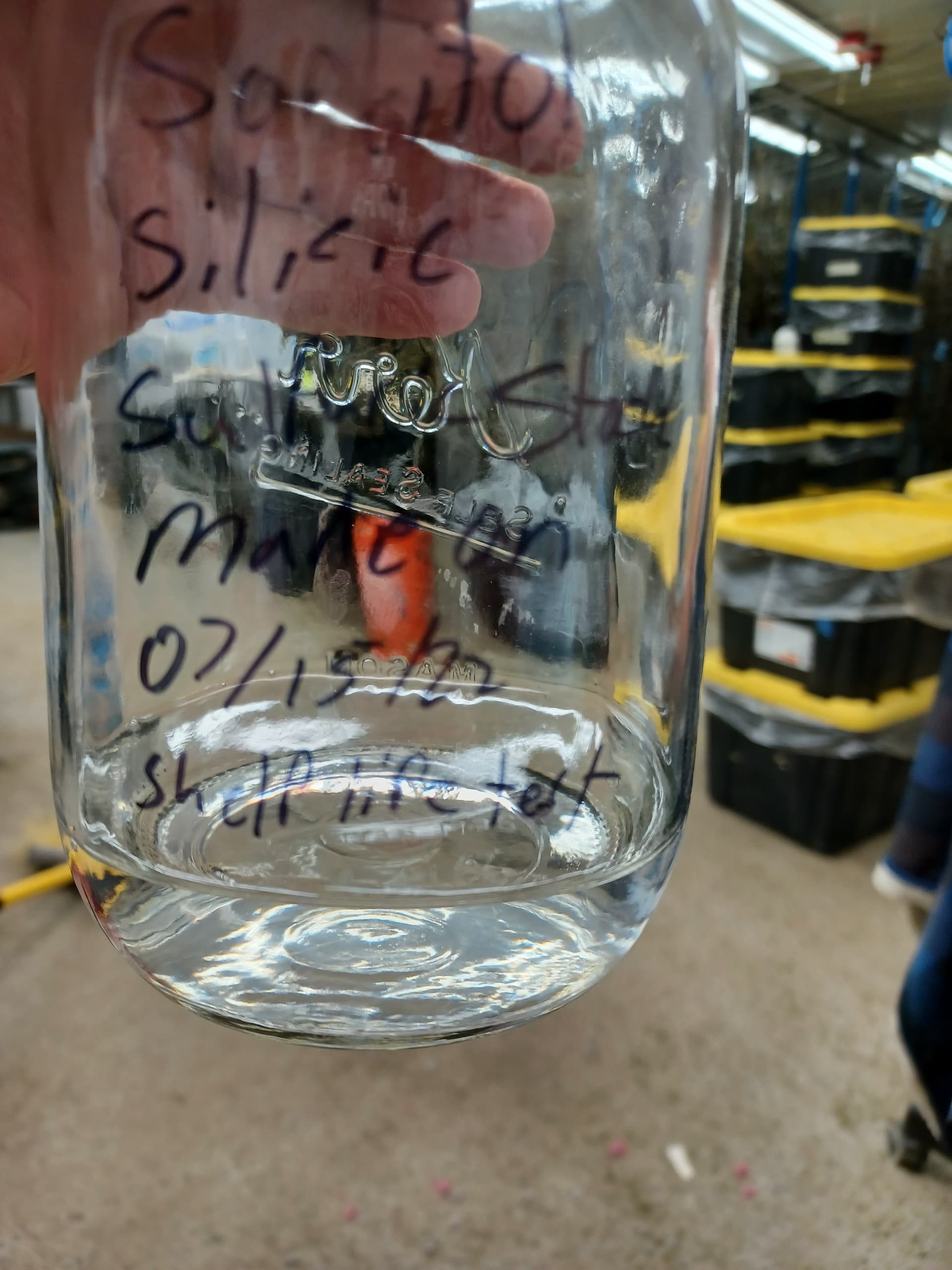
I poured about 100ml into a mason jar and left it on a shelf. It’s still stable, completely clear.
I’ve been making about a gallon a week since the first time I made it, but still only applying as a foliar. When I have some free time, I’ll experiment more with using it in a fertigation system.
@emdub27 Awesome, thanks for the reply. It does seem that sulfuric acid prepared is much more stable, probably just because it gets to the acidic pH much faster on initial preparation.
I am also working on a new blog post to share how to make a 30-40% monosilicic acid containing product from non-aqueous silicon reagents that are not potassium silicate, but still available for purchase. Hopefully that will lead to a more practical DIY approach, for those who can have access to the inputs.
I tried to see if I could screw it up, and it worked fine…I added sorbitol, water and the pre-made silicate solution to a mason jar all at once, shook it and as soon as it was dissolved added sulfuric. That still resulted in a water clear solution. I’m assuming it has to be silicic, because if I did that without sorbitol, it would gel instantly.
Anyone had experience finding the upper limit on silica dosing? I’ve looked it up briefly and didn’t find much on what happens in a silica toxicity scenario. I have seen leaves get “thicker” looking and their edges and veins seem more defined, but I think those are positives. Has anyone seen any negative reactions to higher amounts? Anyone tried a foliar with 5-10x the recommended mixing ratio on the bottle? Somebody talk me out of this, hurry.
I foliared the sorbitol silicic stock at 20ml per gallon the other day without issues. On that particular one I used ferti organic soluble kelp extract (very basic) to correct the pH.
As far as potassium silicate goes, Sil Matrix is potassium silicate sold as a pesticide. It’s label rates are very high compared to using silicate as a fertilizer. No issues seen using agsil 16h at the same rate as Sil Matrix.
@emdub27 Thanks for sharing. I’ve noticed the same thing. Phosphoric acid preparations will be unstable at around the 1-2 week mark, but sulfuric preparation are just much more stable. I will change the blog post to use sulfuric acid instead.
Add 25g of Carnitine (pre dissolved 25g in 50ml of hot DI water, let cool)
I have redone this as it was perfectly clear but then gelled up a week in.
I have now added 40g of Carnitine HCL in 50ml of DI water and put it in a ice bath (<30 degrees, around 15-20 C I got it down to)
I also put the grotek and glycerol on a ice bath so when adding the sulfuric acid it keep it cool, i noticed this may have reduced the tendency to polymerize (may have just been coincidence)
So far about 5 days in a all 4 samples clear and stable.
Variables are doubling the glycerol, all 40g carnitine, 15ml and 33ml grotek variables.
Thanks for calculating the Si, i have not done this yet until i get a stable formula then ill go and calculate it. What is your math to get 1.5% and if using 99% Sulfuric acid how much S?
how many ml would i need to add of 17% Si Growtek per 100ml to be equivalent to your 4-5% Si formula mentioned previously ?
ok good to know.
Have you made the carnitine one? Or made the sobitol one more stable?
I have tried about 15 variations. Have 4 now testing for stability. Then ill have to work out what the ppm of Si will end up and how much S and K is in the mix.
Cheap pool FAC sticks will give you an idea what your stock tanks are. Do you also treat the source water tank ?
I’ve just been using the sorbitol one as a foliar. I’ve been busy with other things.
Storage tank after RO is what’s treated with cal hypo without ph correction to 500 orp. Stock tanks are made with the same water. I only have growth issues in my Ca tank, so it gets potassium sorbate. After reacting with salts and the ph drop the orp usually stays 550ishmv.
To calculate the dilution you need to multiply the % composition of the source by the volume of the addition divided by the final volume of the preparation. So if you have 7.5% GrowTek and you add 33mL and the final volume is 200mL, then the final concentration will be ~0.8% (7.5*33/300).
If you want highly concentrated Si solutions you need to start from a solid form of Silicon, with the Growtek you are unlikely to get to significantly higher concentrations due to how low you start.
I was told this might be better in this thread
Loveland SST vs Agsil16H
I was interested in trying Loveland’s SST28 which claims 28% monosilicic acid. Seems like quite the value compared to something like powerSi @1%. Can anyone talk me out of this or maybe im missing something? Im currenty using Agsil16H but I like the lack of K and the stable pH of the SST. BUT…theres a chart on manicbotinx that shows it having the lowest-in-class plant available si. https://manibotanix.com/silica-additive-quality/ Do they have this wrong? It also shows mills vitilize as very low in available si but ive seen that product work well. Looks like i have some gaps in my knowledge and any input is appreciated. Thanks yall, have a good day!!
So to convert Si as Si(OH)4 to Si as SiO2 you need to multiply by 0.625, so a 28% of Si as monosilicic acid would be 17.5% Si as SiO2.
Also note that the way of reporting the concentration has sometimes nothing to do with the chemistry, it is just a way of reporting composition. So 28% of Si as monosilicic acid does not mean that the Si is present as monosilicic acid, just that if all the Si was present at monosilicic acid, it would be 28%. But it might be something completely different.
A lot of these highly concentrated Si inputs will not contain a true monosilicic acid (like the preparations we are doing have) but they will contain an organic Si molecule that reacts with water to generate monosilicic acid with time. This might take hours or days, so this is why these products often read low in bio-available silicon tests. The actual form of silicon, stabilizing agents and the actual form the Silicon ends up in after the pH is set to 5.5-6.5, are all vital to bioavailability of the Si.
I have been at Bruce Bugbee’s lab this week doing Si tests, we created solutions buffered at pH 6 with Si from both potassium silicate and a glycerine+sulfuric acid stabilized silicon solution (which we created with the procedure in my blog, replacing sorbitol with glycerol). After 48 hours we are seeing more stability from the acid derived form than from the base derived form. It will be a couple of weeks till we have all the results of these stability tests.
Another point is that these lab tests of “bioavailable silicon” assume that all molybdenum reactive forms of silicon are equally bioavailable. Which we know is not true because, for example, foliar spray studies of silicate and acid stabilized silicon at equivalent silicon concentration at equal pH yield different uptake results. This is because many forms of silicon that are soluble and molybdenum reactive (small chains of monosilicic acid for example), don’t have the same plant availability. For example we don’t know how simple monosilicic acid, small oligomers of silicic acid and monosilicic acids linked to different stabilizer agents, differ in uptake properties.
The chemistry of Silicon sadly does not allow you to make predictions based on just reactive silicon in solution. There is still a lot to study in this field. Perhaps just 1 ppm of a form of Si is much more effective than 10 pm of another form.
Also note, commercial Si products might contain a lot of things beyond Si (some contain Boron, Molybdenum, amino acids or even PGRs). This is why making our own stabilized Si solutions from inputs of known composition (like AgSil16H or other raw materials) is so important.