Let’s talk silica

@DIYGuy About your questions:

  1. I live in Spain.

  2. Sorbitol enhances the stability of silicic acid through the creation of a polyol chelate. Sorbitol has 3 hydroxy groups in what we call a “threo” configuration, which makes this possible. Glycerol does this, although to a lesser extent. I don’t know of any studies that have actually attempted to describe those structures precisely though, so this is all speculation from what we know happens with other sugars and polyols.

  3. About carnitine, carnitine HCl is indeed the best one, as Cl- is a benign anion in terms of silicic acid stability. Other products, like carnitine tartrate are more unpredictable as the effect of those anions is not well studied.

  4. Measure the pH of the product. If the pH is >10, then it is a silicate based product. If the pH is <2 then it is a stabilized monosilicic acid product. If it is in the 4-8 range, then it is a silicic acid stabilized in a way I’m not familiar with. It has become quite common practice to label silicate products as “silicic acid” products, just because people have started to associate “silicic acid” with “better”.

From a practical standpoint both stabilized silicic acids and silicates turn into the same thing at the pH in hydroponics. The question is whether the stabilizing agents can still play a role in low concentration environments and somehow “enhance” plant absorption. Another question is whether when the pH of silicates is lowered the silicates do all become mono-silicic acid, or if there is a significant percentage in higher order polymers that never gets turned into mono-silicic acid.

Both questions are unanswered at this time (to the best of my knowledge). Studies comparing silicic acid and silicate derived solutions do show differences in silicon uptake and plant responses (I have some instagram posts on this). It is however reasonable to expect this to depend significantly on the stabilizing agents used in the silicic acid products.

8 Likes

Amazing info ! Thank you so much for your time and knowledge.

Great to understand the role of Sorbitol / Glycerol in creating polyol chelates. Is there a certain minimum % of the formula that we should use as a starting point? using the same amount of carnitine hcl as sorbitol would be alot compared to other formulas so must not be that simple.

I can send you some Carnitine HCL from china if it will make it past customs?
Otherwise im happy to use the stuff i have here and make up different formulas you recommend and report back on the outcomes.

Should I use both the amt sorbitol your describe minus the amount of carnitine (15-25%? as flowerman does?) and go from there? When you say different order, can you explain :slight_smile:

I will do some more pH testing and report back on the PSI brand pH as a concentrate and then once mixed with some DI water.

So pH>10 being a silicate based product (this is not the same as AgSil correct? should convert to mono-silicic acid at pH of 5.8-6.2 (hydroponics)? but we dont know how much will convert as a %. Where using >2pH stabilized monosilicic acid we know its already converted.

Thanks for clearing that up, I think I understand now !

1 Like

@DIYGuy The amount of sorbitol used is at a significant stoichiometric excess, because these chelates are not very strong and therefore require a substantial excess to be created in a significant quantity. For these formulations it is better to think in molar equivalents to Si, rather than in % terms.

About sending me the Carnitine, thanks for the offer but it wouldn’t pass customs and would likely get me into some bureaucratic nightmares, so better not to send anything.

About the different order, please try the following process:

Note: I have not tried it before, so I don’t know if it will be successful, it is a best guess from my experience up until now.

Preparation of Si solution

  1. In a 1000mL beaker add 500mL of distilled water with a magnetic stirrer
  2. Add 5g of KOH, stir till dissolved.
  3. Add 200g of AgSil 16H, stir till dissolved.

Preparation of stabilized monosilicic acid

  1. In a 1000mL beaker add 300mL of distilled water with a magnetic stirrer. All the following steps should be done with constant stirring.
  2. Add 70g of glycerin and wait till fully incorporated
  3. Add 200mL of the silicate solution and stir for 5 minutes
  4. Add 20mL of (>80%) sulfuric acid. Verify pH is < 2, if not, add sulfuric acid to lower pH < 2. Note that the bulk of this addition needs to be done quite quickly, if the solution takes too long to drop <2, then you will have polymerization happen, especially if it spends any significant time in the 4-8 region.
  5. Add 150g of Carnitine HCl and stir till dissolved.
  6. Verify pH is < 2, if not, add sulfuric acid to lower pH < 2.

This should give a solution that is around 4-5% Si as elemental Si, or 9-10% Si as SiO2.

So pH>10 being a silicate based product (this is not the same as AgSil correct? should convert to mono-silicic acid at pH of 5.8-6.2 (hydroponics)? but we dont know how much will convert as a %. Where using >2pH stabilized monosilicic acid we know its already converted.

Yes, if the pH is high this is a silicate based product. This could be the same as Agsil or could be a sodium silicate based product. In chemical terms, also very similar to AgSil. Any basic silicate - including AgSil - will convert to monosilicic acid once the pH is taken down. However, not all of it might, since basic silicates exist as silicate chains, some might not entirely hydrolyze when the pH drops.

With stabilized silicic acids in pH < 2, everything did initially convert to monosilicic acid, but it does also polymerize with time unless the stabilization is high enough. So it’s not like this guarantees everything will be silicic acid for all time. With time it might just be as bad or worse than a basic silicate (depending on the formulation).

5 Likes

Amazing once again, very informative information !

I have 98% Sulfuric acid, 48% KOH as a liquid and possibly may have some 100% KOH flakes left (is that what you prefer when suggesting KOH @ 5g?) I can test both and see which helps the KSi dissolve better, I can also increased heat to 80 degrees C to assist and dissolving the KSi solution, I have done that before but it still leaves some undissolved, although I have not used 5g of 100% KOH, only few drops of the 48% KOH until the pH was >11 since some studies show thats the best pH KOH dissolves in (as you know).

How can I use your amazing HydroBuddy software to calculate the K% and Si% your Preparation of Si solution yields ?
Will 200g in 500ml be similar to the liquid KSi I have (Potassium (K) (as silicate) 15.3% and Silicon (Si) 17.3%) ? Just so i can also see if I get better results with a Ag Liquid “AgSil” product.

Step 5 of the stabilized monosilicic acid, if i have problems getting the carnitine to dissolve can i make a liquid Carnitine HCl but using the minimum amount of DI to get it dissolved and remove the amount from the 300ml in step 1.

I am very excited to try this, especially making a 4-5% Stabilized mono-silicate acid ! I will sew how long its stable for and see if i can get lab tested for an accurate Si %
How did you estimate the 4-5% by the way ?

Will keep you updated. Wont be able to try this till next week when some more supplies arrive !
Thank you again

@danielfp, do you think AgSil 16H is the best silicate raw material for this purpose? If not, what would you suggest?

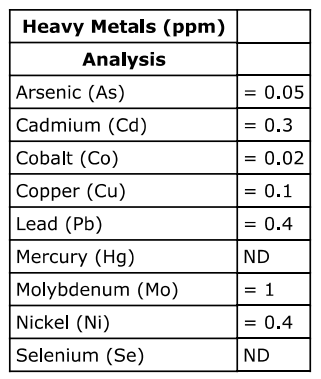
I wonder if silicate raw material purity will impact the final product’s stability, gel time, etc. For example, do you anticipate heavy metals in AgSil 16H to act as interfering ions or otherwise affect sorbitol or carnitine chelation efficacy, stability, or strength?

Regarding AgSil 16H, is anyone aware of lab analyses for K20 and SiO2? Ideally, analysis of a few batches for batch-to-batch consistency? For example, CDFA testing shows ND for mercury, but WS State shows 0.1 ppm.

You can’t use hydrobuddy for that calculation.

For a weight/weight calculation, the easiest methods include the use of an online molar mass calculator, or simplified oxide to element conversion factors. For example, to find % K, multiply % K2O by its molar mass of K (how much K is within K2O by weight), which is 83.0148%, and divide by 100; giving a K2O to K conversion (multiplication) factor of 0.830148.

[1] For AgSil 16H, based on its label of 32% K2O and 52.8% SiO2 while using the conversion factors in the above link, contains:

  • 32% K2O x 0.8301 = ~26.56% K
  • 52.8% SiO2 x 0.4674 = ~24.67% Si

[2] Find the mass of K and Si within the 200 grams of AgSil 16H:

  • 200 grams x 26.56% K / 100 = 53.12 grams K
  • 200 grams x 24.67 % Si / 100 = 49.34 grams Si

[3] Assume 1 mL of distilled water = 1 gram. So, 500 mL weighs 500 grams.

[4] Sum the weight of the added elements (K and Si) with the water weight:

  • 53.12 grams K + 49.34 grams Si + 500 grams water = 602.46 grams solution

[5] For your answer, divide the mass of K and Si in solution by the mass of the elements plus water, and multiply by 100:

  • 53.12 grams K / 602.46 grams solution x 100 = ~8.82% K (w/w)
  • 49.34 grams Si / 602.46 grams solution x 100 = ~8.19% Si (w/w)

Suppose you want a weight/volume calculation. In that case, you need to find the total volume of the solution (as liter) after you dissolve the potassium hydroxide and AgSil 16H. Then, follow the same steps as above. Except you would skip #3 and #4, and for #5, replace the sum of the elements and water weights with the solution volume. If you wanted to find ppm (mg/L), you would multiply the % w/v of K and Si in the solution by 10,000.

Edit

Nope, see the above math. Assuming you can trust the label on your liquid potassium silicate, your bottled product has 73.47% more K and 111.23% more Si than Daniel’s solution. That’s on a weight/weight basis because, in the US, fertilizer labels must report w/w.

Here’s how you can add approximately the same amount of Si with your product as Daniel’s “Preparation of Si solution”:

[1] Find the Si conversion factor of Daniel’s solution to your product by dividing the % Si (w/w) in Daniel’s solution by the Si in your product:

  • 8.19% Si (Daniel’s solution) / 17.3% Si (your product) = 0.4734

[2] Multiply the volume of Daniel’s “Preparation of Si solution” added in step #3 of his “Preparation of stabilized monosilicic acid” SOP by the conversion factor from the above step:

  • 200 mL of Daniel’s solution x 0.4734 conversion factor for your product = ~94.68 mL of your product

[3] Convert the volume of your product to mass (because it’s hard to measure 94.68 mL accurately) by mulplying the volume by your product’s density. You can often find the density in the SDS, but it’s best to measure its density. Assuming the density is 1.05 g/mL, which isn’t accurate, it’s just a number I made up:

  • 94.68 mL of your product x 1.05 g/mL density of your products = ~99.41 grams of your product

[4] When replicating Daniel’s “Preparation of stabilized monosilicic acid” SOP using your potassium silicate product it’s probally best to increase its pH to 11.0-11.5 using potassium hydroxide flakes. That way you’re following his SOP very closely.

[5] At step #3, add ~99.41 grams of your product instead of 200 mL of Daniel’s solution (note that adding the potassium hydroxide to your product will reduce its % Si, but it should be negligible)

2 Likes

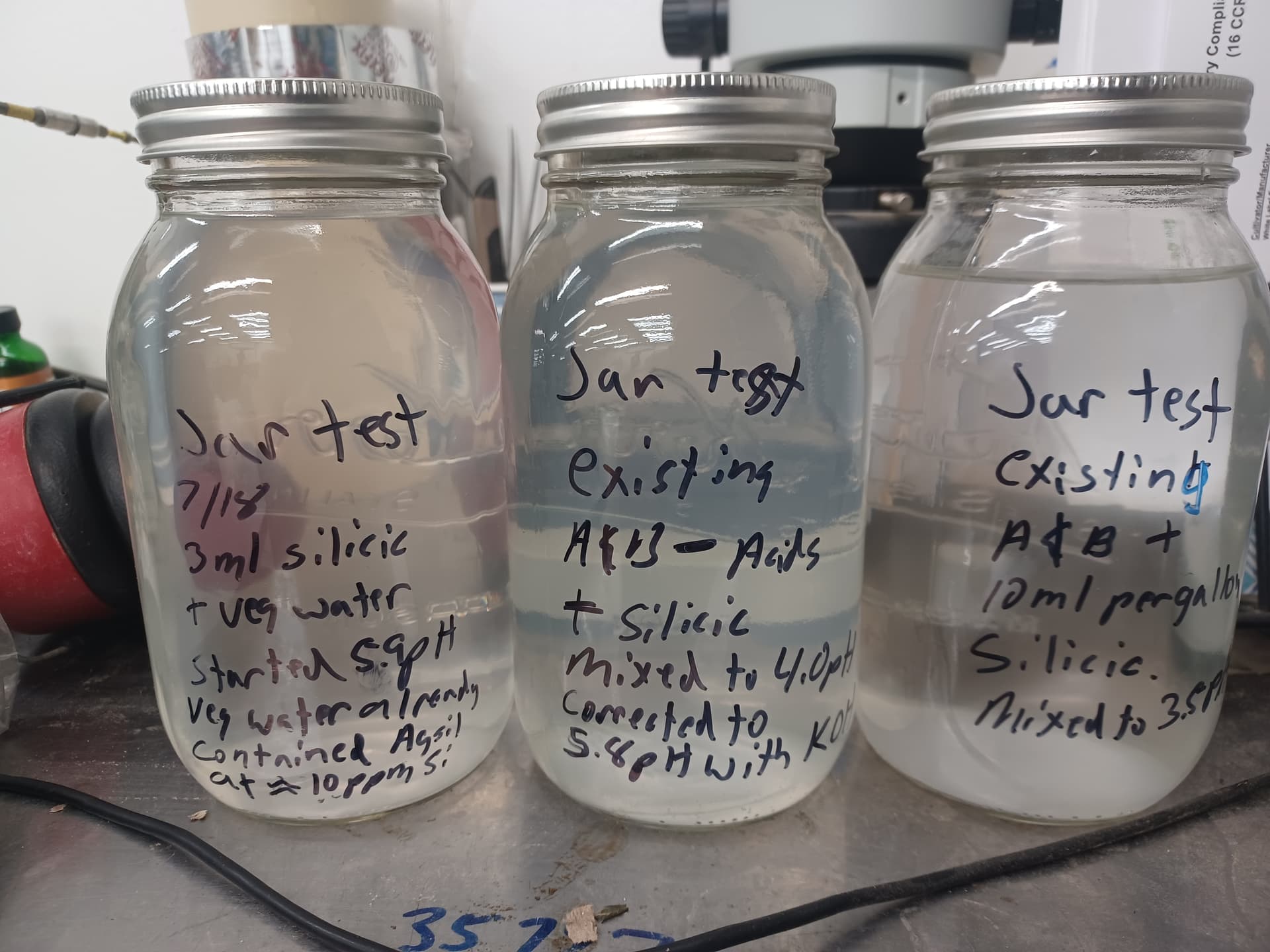
All three jar tests are now precipitating. My control jar, my existing water this was based on is still stable. My stock solution is still stable. For some reason both jars that started at 5.8 pH fell to 4.7 pH. I’m on vacation for the next week, but will order glycerin and carnitine to play with when I get back.

5 Likes

Please correct me if wrong, but don’t you want to use glycerol, not glycerin?

2 Likes

For me personally I’m hoping 99.7% food grade glycerine will work because it’s easier and cheaper for me to source at the volumes I would need. Glycerol is basically just technical grade glycerine.

I already have 100lbs of sorbitol, so I can play with that more also.

2 Likes

:+1:

I’m not sure what the glycerol/glycerin is supposed to do, but maybe I’ll give this a shot and use UltraPure/ASC glycerol so we can compare to see if it matters. I’m also thinking about making this and the sorbitol version with different acids (phosphoric, nitric, sulfuric, and hydrochloric) and pH values (1.0 to 1.75) to see if that affects the outcome.

Because glycerol is a nearly pure substance (1,2,3 propanotrial), and consumer grade vegetable glycerin typically is ~96% glycerol (not referring to the 99.7% FCC grade you’re using), I wonder if impurities in glycerin could affect the outcome; what do you think, @danielfp? I believe those impurities include methanol, monovalent salts (K and Na), free fatty acids (linoleic, stearic, oleic), and water.

2 Likes

@Ralf I usually recommend AgSil 16H because it is the easiest thing to get, but it might not be the best silicate source to use. The best silicate would be obtained by buying high purity silica and high purity KOH and preparing your own silicate solutions by dissolving the Silica at high pH. However this is quite inconvenient in most cases.

Although there are likely to be differences in stability due to the impurities in the different commercial silicates, in the end we must also come up with things that are easy to get and use in practice if we are to pursue a DIY approach to this.

2 Likes

@emdub27 Thanks for sharing the results of your jar tests!

The polymerization of the silicic acid releases no acid at all:

H4SiO4 → SiO2 + 2H2O

So the decrease in pH is likely unrelated with the silicic acid. However the oxidation of sorbitol by bacteria can reduce the pH of a the solution. It might be worth it to do a jar test that just has the sorbitol added to see if the pH also drops.

If the silicic acid polymerized here, then this shows that the silicic acid coming from the acidic mono silicic acid solution is more unstable than that obtained from the acidification of AgSil16H. This might be because the silicon is already fully converted to mono-silicic acid and all stabilization effects of the sorbitol are lost at a high dilution rate at a pH of 4-6. If this is the case then this form might be more bioavailable at first, yet much more unstable as a function of time.

@Ralf Glycerin and glycerol refer to the same thing, although glycerol is used more commonly in chemical contexts and glycerin is more common in the fat industry or in the cosmetic industry. From the wikipedia page on glycerol:

Glycerol, also called glycerine in British English and glycerin in American English, is a simple polyol compound.

Regarding purity, any pharmaceutical grade glycerin (usually >99% purity) would be acceptable. I do not foresee the impurities normally found in glycerol to be problematic for the stability of silicic acid.

1 Like

The pH falling was odd. When I get back, I will jsd test it at a client facility.

My water should be pretty much sterile. It’s double pass RO, UV sterilized, then stored in tanks at 500mv orp from cal hypo, then UV sterilized again before hitting the injectors.

I’ll also try a jar test with water that doesn’t have cal hypo to eliminate that variable.

2 Likes

I don’t know if it’s related at all, but I can’t run power si in my res without precipitation. Anything more then 2 days it’ll get cloudy.
That’s also running 500-600mv with calcium hypochlorite.

Enjoy your vacation @emdub27 I’m sure it’ll feel good.

3 Likes

Daniel Step 5 of the stabilized monosilicic acid, if i have problems getting the carnitine powder to dissolve can i make a liquid Carnitine HCl but using the minimum amount of DI to get it dissolved and remove the amount from the 300ml in step 1?

Thank you so much Ralf, that has helped alot, not just knowing how much the Prep of Silica is but how to calculate it in the future. I will for sure make that into a formula so i can type in the mol weight and grams used work work out the mineral %. Amazing !

Also great knowing how to find the conversion factor and work from there. That info has been really helpful.

@emdub27 i will have some jar tests made up also soon and be able to contribute.
What will you sterilize the Stabilized Mono-silicic with? sodium benzonate ?
And good to see you use such amazing water. what % calcium hypochlorite are you using? If you stored water is 3.5 to 5 it will be in a hypochlorous acid form which is the best sanitizer there is. I have been thinking of making up a concentrated version and adding it each new res full @1ppm of FAC. Ill have to see what that is in ORP. What UV system are you using?

I am getting precipitation with the current store silica i have, the injector line forms it at the end of the line once other nutes have been mixed in. I now have the tube sat above the water line and that seems to be ok for now.

Will have to see how stable this is with my 3 part formula and adding H202 in for DO. I have been thinking of dropping this once i add the Cal Hypo incase the form singlet oxygens and that does something bad to the nutes (not sure if it would???)

I did some further experiments using 1/3rd the amounts to save on wasting ingredients when it fails.

The Carnitine HCL will not dissolve when added as powder - it must be pre dissolved in hot water. I have not found the concentration limit but 50g will dissolve in 50ml of DI Water.

The Sulfuric acid needs to be added concentrated and very fast to the water+glycol+Silica mix otherwise it turns it to jelly. It polymerizes in the >2, <11 range very fast and you have 2-3 seconds to get it to <2.

I tried both 17% liquid “Grotek” and used half as much as per Ralf’s calculations. to get to a 7% solution that Daniels recipe calls for so 100g is the equiv to 200ml of the Silica solution and since im only using a 3rd of the ingredients = 33ml. I did try some versions at 66ml but after a few hours the blend would have powder precipitate out of solution and settle on the bottom of the glass and then polymerize into a gel an hour or so later. not sure if this is carnitine and the KSi doing this. ??

When pre-dissolving the 200g of AgSil (generic brand stuff i can get) in 500ml of DI water as per your recommendations, using 5g KOH (100% flakes) i cant get it to fully dissolve and have particles not dissolved. I filter them out but every batch i made using this the blend gels up after a few hours, and is usually more cloudy after adding the carnitine hcl than when using the store brough liquid KSi.

Out of the 10 or so batches and variations i made, the best batch i have made so far was using store brought 17% KSi (33ml per 100ml of DI water), 22ml Glycerol, 13ml Sulfuric acid, 25g of Carnitine (50% of what you recommended). The 50g (one third) of your formula after some hours i can see it precipitating. The 25g version is still clear. Will leave it and see how long its stable for.

Other variables to try is an ice bath to keep it super cool during the process, trying 50% less glycol and 50% more glycol.

I tried different acid (Phosphoric acid 81%) but it was far weaker and took too long to get the KSi down to <2pH and it gels up right away when mixing.
I tried lowering the pH of the water and glycerol blend but upon adding the KSi it gels up right away.
I tried lowering the pH of the KSi before it was mixed in, but as i expected it gelled up.

With your formula how much per L should be used for foliar and res ?

Thanks again !

1 Like

I’ll probably try potassium sorbate first. Nothing weird has happened to my shelf life jar test of the stock solution yet, so it may not be necessary for me because I only typically keep a week worth of stock solution on hand. Right now the only stock that has issues for me is my cal nitrate/micro tank and I use potassium sorbate for that.

Chlorine injection is handled by an orp controller, so I have no idea what the actual ppm of chlorine in solution is.

My UV’s are pool units made by Delta.

1 Like

What do you keep your ORP at? I’m sure those roots SPARKLE.

Give or take 500mv.

2 Likes