The interest in CBDa salt is the water solubility… You can have a 100% CBDa (or any acid) water soluble product with no emulsifiers. 
7 Likes
I think I understand…you are not talking about purging volitle amine salts.
You are talking about purging solvent from the cannabinoic acid salt crystal…
To produce a stable high temp melting point complex. In the liquid state these may represent liquid
Ions concepts.
I would guess a non amine salt, Ca++ might be in the pool?
Nice work…but we are talking some serious time and energy here…nice.
the other way around it is to work with the weak and strong anion exchange resins
Where you make the “salt complex” with an immobilized counter ion/h-bonded.
Regards
5 Likes
This is very true… At which point sizing the filter is the only problem to figure out. We have 0.22um filtration on our systems inline at 10gpm flow rate. I wouldn’t doubt an equivalent membrane like which you speak would be on the market already. I have found many options to utilize with our filter housings.
4 Likes
@Kingofthekush420 think that you could find out?
4 Likes
I have hydrocarbon membranes, I just don’t think they’d reject something that 13x mol sieve can’t grab
Maybe if it was something in the plant material causing the reaction, but not if it’s in the gas itself
1 Like
Even different forms of ammonia (amines)
2 Likes
As @moronnabis has mentioned, if you are using a membrane for this, it would most likely have to be an anion exchange resin type system. Simple size selection only will not likely suffice. As an exchange resin you can selectively remove certain range molecules from a mixture.
5 Likes
Actually I was referring to the ion exchange beads, either batch or column…
Not membranes.
I think Magister Chem…keyed in on the ion exchange membranes available…
A while back he made some comment…if any one has thought it through, he’d be the one to ask.
It would take some work to bring a system like that on line.
I.e., resin beads.
4 Likes
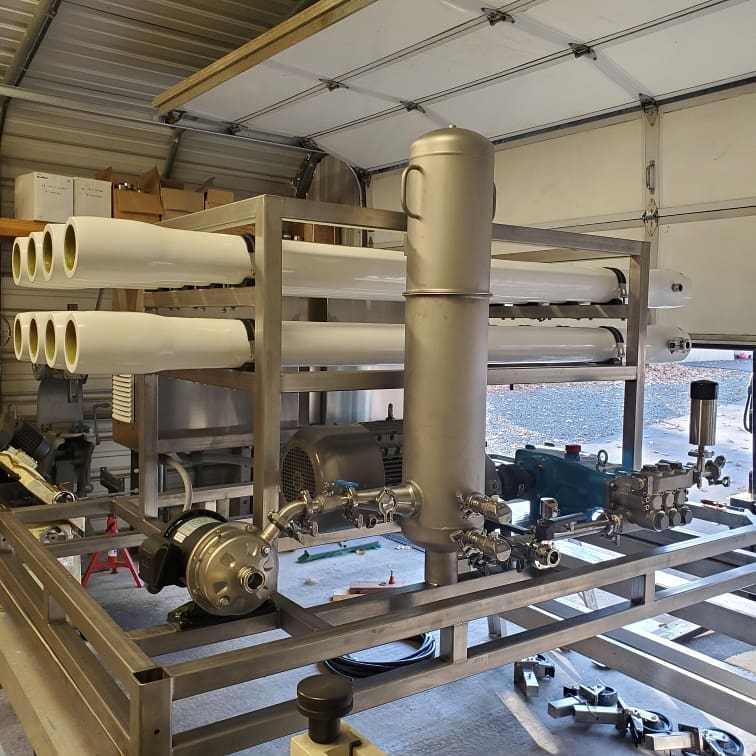
My partner builds ion exchange skids for the neutraceutical and wine industrys
This is something I’ve been talking about implementing for a while, I’ve done quite a few experiments with the beads and had some great successes with them. I definitely think large scale this could be more efficient then batch style reactor conversions
And you wouldn’t need to water wash if done correctly, you could neutralize any remaining acid into water
8 Likes
Thats what I’m talking about, now this conversation is moving in a direction instead of stagnating!
2 Likes
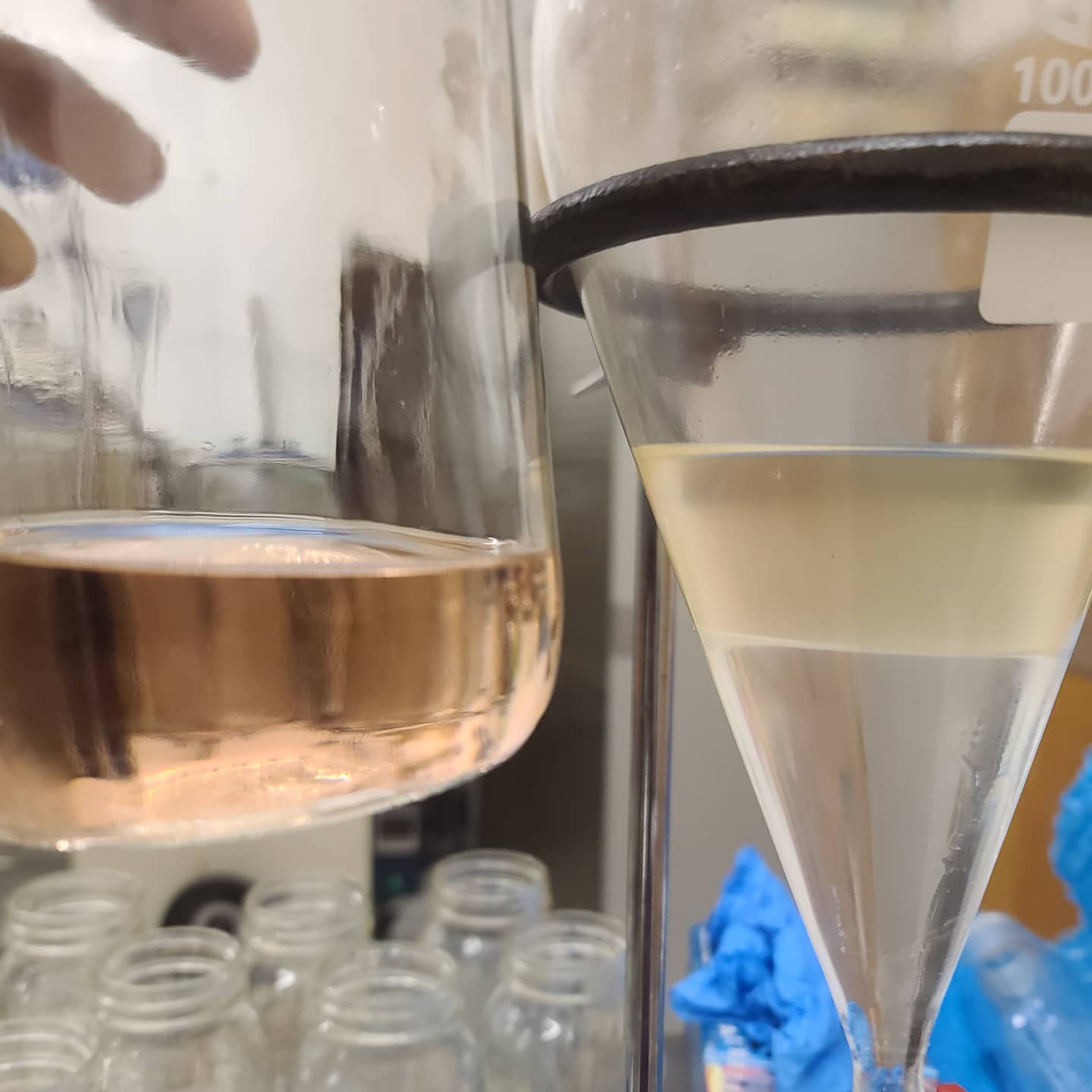
Left was after reaction
Right is 1 bicarb wash
You could implement ion exchange instead of the bicarb wash you need a very specific resin that I’ve haven’t been able to get ahold of yet. I can now and will order some from my chem supplier next time I see them and run some more trials but next time I’ll neutralize with the beads too
2 Likes
@Zack_illuminated mistook my reference to - resin-beads to mean membranes.
Although there is a patent on use of weak anion exchangers and a SOP for SAX
Resins by Agilent, neither provide examples at processing scale.
The methods provide extremely pure cannabinoic acids…when done correctly.
Read this paper carefully…and note the nuances of changed procedures as he provides examples of both THCA and CBDA isolation. He is good…to say the least…expert and inventive.
For instance, to those who think you understand the Chemistry of Amberlyst A-21:
In one case he uses the raw Cyclohexane (BHO like alkane) straight away to achieve binding,
And in another case he uses the Amberlyst. A-21 and Ethanol with 10% (30% concentrate) of Ammonia in water solution (pH about 8.5) to extract , filter and achieve binding. (Dispels some of the notion
That the ternary amine “extracts the Hydrogen ion from Acid to achieve binding). If you want to keep it simple use SAX resins (silica back bone) and buffer to pH 6.5 or so.
Scale problems involve costs of material resins and limited binding capacities (mEqiv/gm)…
Washing with water, pH changes and LLE may be the “scale way”…just because the product does not have the great value. So Zak’s comment should be considered.
I don’t see the ion-exchange membrane steps? I am not advocating ion exchange membranes.
Sorry. Please advise.
5 Likes
I was being rather general as I have not yet gone down the membrane rabbit-hole. Yes the ion exchange is more less a filter than a membrane. Much different in design. My apologies.
Nonetheless, personally I would think a little acid base chemistry with a CRC column and a basin and you got what it takes to clean up the gas.
Though I would be interested to see how an ion exchange system would hold up comparatively.
3 Likes

Off the top of my head, I would guess that quartz sand, properly prepared would work as well as alumina A. …to scavenge amines from butane liquid.
But I would like to see if someone demonstrate that an amine forces “medusa form”
From an Alkane other than butane. I know everyone is looking for the hypothetical
“Butane contaminant”, Does it have to be an amine. Palmitamide seems like a nice candidate,
What wrong with hydrates? Etc. Certainly the diamonds, blocks, medusa and chalk need to go for X-ray Diffraction Analysis.
4 Likes
Just get some of the known listed potential most likely candidates and dissolve some known to be non-Medusa product into pentane or heptane and introduce the amine and stir. They will react without heat and attach itself and lightly release water as the byproduct.
At this point it’s forcefully introduced into a known clean product you should experience a Medusa growth…
Of course unless the possibility of the crystal lattice is strong enough to prevent the release of the amine later in time which apparently pentane can do.
(but that’s also after it’s turned white - if you put it in pentane it grows non-Medusa rocks, I bet if you put it in butane after it turns white it would grow just fine as well. If it is due to the released product amine that is no longer there allowing the pentane to work it should also make butane work as well).
Any base will react with the acidic molecules. The question is how stable is it after?
Since 2020 the same number of butanizer refineries has been operating at capacity in “statistically stagnant” numbers while output increased linearly since that time.
The confirmed uptick in demand for MDEA would also suggest much more sour crudes are being used in supply now than before, and with those sour crudes comes higher NH3 residual content. NH3 residual interacts with the MDEA via CO2 slip in the wrong direction which can occur when operating parameters fluctuate slightly and there are many historical recorded indications of such occurrences within the refining industry.
“Does it have to be amine?” No, but the foaming, and formations of the stones lead me to believe… due to their visual resemblance and characteristics, that we are targeting a reaction caused from NH3 which got there from being mixed and missed for efficient separation within the MDEA?
Of course, I have to add three “?” to the end of my sentances…
Now what we need to determine is the reaction that is occurring, taking into account 13x sieve, alumina, and water washing would all be related to “merox treating” in my opinion and work to remediate the issue, so this is the beginning lead.
Any suggestion that its something else, should be weighed against those 3 things, which are established known facts at this point?
5 Likes
You describe a standard method of amine salt preparation.
Look at the mole amount of candidate amine…
- Are you suggesting medusa is an unknown “amine salt-complex”
With a 1:1 stoichiometry? - With that much amine in the butane,you should smell it…
And if it were remediated with x13 aluminacelA…the material would stink.
???
I am working under the concept put forth by Photon above, the “amine contaminant”
Is somehow catalytic in producing the medusa form of THCA(cooh) crystalline form.
Or do you mean you are sprinkling in very small amounts to achieve the “medusa effect”?
Regards,
1 Like
What would it smell like?
1 Like
You have never smelled an amine?
I am talking free base not the salt.
Get a bottle of Fat Boy Fish sauce.
Pour about one shot glass in your cast iron frying pan.
Turn burner on high for 5 minutes.
Re-ask that question….after you recover
5 Likes