Anyone take you up on this yet???
2 Likes
I haven’t gone yet
3 Likes
Better hurry up…
4 Likes
No, the mobile phase has a composition that ensures the desired behavior and property of the resorcinylic acids. It acts as a buffer.
I’m unclear on what a buffer does. Is it related to pka value of a compound?
It defines the pH of the mobile LC phase which in turn dictates the degree of protonation/deprotonation of any acidic functionalities among the analytes.
3 Likes
Did this crystallography report ever get posted? I may have missed it
7 Likes
In case I haven’t posted these already, @moronnabis , here are some images of crystallization of THCa from n-hexane, as you requested back in October 2021 in this thread:
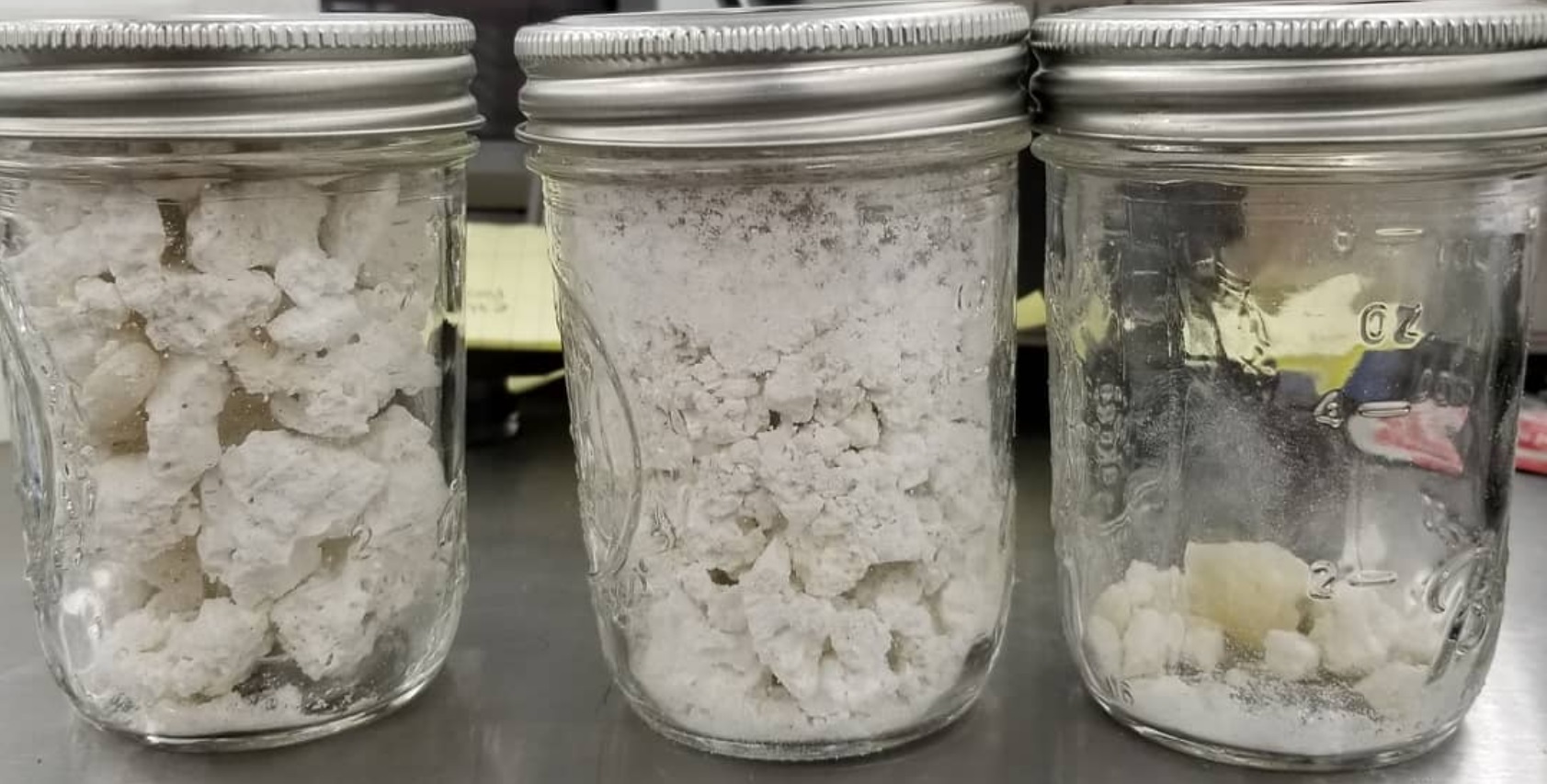
This is some fairly pure THCa that had precipitated from n-butane (mid 2018) in and around the cotton-ball filters I installed at the bottoms of some negative-57°C chilled fresh-frozen biomass columns on a modified ETS MeP system. Clean chunks of this material were selected and pulverized together to a fine powder for use in experiments. It has faint aroma of heavier terpenes and appears to be “chalky,” although that is probably due to the way it formed; i.e., through rapid precipitation from cold butane upon sudden depressurization.
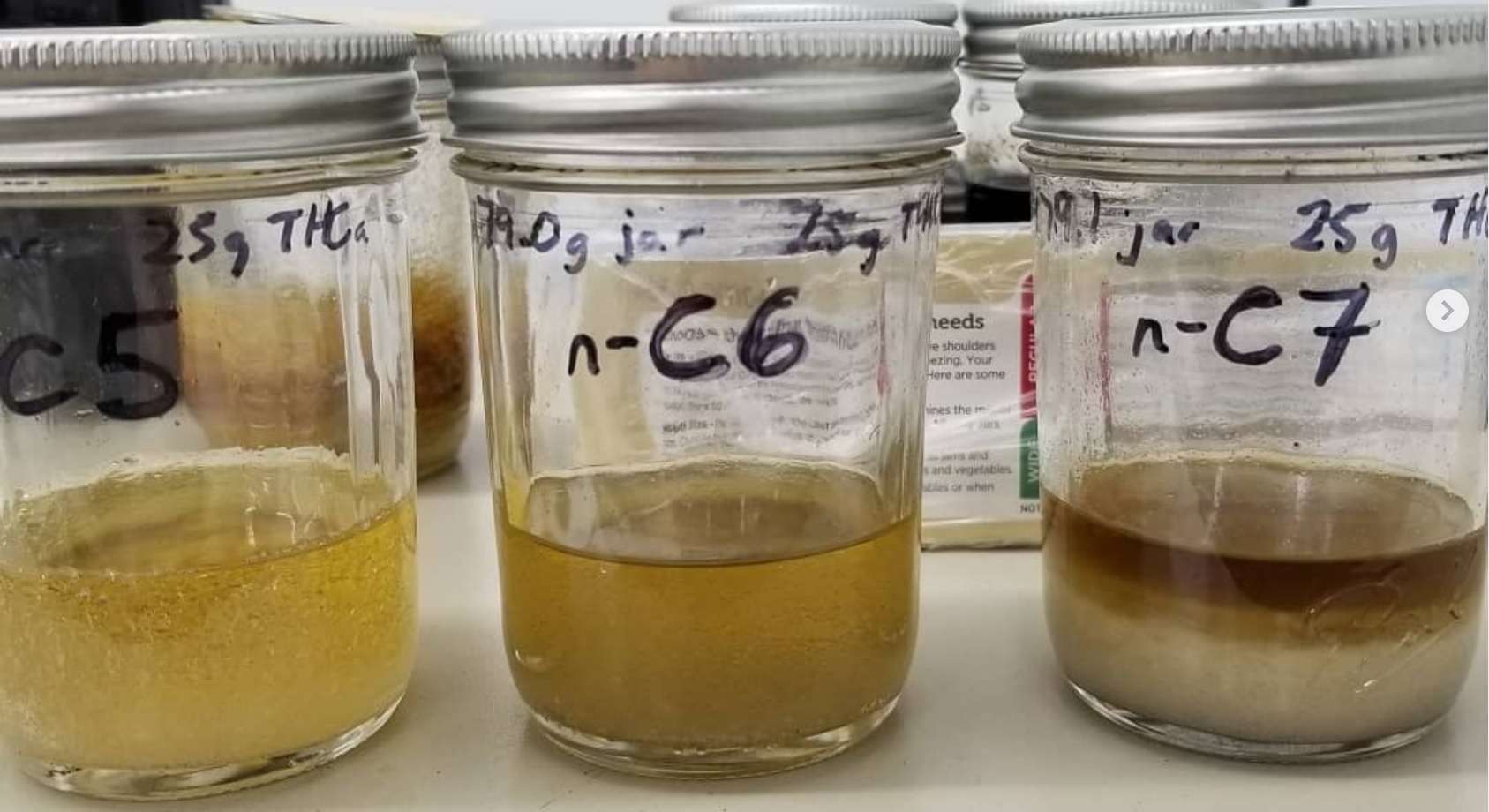
This is room temperature, non-evaporative, super-saturated crystallization of that THCa powder, using 25g of each of 3 n-alkanes (L to R: pentane, hexane & heptane) having mostly dissolved 25g of THCa in each aliquot. Jars were all new and clean (acetone & lint-free cloth, then rinsed with corresponding alkane & air-dried) with smooth, unscratched glass walls. After swirling the capped jars at room temperature to dissolve the majority of THCa powder therein, all solutions were about the same color, and perhaps a bit less than 1g of THCa remained undissolved in each jar. All samples remained undisturbed in the same location on a stainless steel table at a room temperature cycling between 72 to 77°F for the duration of the experiment. Crystallization occurred quite rapidly, over the course of about 48 hours to the point seen here.
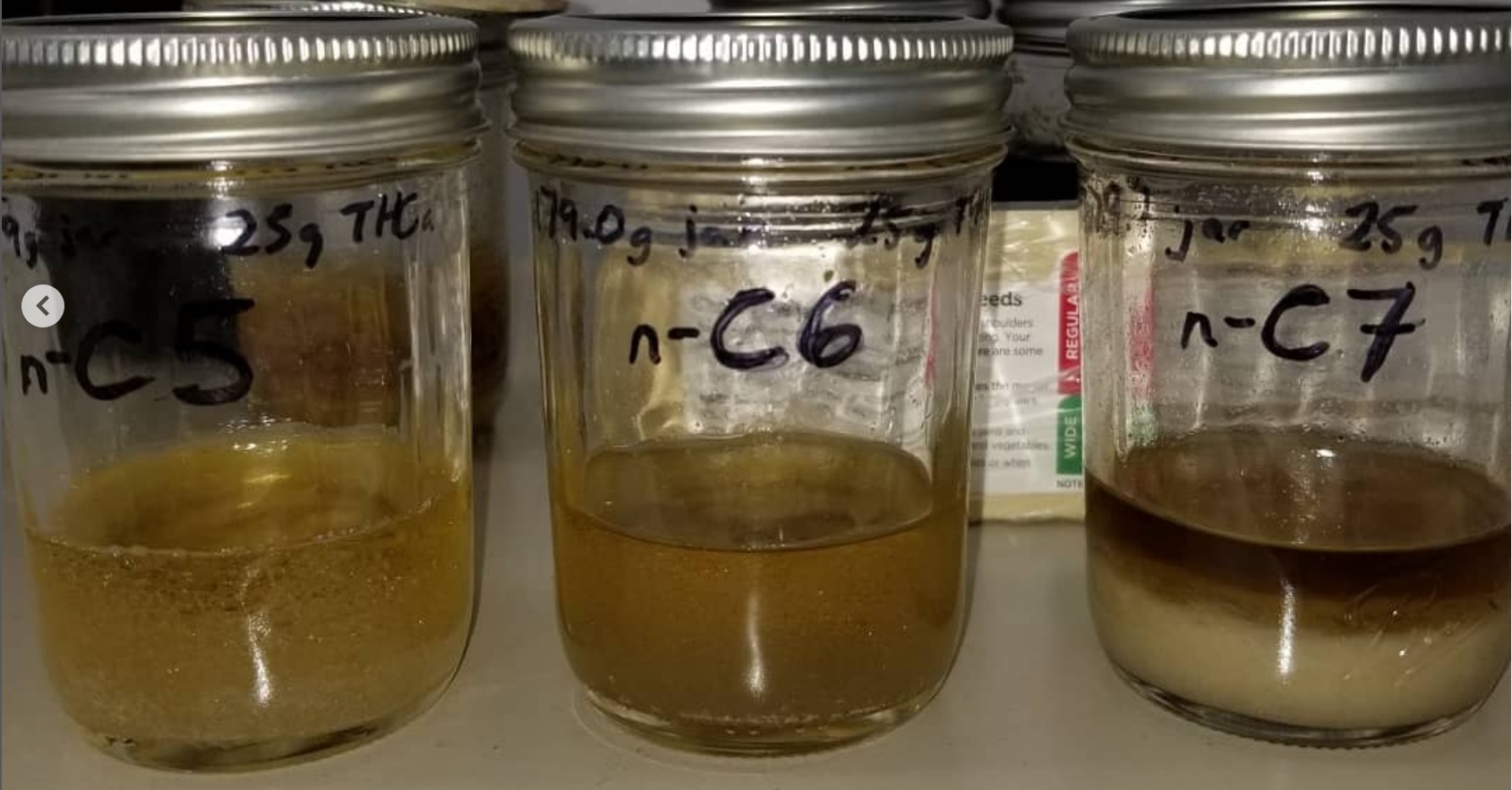
As you can see (kinda), the THCa crystallized differently in each alkane.
- In n-pentane (C5), crystals were largest and all optically transparent. They grew at all liquor/glass interfaces fairly equally, and mostly as individual or well-boundaried, planar clusters.
- In n-hexane (C6), crystals were smaller but still transparent and obviously faceted. They grew mostly in irregular clusters on the floor of the jar, with some small individuals on the sidewall (concentrated mainly at the 3-phase interface ring).
- In n-heptane (C7), crystals barely grew beyond nucleation, and piled up from the floor of the jar like loosely packed sand. Their bulk appeared opaque white due to the vast multitude of tiny reflective facets, but upon close (field microscope) inspection of individual grains, they were clear as fine granulated sugar.
The following are crystals grown from the BHO live resin batches out of the same processing that resulted in the aforementioned in-situ-precipitated chunky THCa powder…
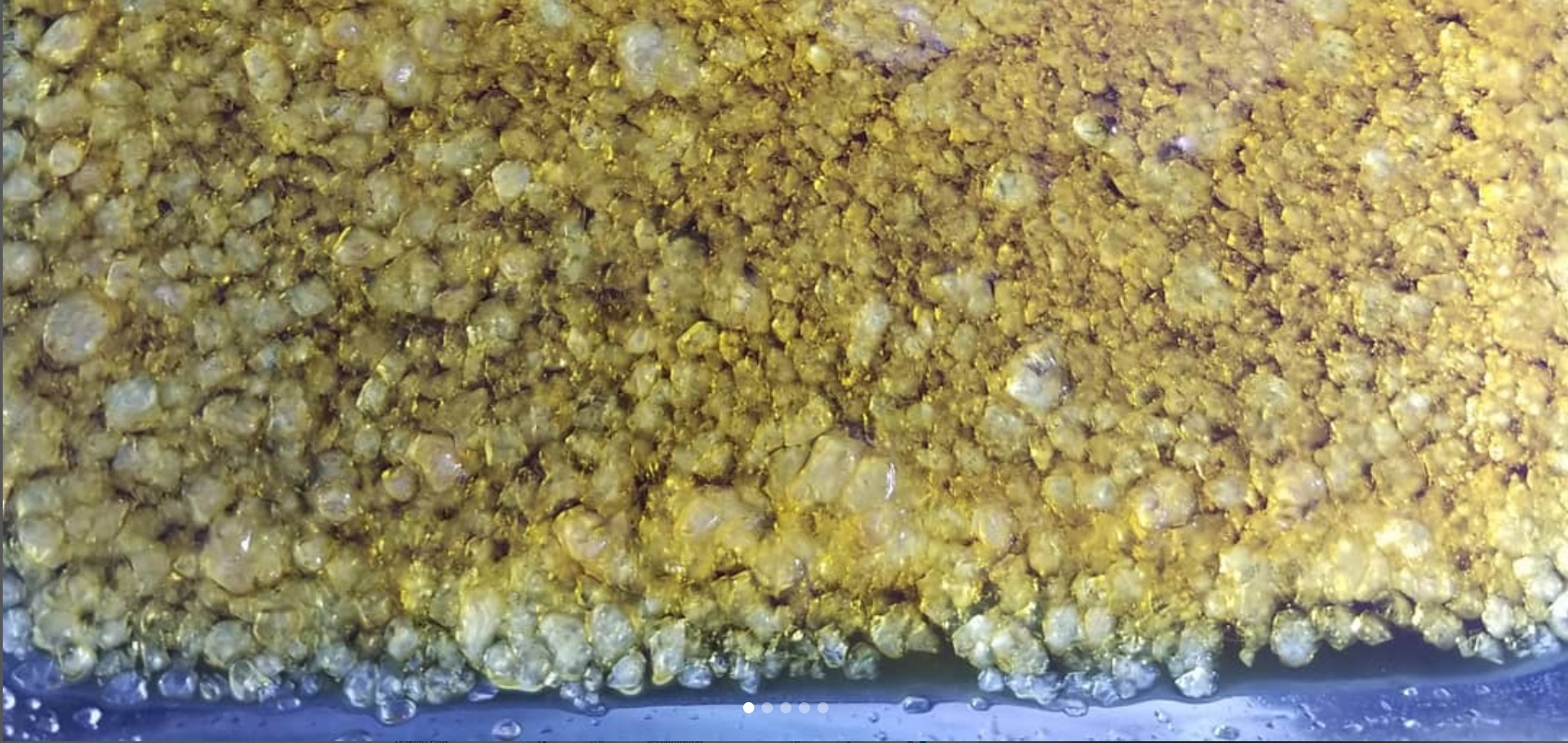
Naturally, the live resin from the pre-precipitated batches was light on crystals in the final sauce.
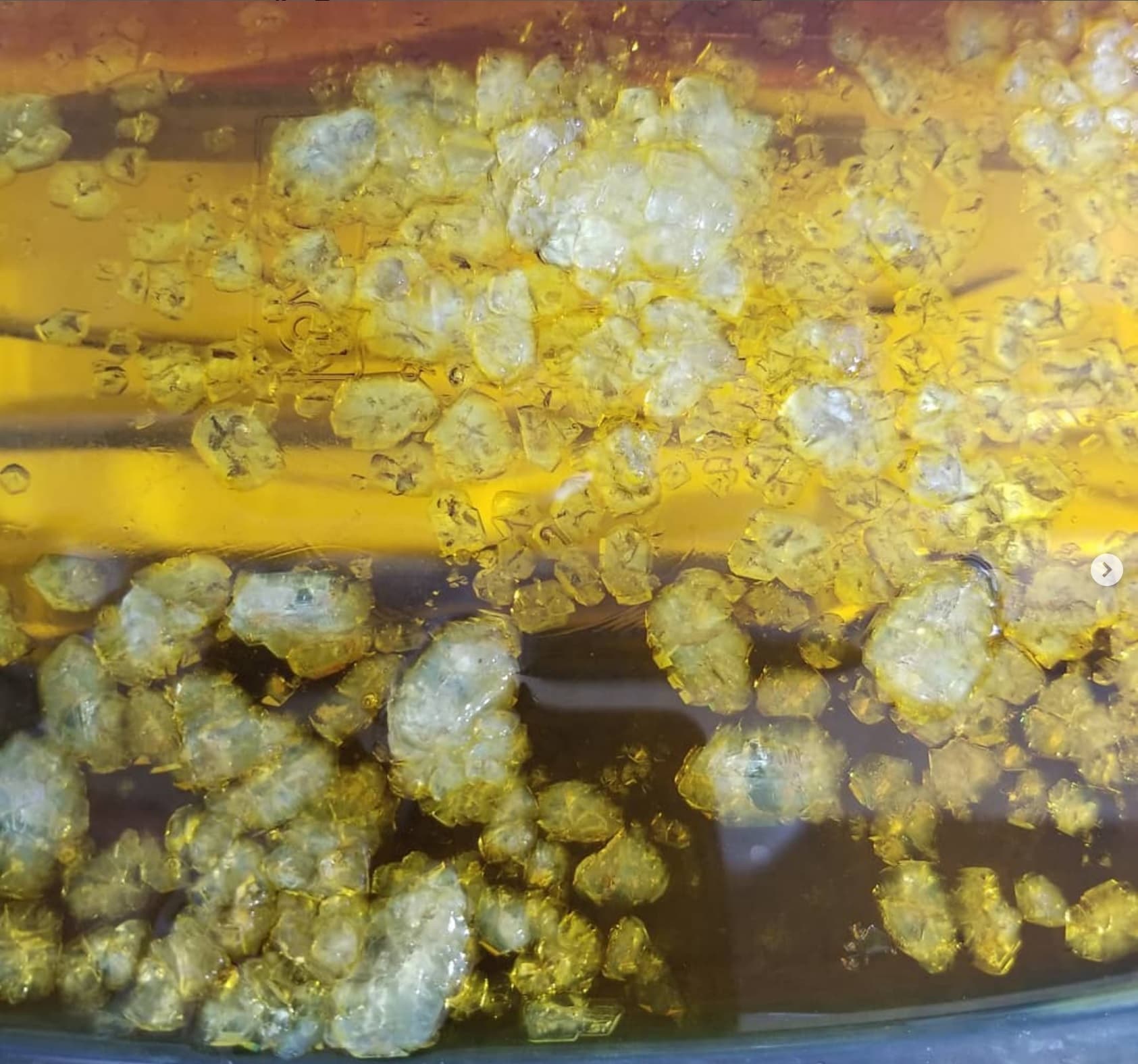
These were grown in open pans (lightly parchment-covered) in vac ovens (vented to maintain atmospheric pressure) at about 93°F, over the course of about a week. The mother liquor is the natural terpene essential oil with residual n-butane at equilibrium under the given conditions.
Lastly, I have the following macroscopic image taken with a magnifier app on my phone camera in late 2015…
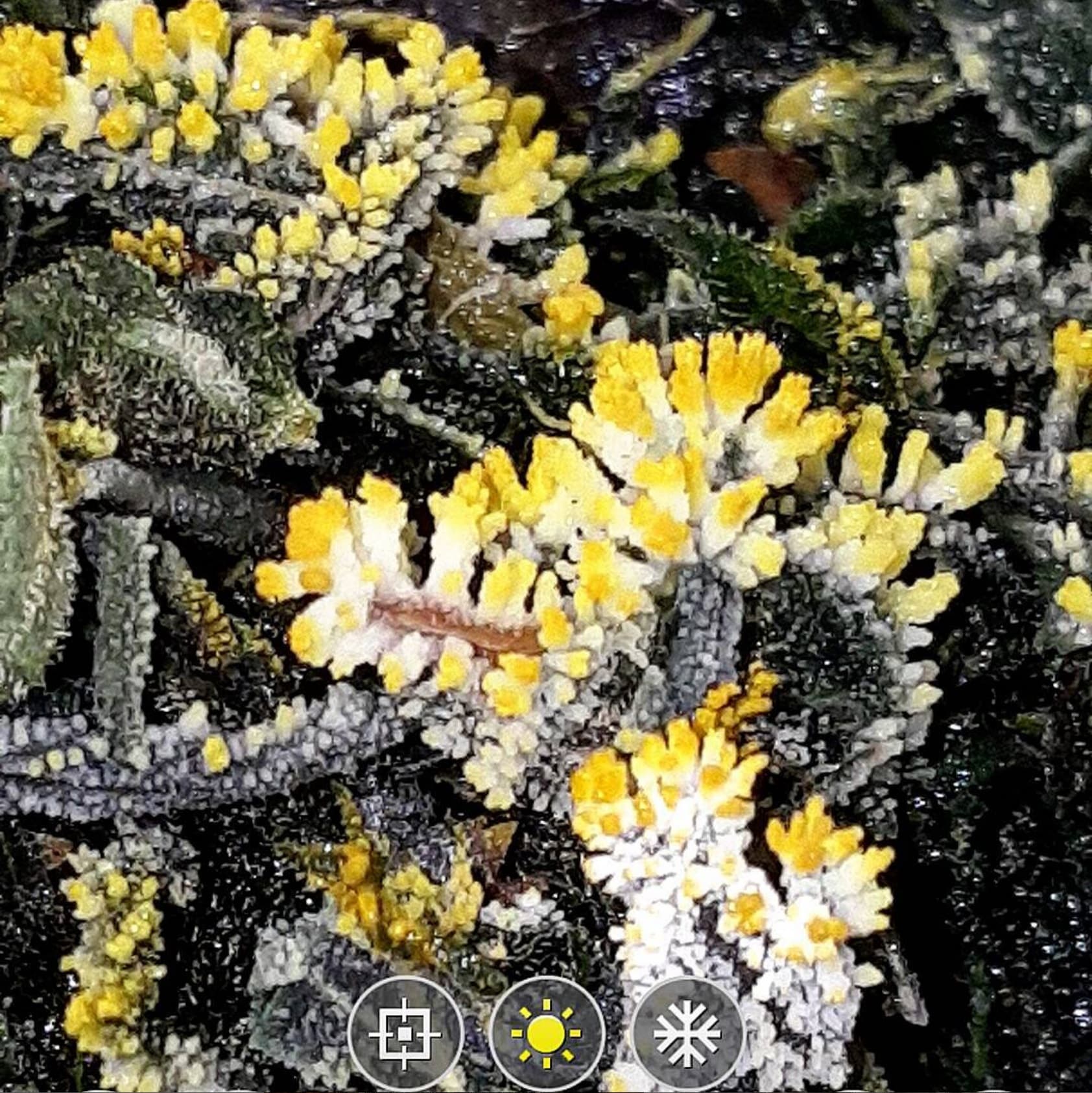
This is (suspected to be) residual THCa co-crystallized with mostly epicuticular wax and oils from the Cannabis plant. These tiny stalagmites grew in the vapor bath of evaporated n-hexane off post-extraction biomass in a bucket! The extraction and this phenomenon were at about 52°F, within a relatively enclosed (windless) space, semi-outdoors. I noticed these in the pail of temporary post-filter waste by chance and tried my best to snap some photos; fortunately, since these were as ephemeral as I suspected they would be… They “melted” away almost immediately after lifting the biomass out of the well of hexane vapor inside the bucket! Very strange, indeed!
17 Likes
Sadly, @catmachinist , the crystallography has not panned out as I had hoped, but I still have the one sample un-chalked rectangular prism crystal that @TheWillBilly gave me. I still need a sample of a chalky (but equally well-faceted) crystal, and hopefully one of his blue crystals for when we finally have the opportunity to get the crystallography done!
3 Likes
Did you mean to say 5 “permille” (per-thousand) acetic acid or 5 “percent” (per-hundred) in this post, @mitokid ?
1 Like
Got this from recrystallizing fast crash THCa in heptane over a water layer. It crashed into sugar initially, but I added more heptane and redissolved it and this was the result
15 Likes
Almost every batch of ff I run with this Medusa gas does this. The biomass offgassing in hood all gets covered in little microcrash that looks identical.
1 Like
Holy fuck that’s nice
1 Like
That’s pretty awesome and awesomely pretty, @pdxcanna ! It makes sense, too. These acicular (needle-like) formations are due directly to the concentration gradient of water in the supernatant heptane layer! Water in nps like heptane is anti-solvent of THCa, so it promotes precipitation. It is still affecting the protonated carboxyl group, however, which keeps the crystals growing in the direction away from the water (so NOT horizontally, in this case), and toward the greater concentration of nps/heptane! THANK YOU for this demonstration, Sir or Madam, as the case may be! Duly appreciated! 
8 Likes
Aha! THANKS, @Dukejohnson ! I knew someone else had to have seen this phenomenon by now besides me! I’d love to see images if you have ever photographed it! 
2 Likes
I have ones(plural) that I can give
7 Likes
If you did previously post I definitely missed it.
AAAA…let us give it up to @Photon_noir for the time and effort of a real experiment.
A very nice experiment with interesting results.
I would like to ask two questions:
- your caveat: “crystals grown from the BHO of live resin batches”
can you elaborate on your terminology…I usually think of “live resin”
as fresh unfrozen or frozen trichomes isolated and hot pressed to
produce “live resin”…is this what you extracted with Butane…?
or are you doing what BHO people sometimes do to emulate “live resin”
perhaps fresh bho…with one step CRC??? I really do not know. - was the material that produced the “white chalk” noted above, treated in
any way with CRC or acid wash prior to crystallization on the cotton balls.
I like the microscopy of the post extraction-plant material.
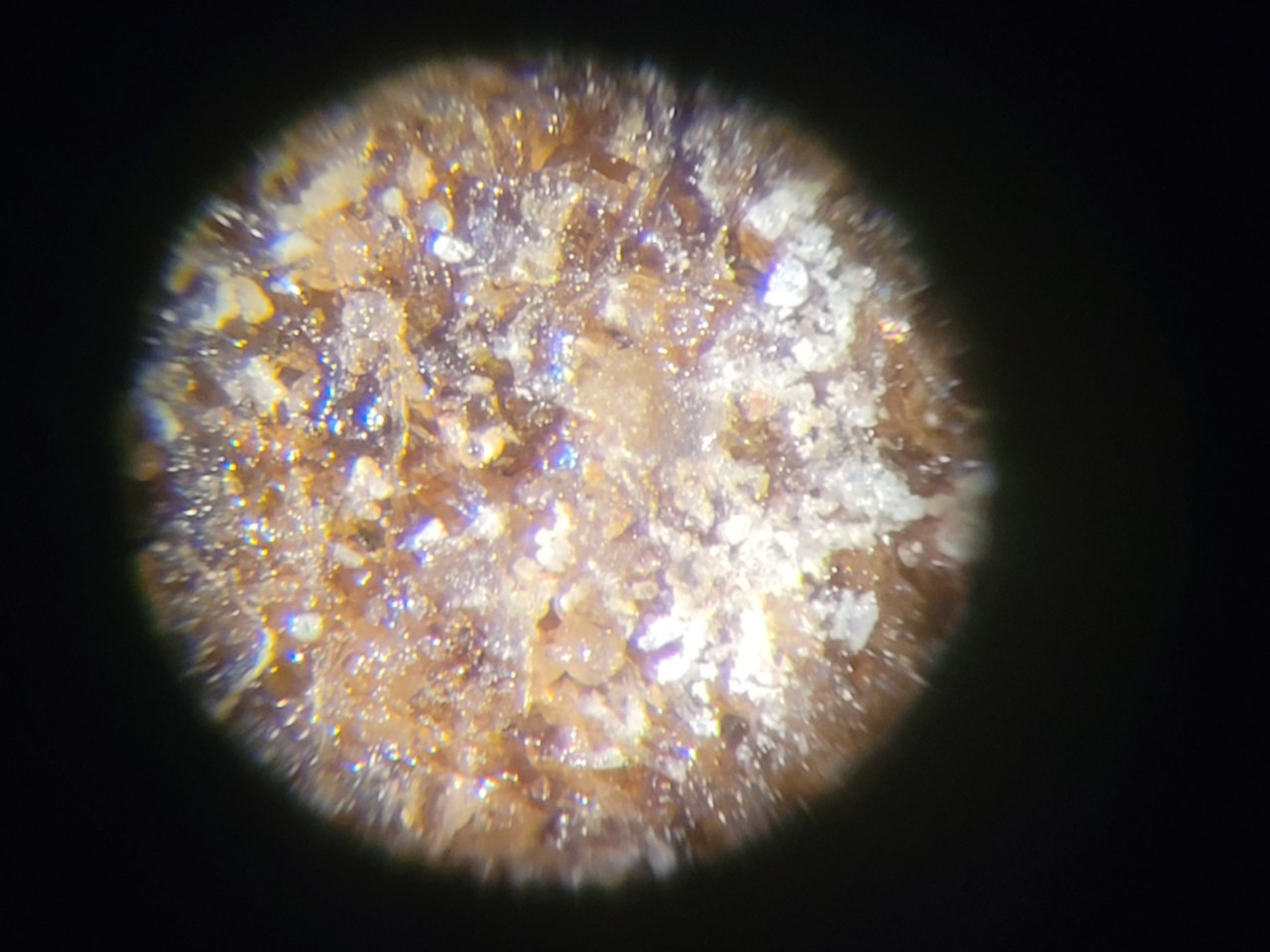
Below find a photomicrograph of “chalk” appearing on the surface of 45u trichomes-bubble hash.
Mechanical process was done with vinegar soak, sieve, dH2O wash then open air dry for a month or two. picture washes out a bit straight on, but tilt screen for higher definition.
2 Likes
‰ means “pro mille”.
3 Likes
Righto! Thanks for clarifying it wasn’t a typo, @mitokid ! 
-
In my experience, “live resin” just means it was extracted from “fresh frozen” biomass. This was fresh leafy flowers, lightly wilted, preloaded into 6"x36" nylon mesh socks, frozen in a neg-80°C chest freezer (layered horizontally on rack supports to avoid self-crushing). The modified ETS MeP had three jacketed columns which I put on a custom manifold to equally & evenly chill to neg-60°C (surface contact probe measured neg-57°C). The stainless steel vacuum-jacketed solvent tank was also chilled to neg-60°C via dip coil. The pure, cotton-filtered n-butane (from Oxarc***) in the solvent tank was injected with pressure of non-odorized room temperature propane configured for GAS delivery.
-
Nope. Nada.
I am intrigued by your micrograph. Is that “greased kief” or pressed hashish?
And I totally use that screen method to look at stuff rather often! My newest screen doesn’t have that effect, somehow, but I can still use a polarized lens to “darkfield” images on-screen. 
***OXARC BUTANE DOES NOT APPEAR TO “CHALK” OR “FAST CRASH”, EVEN NOW!
@Dukejohnson @Dred_pirate @johnbigoilco !!!
5 Likes
I think you’re confusing live resin and live rosin
Live resin from hydrocarbons came first
Followed by extracting fresh frozen with CO2 or ethanol, and then came solventless aka Live Rosin
Least that’s what it looked like from the cheap seats
7 Likes