Thank you for the kind words. Absolutely no hard feelings, except jokes about my formatting tendencies
Every branch of science needs posing of questions from operators with lesser understanding and with synthetic chemistry in particular, understanding of the underlying mechanics, and beneath all that lies quantum mechanics, orbital overlap, symmetries, weird solvent/reagent heterogeneous/homogenous Twilight Zone effects, etc… It quickly turns very complex, or at least often do.
It is sort of a duty to be helpful and steer operators’ thinking. That can build confidence and empower operators to be a little more bold, trust their own abilities. Do novel stuff, trailblaze.
For everyone I piss off, there are a handful that are grateful and in awe of the power of chemistry and how quickly efficiencies can be achieved. That is my reward.
I dislike secrecy at the expense of safety. Knowledge is supposed to be shared. That is how we prevail.
Support bound reagents in general, and ion-exchange resins in particular, have immense potential in almost all types of synthetic chemistry. None of the current RNA based vaccine technologies would have been possible without solid phase oligonucleotide synthesis.
But it can get costly, at least initially and until you master regeneration of your resins.
I guess that’s one of the things we’ll talk about in person next time around…
I actually have had this idea long before we started talking because my partner builds ion exchange skids for the wine industry that correct the pH of the wine with a similar technology
Only reason I’ve never tried it is the beads I need for neutralization never come with the OH bonded to it its always CL and idk how to change it which is why I asked you
This industry is also obsessed with who had what idea at what prior date while blatantly ripping off valid patents.
I have people staring at me like a question mark and then two weeks later claiming that they had the same idea six months earlier.
Totally disregarding decades worth of prior art.
It’s pathetically two faced, both mugs equally ugly.
It is not until you actually reduce something to practice, and not once or twice, but repeatedly and reliably, that you can claim some kind of moral ownership. And it is not until someone who actually understands what your notion of an idea is based on and successfully transfer that knowledge to you that your idea becomes more than an idea, a possible reality.
No, King. I am not singling you out. You have nothing to prove to me. You don’t need to. I like you just the same.
And to everyone else; Document your ideas/inventions, have them witnessed by an IP-lawyer. That is the one and only way you stand a chance of proving priority date in the eyes of the legal professions.
Not if you start with CBD but then you can just pick conditions that minimizes formation of d9, like higher temperature. But of course, not too high or you will see other products as well.
Making d8 with a little d9 is “easy”. Making d9 with a little d8 is much harder.
Making d8 with less than 3‰ d9 is basically impossible starting from CBD. Unless you add another step to your route.
I think most if not all of the high techy total syntheses of the last decades have targeted d9. I consider this to be the most recent definitive review on the subject:
the people targeting ‘compliance’ are shooting for compliant delta 8/nd d9. @Photon_noir@TheGratefulPhil do either of your compliant methods avoid delta 9 as an intermediate product? @Pegasus ? You still here?
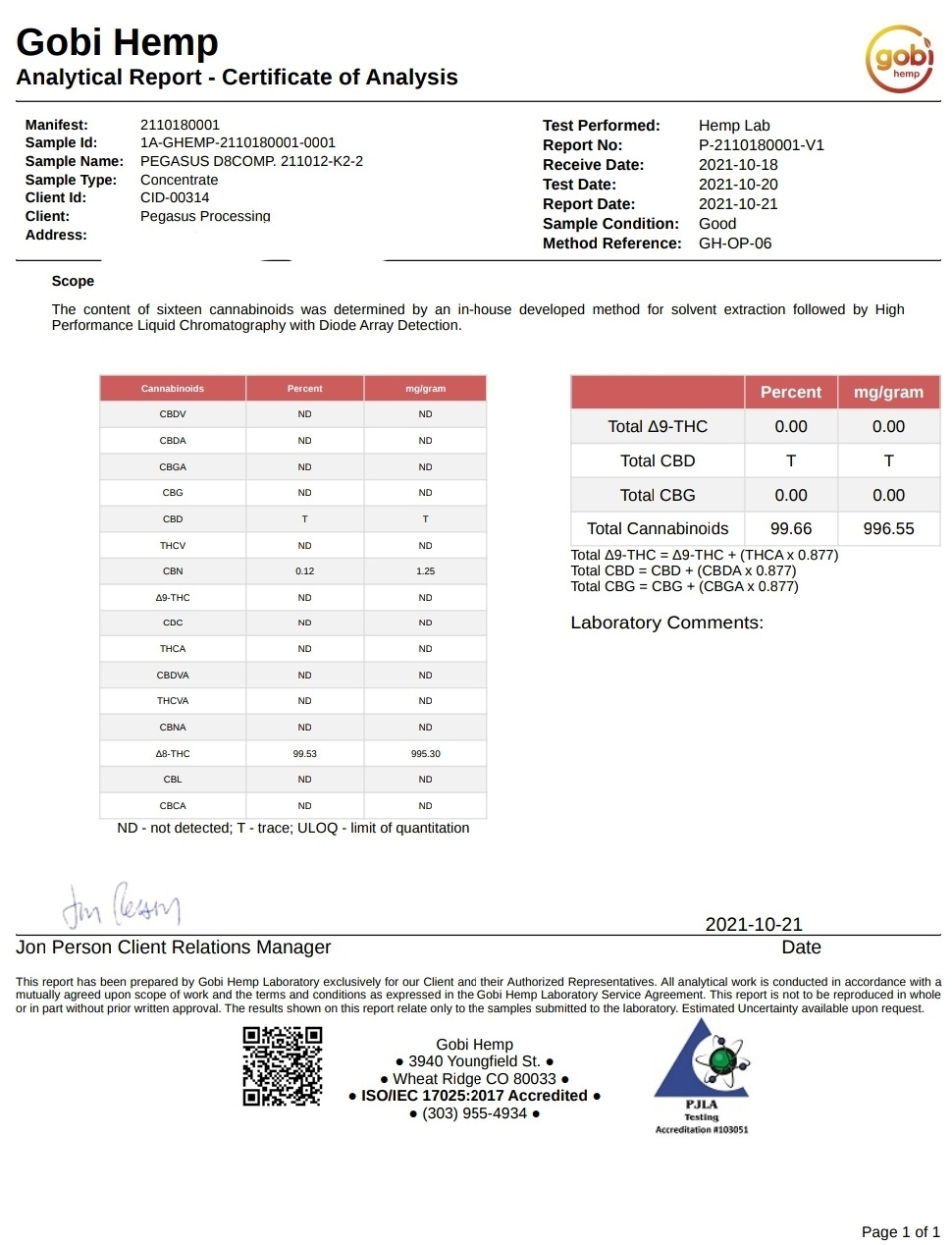
I would try to maximize d8 while minimize formation of d9. Then I would purify that mixture to high degree of purity. Then follow up by converting the small amounts of d9 into CBN. I would now have a mixture of d8 and CBN, two components that ought to have enough difference in volatility to allow their separation in a well-tuned WFE.