How does it compare to the systems by WhistlerTech out of Canada?
I like their vibratory sieves for seperation, seems way easier and advanced than the bags.
2 Likes
Im hearing through the neighborhood that the Osprey really sucks with some biomass.
Stuff that takes harder/aggressive agitation to get the heads to seperate, doesnt work well in the Osprey.
Apparently something with mixing mechanics not being powerful enough?
Anyone able to chime in?
4 Likes
Cleanout is time-consuming in those types of system as flower needs to be scooped out. This is why you rarely see people posting about cleanouts on some systems. Those little bags get caught in the impeller and slowly rip over time. If you pack the bags too much you risk losing on yields. I’m not a fan of naked or little bags BTW.
1 Like
One of the problems with bottom agitator machines is the trichomes get beat up during the entire wash cycle. Trichomes are heavy and fall to the bottom and get sucked into the impeller over and over again. This is one reason machine washing is usually not as good as hand washing. Trichomes can’t settle.
2 Likes
Big lebowski right?
1 Like
I’ve noticed different types of biomass fits differently in a vessel. Sometimes we fill up with 15kg and sometimes we fit more. I think our max was 33kg in an 80-gallon vessel. So keep in mind that may be why they made those claims, though still seem to be overselling themselves a bit.
Gravity draining sucks. Consider a pump to speed up the process. We use our hash pumps for this very same reason. It would just be too slow and inconvenient to gravity drain. Plus we would need our equipment at a height that permits draining, which makes cleanup and filling a bitch.
I do agree with you about bags. Little bags suck and running naked is labor-intensive to clean. Big bags are the way to go. Of course, that’s impossible if you have an impeller on the bottom of the tank.
1 Like
Any vibratory screen company can sell you this system. Russell Finex, Kason, etc… etc… that’s what works and what most are using. The problem is that an entry-level system is $15k and easily $40 for a bigger system with 5 decks. Then you need to integrate that into your system. You can google “circular vibrating screen” or “vibratory screener” and get lots of options. We use VibroWest in Italy just because they are awesome.
4 Likes
I agree. I dislike chillers because you have to spend the money on jackets, chillers and the added electricity bill. Plus deal with the condensation or spend even more on a third jacket.
Most nice labs I’ve seen are in a cold room or walk-in. Our tanks are made to be rolled into any room for this very reason. The actual agitation can be done in an environment that isn’t so cold.
At least with our system, you don’t need to mess with jackets or chillers. Our material is a thermo insulator and retains temperature throughout the entire process. You just need to remove heat generated by the pulsator by adding a bit of ice after every wash.
2 Likes
It’s an industrial sieve
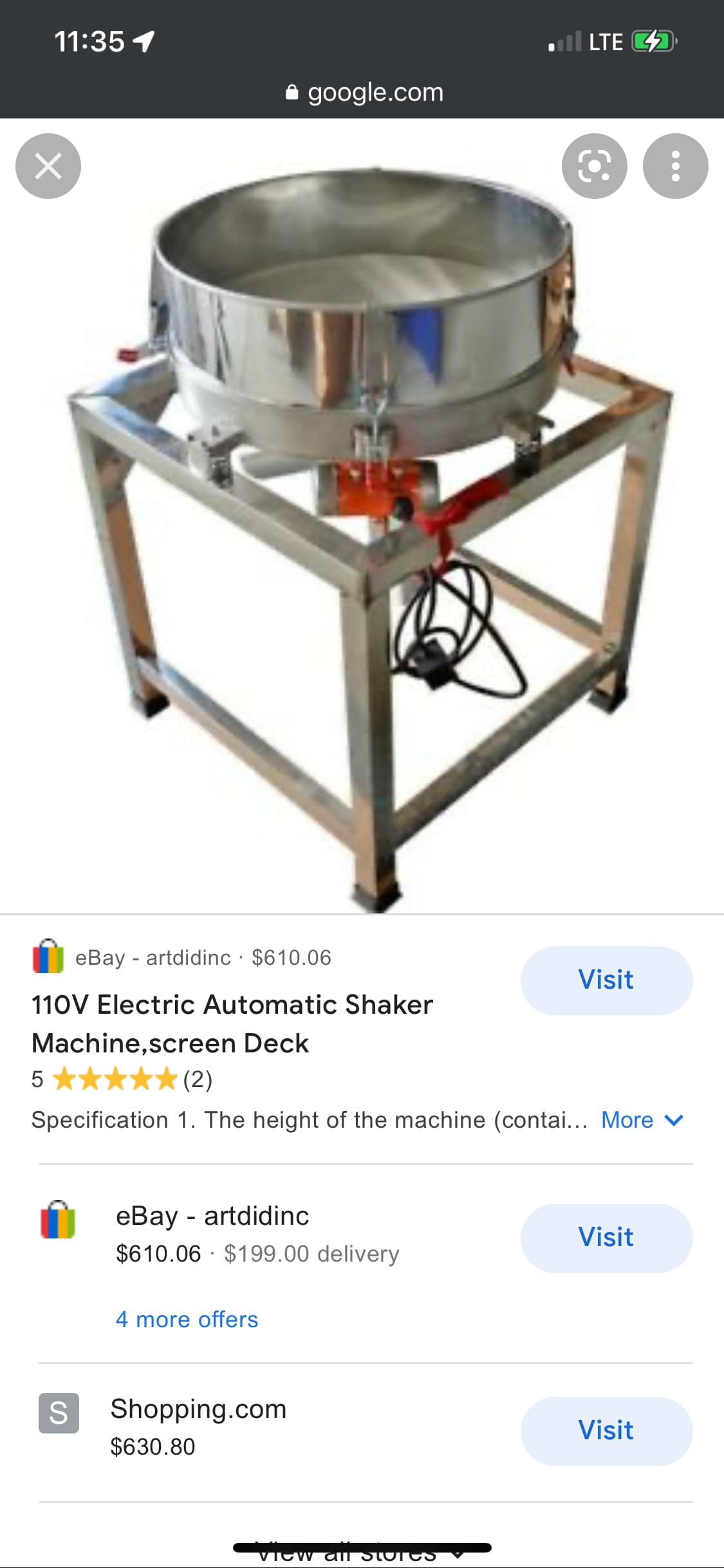
Ah the days of getting weird looks for asking to take their trim
First trim job I had I would walk away with garbage bags full of sugar leaf every week
1 Like
You can add sieves to any system. Whistler uses Rusell Finex I believe.
1 Like
I heard something similar, but here are my two cents of why and how to fix it.
The issue is power, or lack thereof. So they don’t have enough power to perform the necessary agitation, causing these problems.
One reason to be short on power is that the user may be overloading the tank outside the normal operating parameters used to design the system. The system falls short on power. To fix, reduce the biomass.
You can also reduce the amount of water used. Less liquid means less power is required to generate the necessary agitation. Also, less water brings the floating biomass closer to the impeller. I can see this being important on tall washers like the Icetracts Icon. I wouldn’t expect this on the Osprey since it is so low.
Tank shape would also play an important role in causing this issue. Round tanks without baffles (I haven’t seen anyone use baffles actually, maybe Whistler or Hashatron?) have poor mixing. Most of the power is lost in the fluid radial speed that creates a vortex. That vortex (cone or whirlpool) is actually just a waste of energy. You can see this on round machines where the agitation actually only occurs when the impeller changes rotation direction. This is why they do this whole change spin direction thing and must do this every 15-30 seconds. Baffles disrupt that vortex and convert that energy into mixing/agitation. The Delta and Osprey don’t use baffles but their shape creates better agitation and turbulence. The Delta has 2 main zones and the Osprey has 4 small vortexes. Whistler attempts to fix this mixing/power issue with their “Torus” agitator which is just a few agitators moving water in different directions. All of these shapes work but they all have their own shortcomings.
An important element to the whole mixing issue is well of course the actual mixer used. Osprey uses a simple agitator. So do the Delta and their Chinese clones. Icon uses an Axial impeller. We use a pulsator with a double radial flow so fluid pushes up from the bottom to create mixing at the surface, and pushes down from the bottom so the trichomes that reach the false bottom get pushed to the tank bottom, stay there and don’t continue to get beaten up.
Anyways, though these machines may have a motor with the power to do the work, the design of the actual agitator may not be best at translating that energy into a motion that promotes trichome separation. It’s an easy fix and just means they need to do their homework.
Another issue is soak time and/or lack thereof. We find that soaking is critical for large batches. Basically, the biomass freezes together. The energy needed to move the biomass around isn’t there. These systems aren’t designed to move this viscosity. Trim is less viscous than flower. So to fix this type of issue, soak long enough. Frenchy has great videos on the why to this, I suggest watching them. It’s good practice to move the biomass with a paddle to ensure the top soaks just as well as the bottom. We designed our lid with an integrated system to overcome this issue.
Check it out here:

16 Likes
Sambo dropping knowledge this Saturday. 
2 Likes
If anyone can’t sleep, watch this and my other videos on my comments to this thread. I promise it will put you to sleep. 

6 Likes
Totally not boring, I found it super interesting. Also watched your most recent QnA video on YT that helped a lot better understanding the process with the different trolleys. I see a huge advantage with the mesclatore cpared to other systems.
Keep up the good work!
I’ve seen a few sweet washing systems this year.
Still nothing is plug and play.
What did you have in mind? Can you share a “wish list”?
1 Like
no plastic buckets would be the big one
2 Likes
Why does that matter. Plastic buckets vs stainless (or at least having the option) would lower the price by hundreds. 710 and Olio still use plastic buckets but motherfuckers camp out for their drops. I have never once heard ‘damn fire rosin…but are you using plastic? oh wait you are nevermind…’. Although that is something common in people who are butthurt they can’t make good rosin.
Unnecessary cost.
I’d worry about that gentleman’s input once he makes hash
6 Likes