Doesn’t propane help color? obviously not as much as CRC, but i remember folks switching to propane 4-5 years ago for terps and color, if their systems could handle it.
Also, to be clear to OP, don’t use propane with windchime tek
I don’t have dosage information handy, but water clear is pretty easy with a little silica ontop of our b80. I’m sure enough clay would do the trick as well, but I pack the CRC, not chose the mix.
@Concentrated_humbold do you find that CRC removes lipids? That’s my issue here. At times, I find something that resembles lipids on top of my media cake, but I have to assume not all of it drops out, and is just clarified and bleached.
I also absolutely believe media works BETTER when warm. Ideally, I’d run a custom system that extracts cold and warms before the CRC, but I’m curious what you think of the lipid content of your extract. I know you’ve made more distillate than many members on this forum, so I really trust your appraisal here.
Yeah propane definitely pulls better colors and terps, i run iso/propane. Butane is too slow and super cold injection is a pain with the psi differential’s for me to be able to drain columns. I don’t soak for more that 30 seconds just to avoid channeling and then just blast a few mins of melt ice cold solvent and done.
From my Instagram post:
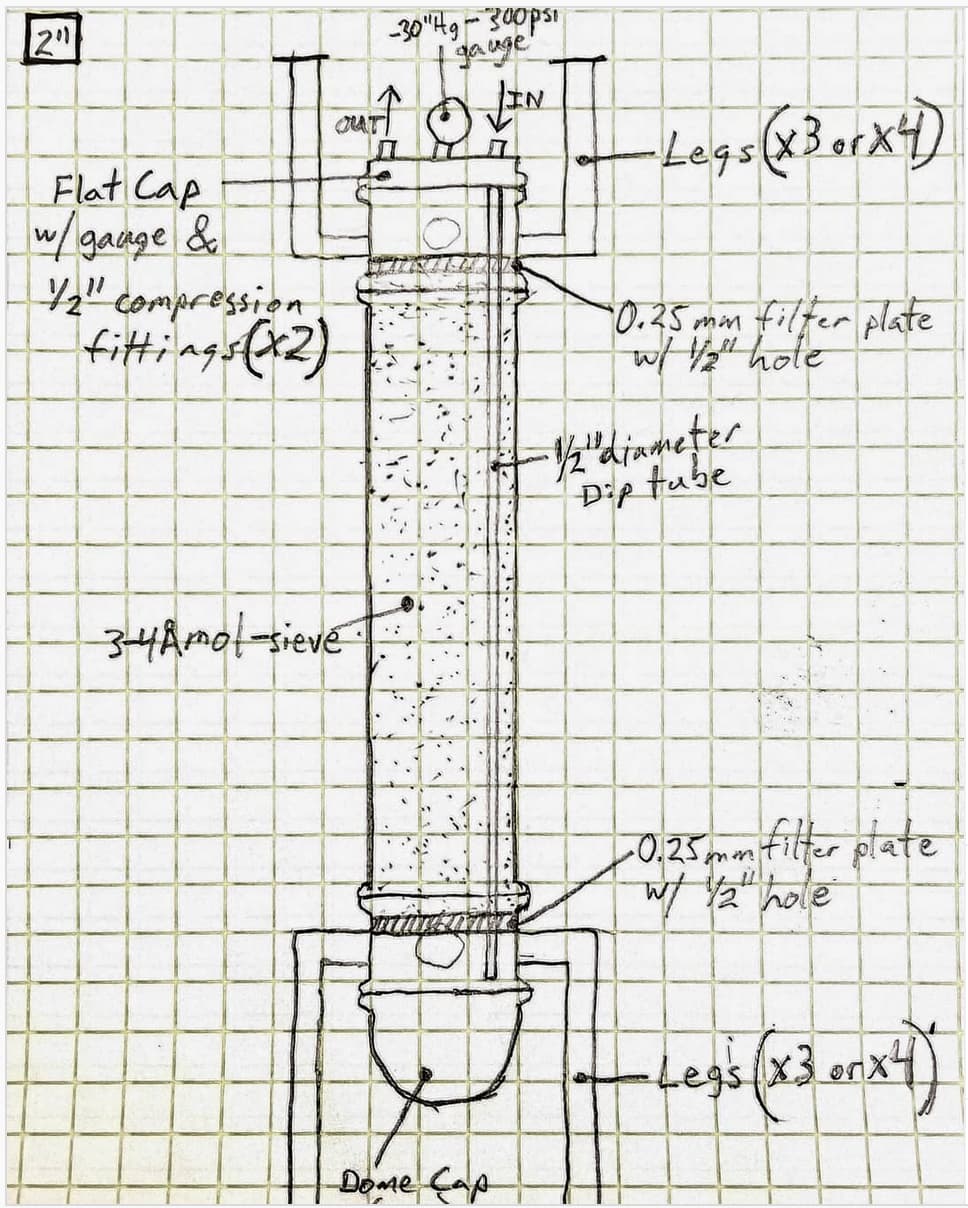
This was the original design for the in-line [#molecularsieve] trap I had [nate] build. Some things have been moved around, sizes changed, added, etc, but this is the basic idea. As you can see, this design keeps the mol-sieve free of resin (if any is coming through from the collection vessel recovery distillation) by catching it all in the bottom bowl, which acts as a rapid expansion chamber to precipitate liquids and solids from the vapor. Clean vapors then rise through the trapped bed of mol-sieve and out to the recovery pump. There are a few small things you need to put in place to make it work perfectly…
I use cotton or glass fiber between the screen and the exit port to catch the finest dust (so it doesn’t continue on to the vapor compressors).
I’m also a fan of using an in-line moisture-indicating sight-glass on the vapor outlet. This lets me know when to change the mol-sieve.
[The top legs] are for ease of loading. This unit must be filled with mol-sieve from the bottom while the dip tube remains in place. The bottom cup, however, can be removed easily to be cleaned out as needed without disturbing the mol-sieve.
Btw, this design works perfectly as is with 3Å molecular sieve. You could also use 4Å, but I would usually avoid using 5A or 13X for gas phase butane.
However, this design could ostensibly be used with alumina and 13X to dry medusa-tane after bubbling it through water.
The inlet tube end should just be high enough to allow any terpy resin to fall out without interference or splashing back up onto the screen holding up the mol-sieve. A straight-through design will often get clogged with said terpy resin, since usually the only thing separating the inlet from the sieve is a fine screen, which clogs easily.
Without this dip tube method, if you have an effective pre-filter stage before the mol-sieve, you should be fine. Just make sure you clean or change it often.
EDIT:
Those filter plates are supported Dutch-weave screens or sintered discs at 10µm. The final design had the dip tube running down the center, so the 2 screens and supports could be symmetrically fixed around their central 1/2" holes.
So! I’ve been “ignorantly” using 10a/13x for gas phase. (personal system, passive)
I personally haven’t noticed any issues during regeneration, and I’ve noticed a fairly healthy mass difference after desiccation under vacuum. What should I be looking for?
I am very much a fan of these diptube traps. They are forgiving and really seem to catch most of the entrained resin in the lower bowl.
Not at all, @CallipygianDabs… Did I edit the part out where I said “not using 13X for gas phase butane is my own opinion/preference”? Well, it is. I believe it is much more efficient at adsorbing contaminants from liquid solute phase than gas phase, but that doesn’t mean it would fail to dehydrate butane vapor or anything. I even talk about doing as much when it is for post-de-medusafying butane with water.
The dip tube is a more turbulent flow method that shoots the heavy, sticky particles (which were not previously coalesced either in the heated vertical shotgun condenser tubes atop the evaporator, or in the curved scrubby-filled sanitary segments at its exit) directly at the floor of the trap well, which evidently creates a neat little blob of high-terpene absolute in the center of the well.
Yes, @highestzen ! Using cyclonic separation from a tangential port in the side and near the bottom of a conical-shaped well of a drier column could work instead, as long as the incoming vapor flow speed remains sufficiently high! I would therefore make said inlet tubing no bigger than 1/2" (just like the dip tube), and also cut a long, steep bevel out of the end like a giant hypodermic needle, installed with the open side facing the nearby well wall. Such a tangential inlet would ostensibly make a similar blob of absolute smeared along the wall of the well, which would build up and ooze down to the floor over time!
Either way works, so it’s probably just a question of which is least expensive to fabricate.
@TRIPPIE , the resin buildup is highly viscous in my experience, so I’ve found it necessary to simply open the bottom and clean out the well with a bit of solvent and elbow grease.