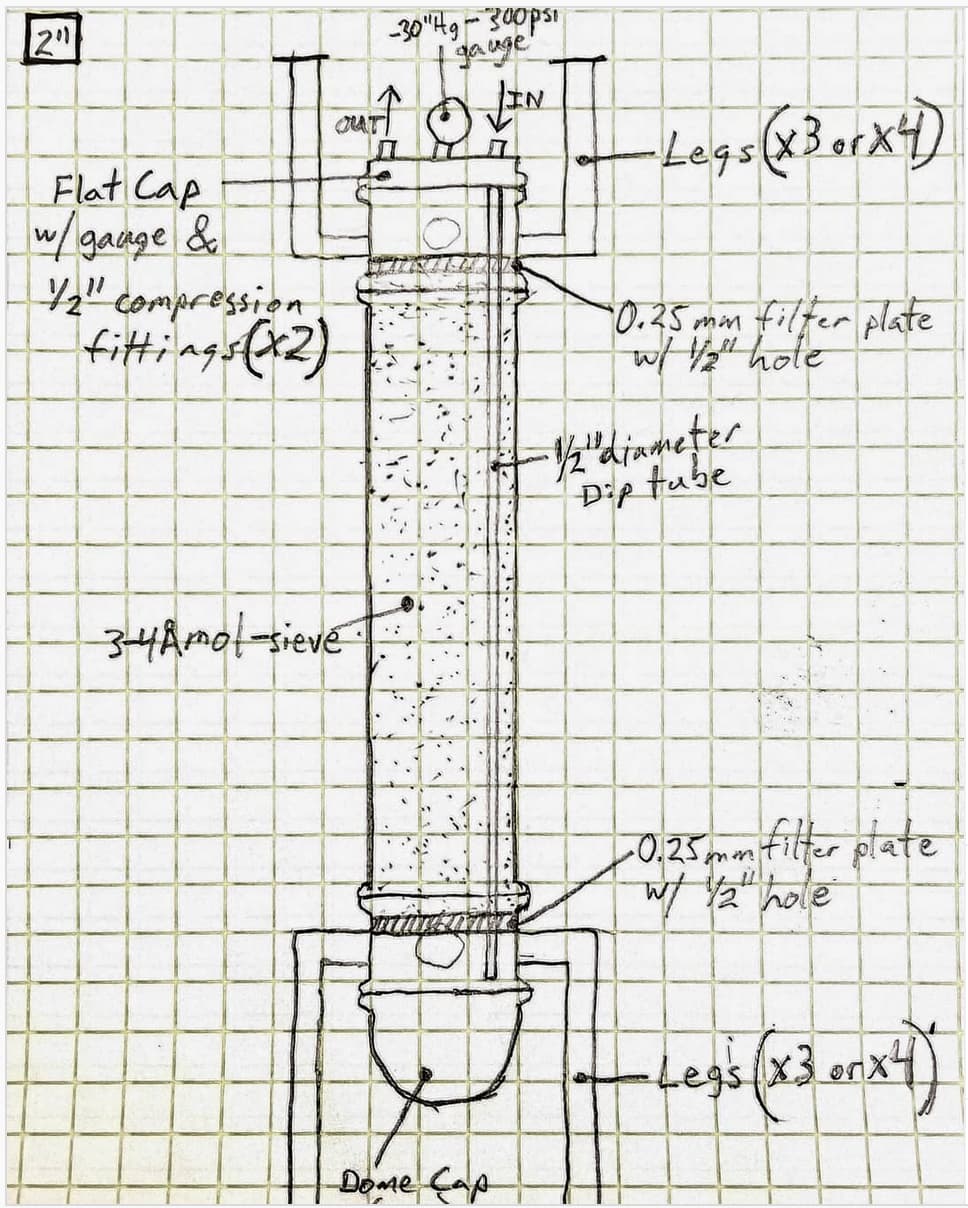
Here is a copy of the molecular sieve trap I designed:
From my Instagram post:
This was the original design for the in-line [#molecularsieve] trap I had [nate] build. Some things have been moved around, sizes changed, added, etc, but this is the basic idea. As you can see, this design keeps the mol-sieve free of resin (if any is coming through from the collection vessel recovery distillation) by catching it all in the bottom bowl, which acts as a rapid expansion chamber to precipitate liquids and solids from the vapor. Clean vapors then rise through the trapped bed of mol-sieve and out to the recovery pump. There are a few small things you need to put in place to make it work perfectly…
-
I use cotton or glass fiber between the screen and the exit port to catch the finest dust (so it doesn’t continue on to the vapor compressors).
-
I’m also a fan of using an in-line moisture-indicating sight-glass on the vapor outlet. This lets me know when to change the mol-sieve.
-
[The top legs] are for ease of loading. This unit must be filled with mol-sieve from the bottom while the dip tube remains in place. The bottom cup, however, can be removed easily to be cleaned out as needed without disturbing the mol-sieve.
-
Btw, this design works perfectly as is with 3Å molecular sieve. You could also use 4Å, but I would usually avoid using 5A or 13X for gas phase butane.
-
However, this design could ostensibly be used with alumina and 13X to dry medusa-tane after bubbling it through water.
-
The inlet tube end should just be high enough to allow any terpy resin to fall out without interference or splashing back up onto the screen holding up the mol-sieve. A straight-through design will often get clogged with said terpy resin, since usually the only thing separating the inlet from the sieve is a fine screen, which clogs easily.
-
Without this dip tube method, if you have an effective pre-filter stage before the mol-sieve, you should be fine. Just make sure you clean or change it often.
EDIT:
- Those filter plates are supported Dutch-weave screens or sintered discs at 10µm. The final design had the dip tube running down the center, so the 2 screens and supports could be symmetrically fixed around their central 1/2" holes.