I have had good results rotating venerate and grandevo
What’s your dosage? Just got some
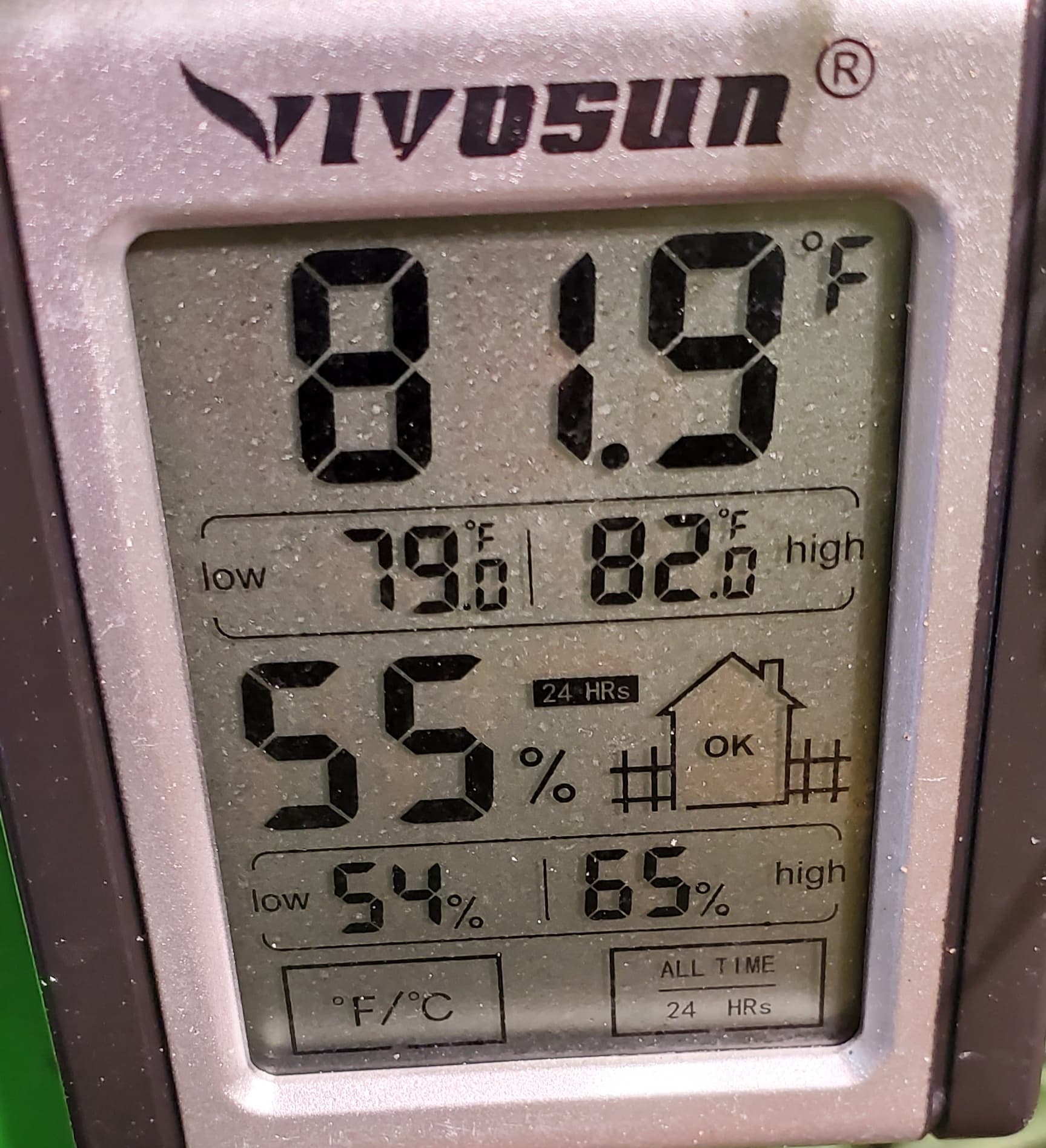
There are a lot of variables there, light intensity, temp, leaf temp, humidity and goals. Perso ally I work with mostly production settings, but also a few smaller craft guys. In production setups I’ll gladly run them up at 87f, craft setups typically 78-80f.
Regardless of those goals it’s pretty trivial to find the optimum vpd for whatever temperature you’re running. You’ll want to check leaf temperature at different humidity points and figure out which humidity point gives you the lowest left temp. The evaporative cooling capacity of transpiration is a pretty good indicator of stomatal conductance. Say you check 70% and your leaf is 2 degrees less than ambient, at 65% its 3 degrees less than ambient, at 60% its 4 degrees less than ambient, at 55% it starts going back down to 3 degrees less than ambient, at 50% it’s 1 degree less than ambient. If I was presented that data, I would try to maintain 62% humidity. You’ll want to error slightly on the side of too wet.
Then using a fixed nutrional regimen throws another curveball your way. There is going to be an exact transpiration rate where the stars align and the mass flow absorption rate is in perfect balance with the diffusion absorption rate.
For a direct answer, my flower setups are set to 82f and veg are set to 85f.
3 Likes
Apply 2-5 tablespoons per gallon at 7-day interval.
On both.
i feed my plant pre workout by just topdressing exessive doses. im chopping and the stems are nuts. buds took a beating. last week or so the fans and ac blew a fuse while lights stayed on. its a bit crispy
1 Like
New member here. Joined because it seems like some really knowledgeable people here…sorry to bump an old thread, my question is for @emdub27.
In this thread you mention most dicots prefer 1.5-2.0 k:ca ratio. My question is how does this translate to a coco application?
On Cannas website, they state something similar in their educational section yet their k:ca ratios in their actual formulas dont match what what they preach. In terms of potassium, compared to other nutrients lines their K is almost non existent. Why does their formula work so well with such low K ppm and how come you don’t need to supplement K with their line either?? They sell a pk and a some kind of booster but you don’t actually need them.
Can coco really supply enough K on its own to bring K:Ca in line with a nutrient that would be deemed K deficient in any other medium?? I saw one post that said your minimum was 180ppm Ca. That would mean 270-360ppm K. I know you do consulting and can’t answer holy grail questions.
1 Like
I can tell you from trials that as long as K is roughly 1/2 the concentration as Ca, and N is in a sane range with Ca, you won’t see dramatic visual deficiencies or even a huge decrease in yield. I’ve left work for the day, but that particular trial was only down about 10% in yield. K is one of the ions that can be taken up actively, therefore the plant can correct undersupply to a degree. A green plant doesn’t necessarily mean it’s actually healthy.
Coco doesn’t directly supply K. It’s CEC makes the K a bit more available than an inert media like rockwool.
3 Likes
Thank you. I lost my connection to the online world and wasn’t able to respond earlier but thanks for your willingness to answer.
I started experimenting with low K levels and had some interesting responses from the plants. My basic goal was to get N K and Ca 1:1:1 which I couldn’t quite do with MAP as my P source or at least didn’t want to try as it seems like id be putting in too much nh4? Ph balance aside, some studies I’ve seen on similar plants seem to suggest you can do a 70/30 no3:nh4 but my concern is some other studies I’ve seen on nh4 in coco not really becoming available.
So far the mix seems to work ok with the low K ratio. I’m hesitant on the K long term as I read one of your posts about adding K 10ppm every week until new growth narrows or turns pale. I like your methodology. Makes a lot of sense on how you find the path. The micros i wanted to get my Fe and Mn to 1.5:1 and then I wanted to keep P:Zn somewhere between 30 and 60:1 based on some studies I’ve read. The MOST gets close except for the Fe which is closer to 1:1 with Mn, but the B is low for that much Ca isn’t it? My ratios are just a concoction of agricultural study info I’ve deciphered with my limited knowledge. Anyways here’s my mix, pure coco.
149-35-160-160-53
.356B .608cu 1.98fe 2.11mn .011mo and 1.19zn
How much validity is there to the issue of coco needing more N than other media due to microbial life in coco needing sufficient N to function and as such takes some from the reserves in the coco? I don’t see N def, but I wanted to experiment by adding KNit as some of my K source in order to increase the N while I hit my k target just to see. All k comes from Potash now. I can get N up to the 170-180 range but not sure its needed? My dilemma is strictly coco based… My only goal is a “perfect” veg recipe for now under the new led tech, I feel close
The only real reason to use ammonia is stabilize pH unless you’re dealing with cold temps. It’s not terribly important in drain to waste setups. NH4 is readily available in any media I’ve ever dealt with.
I have not seen N being needed more in coco in general. Low N with every media is a common occurrence I see. It’s actually pretty common to see 2% tissue N levels on plants that look perfectly green. The dead giveaways are small leaves and old looking brittle stems. In general, the more light you have, the more N you need. 250ppm NO3 isn’t a crazy number to me in a bright led setup. 170-180 may be ideal for your setup, I can’t tell you for sure without tissue data. About the best advice I can give without data is to increase N until maximum leaf size is achieved.
As you increase K you are essentially decreasing Ca due to antagonism. That’s the balance you’re watching for when slowly increasing K.
That’s not crazy low for B, I’m typically around .5ppm. But luckily it’s easy and cheap to increase. Most roach killer is 99% boric acid. Boric doesn’t need to be chelated, so it works just fine.
If you’re reading studies on other plant species, remember they aren’t 100% accurate for this species, so don’t take them as gospel. For instance tomato fertigation is not ideal for cannabis. That being said, I’ve never seen a huge micro problem caused by using any off the shelf mirco mix as long as Fe was at a sane level.
4 Likes
Thank you for being so thorough. I’m just diving into this world for a little bit now. Nothing I “know” is set in stone so I’m ready to drop anything ive learned for new information at all times. Thanks again.
Quick question if you can answer. If not I understand, but how do you feel about the north Carolina Boron study that was done on actual cannabis? The claim is 8-10ppm. Much higher than anything ive ever seen but was something I wanted to experiment with. I just assumed 8-10ppm was a sure death?
1 Like
I have not seen that study. I can tell you from personal experience, that me screwing up by a decimal place and fertigating 5ppm B instead of 0.5ppm B produced B toxicity symptoms in rockwool and coco.
3 Likes
Yea and that’s the general theme I’ve read from everyone. I kind of chalked that study up as an outlier and really wasn’t sure if maybe they made a decimal point error in the same way. Maybe they meant 0.875 to 1.00 instead of 8.75-10.0. Thanks for your insight. I actually just realized who you are because I followed you and a few other members aound icmag for a bit. Ive always had this Boron question on my mind. thanks again. Guess there is only one real way to find out without tissue analysis. Gotta go kill some plants lol
Here is the article if you want to check it out. It was posted to cannabis business times. Obviously you deal with a scientific approach so figured you might take some interest in this. Hit the Boron ‘Sweet Spot’ - Cannabis Business Times
1 Like
Why not living organic soil, and then a worm bin, and occasionally get the ladies treats like harmless harvest coconut water and organic aloe Vera (1 oz per gallon, as a foliar and a drench)…
1 Like
For me its simply because we have hard set numbers to work off of with salts. I feel like there is much more going on with organics in terms of how fast and how readily things become available that its hard to compare from a scientific standpoint. Like I know my 19% calnit is the same as yours in terms of Ca. But I’m not sure I can say my compost is the same as your compost right? I don’t know though, not ell versed on organics. My last soil grows were in 05 or 06 so its been a really long time since I’ve attempted the dark arts lol.
4 Likes
BigBird The study you posted about Boron is the same Study/paper I believe that emdub27 posted in post 211. Both from NCSU.
To muddy the waters more here is the same study again I believe,
1 Like
It is quite muddy. The only reference for the Cannabis Business Times articles is the study I referenced in post 211. That study used Hoagland’s solution to characterize nutrient disorders, I like people to see it mainly for the photos, Hoagland’s solution is fairly outdated. There is no study referenced about achieving optimal micronutrient concentrations for cannabis. The nutrient disorder study used modified hoagland’s (.5ppm B) and tenfold higher (5ppm B), so I’m not sure where the numbers for Boron higher than that came from. Also according to that article, my crops should be fucked with manganese toxicity, they’re at 3ppm MN right now.
4 Likes
Hi emdub27. You’re a big reason I just joined this forum. You’re a wealth of information. I always look for what you post. So I figured this would be a good first post for me on this site.
It’s funny timing for this talk about Paul Cockson and others’ claims about boron in those two Canna Business Times articles. They definitely meant to write 0.875 to 1.0 ppm, not 8.75 to 10 ppm. I happen to have emailed him about their typo a few days ago.You’re correct that in their paper you mentioned they used 45 µM (0.4865 ppm) boron as the control. They induced boron toxicity at 10-times the control (4.865 mg/L or 450 µM).
For manganese, in that same paper, they also induced Mn toxicity at 10-times the Mn control. The Mn control was 18 µM (0.9889 ppm), so the induced toxicity level was 9.889 ppm (180 µM). So your use of 3 ppm Mn doesn’t sound too high to me.
There could be B and Mn toxicity at below 10-times the control.
In rockwool with CO2 and >1200 PPFD from Fluence LEDs with crop steering, I currently use 0.875 ppm B and 0.75 ppm Mn. But after reading that you run Mn at 3 ppm, and to get my Fe:Mn ratio to 2:1, I may increase my Mn to 1.875. I run Fe at 3.65 ppm with a 50/50 mix of DTPA/EDDHA (with 5.2% O-O) because I use inline UV for microbial control.
What do you prefer for Fe:Mn ratio? And what is your irrigation and substrate pH? I run pH lower than is typical for rockwool, so I am concerned about Mn toxicity from increased uptake.
7 Likes
They conducted additional studies but haven’t published a paper yet. That’s where they are getting their recommended micronutrient rates. They must have used a ghostwriter or uni student to create the Canna Business Times articles becaue I doubt they wouldn’t have noticed such a bad typo for boron.
The B rates study conducted at North Carolina State University, sponsored by Pyxus International, an agricultural company with a portfolio that includes track-and-trace technology in the cannabis space, sought to determine the rate of B fertility that would optimize plant nutrient uptake and plant growth.
Manganese:
In a second research study, we compared six Mn rates (0.0, 0.25, 0.50, 0.75, 0.88, and 1.0 ppm) to explore the impact of Mn fertility (nutrient feeding) rates on above-ground biomass production, nutrient accumulation on the leaf tissue, and cannabinoid content. The recommended rate for Mn fertility depends largely on which of these factors define your goals as a cannabis producer.
Biomass: For businesses focused on biomass production and optimizing vegetative production, such as what occurs in a fiber operation or mother stock management, biomass increased early in the induction phase of the production cycle at the highest fertility rate (1.0 ppm Mn). During the reproductive stage, biomass was maximized at 0.25 ppm Mn and higher during the pre-flowering and flowering stages, which indicates a wider optimal range for fertility.
Leaf tissue: Nutrient accumulation was highest at the 0.88 ppm Mn rate, with the second greatest values occurring at 1.0 ppm Mn. These results may indicate that the range of 0.75 – 1.0 ppm Mn is adequate to maximize leaf tissue in the vegetative state. For the pre-flowering and flowering stages, the highest fertility treatment (1.0 ppm Mn) resulted in the greatest leaf tissue levels, although a lower rate may be adequate given the higher Mn concentration present in leaf tissue during the flowering stage (>100 ppm Mn). While we focus on deficiencies, it’s also important to avoid overaccumulation of Mn, as many of the micronutrients are also considered heavy metals in chemistry (although not to the same extent as the more notorious metals, such as lead). We recommend a Mn rate of 0.75 to 0.88 ppm Mn to optimize leaf tissue levels.
Cannabinoid: Cannabinoid content is top of mind for cultivators, and this was monitored during the study. Testing involved a composite sample of the shoot apical (top) bud , three terminal axillary buds (outside branches from the upper portion of the plant), and three interior branch, nodal buds. These combined buds produced a sub-sample of material that was analyzed for cannabinoids including CBDA, CBGA, THCA, and Delta-9-THC.
Our analysis found that CBDA and THCA levels maxed out at the 0.50 ppm Mn rate, with no increase in cannabinoid concentration at higher Mn rates. Similarly, no statistical differences occurred in CBGA concentration above the 0.25 ppm Mn fertility rate. Given these trends in the cannabinoid data, our recommendation to growers seeking to optimize cannabinoids would be to utilize a Mn fertility rate between 0.50 and 0.88 ppm, thus avoiding the higher Mn accumulation in leaf tissue found at the highest fertility rate (1.0 ppm).
Conclusion
Higher Mn fertility rates optimized biomass production in the vegetative state, but the optimal range decreased after reproduction (flowering). Likewise, the two highest Mn fertility rates (0.88 and 1.0 ppm) also maximized leaf tissue nutrient accumulation.
However, given the high Mn values in the flowering stage leaf tissue at the highest fertility treatment, a lower rate may be necessary. Cannabinoid concentration appeared to thrive between 0.50 and 1.0 ppm Mn, though a recommended level between 0.50 and 0.88 ppm would be closer to ideal, given the higher Mn leaf tissue values at the highest rate (1.0 ppm).
1 Like
I do like advanced nutrients bud candy for getting things frosty. Iv tried sugaree as secend runner up botanical sweet is 3rd for the frosty sugars. Atleast i think. Molassis works but sticky messy. My only complaint about bud candy is i think it makes all the strains kinda taste the same?.