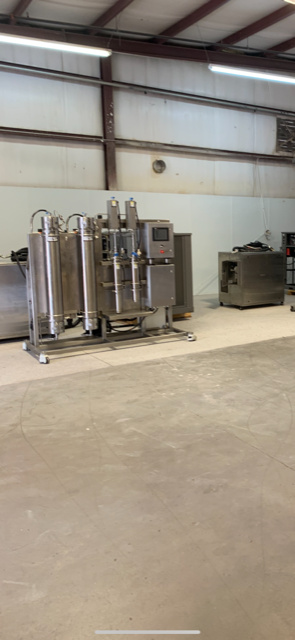
Fully Automated Botanical Extractor Machine with Double 20-Liter Solvent Chamber, Double Fraction Super Critical Carbon Dioxide Extractor. Includes process temperature controller and hydraulic power unit.
The CDMH.20-2X-2F from IES features a TWO 20-liter solvent chambers, a loading capacity of 20lbs and double fraction expansion chambers. With a flow rate of 4.2kg/min and easy open clam shell enclosures, you can expect industry-leading run-times and easy loading and unloading processes. The CDMH.20-2X-2F is the largest extractor in IES’s commercial series and is perfect for a wide range of processing needs.
This Supercritical CO2 Extraction Machine Consists Of:
100% Automation
Two 20-Liter Solvent Chambers
Loading Capacity of 20 LBS
Double Fraction Expansion Chambers
Flow Rate of 4.2 KG/MIN
Condition: Gently Used
Brand: IES (Isolated Extraction Systems, Inc.)
Model: CDMH.20-2x-24
Orig. Price $340,000
SALE PRICE: $199,000
Contact James: james@productsupplylab.com or (720) 619-2236
A supercritical closed loop CO2 extractor is used to extract different molecules from botanicals using liquid or supercritical CO2. The use of CO2 means that typical solvents that might not only be dangerous to work with but also could affect the chemical composition of the oils you are extracting are no longer a concern. CO2 is a relatively inert, nonflammable gas and when pressure and temperature is applied to it, it will undergo a phase change to its liquid or supercritical form, resulting in an exceptionally efficient solvent for botanical extraction.
The plant material is broken down at a molecular level by passing liquid or supercritical CO2 through a vessel with the plant materials. As the CO2 moves through the plant material, it strips the botanical of the desired extract. As the CO2 is returned to its gaseous state it undergoes the Venturi Effect, leaving you with shelf ready pure plant oils (terpenes, full spectrum, etc.)