That is now the new project goal…
That certainly seems like the most direct way to detect them…
That is now the new project goal…
That certainly seems like the most direct way to detect them…
If only there was a way to detect that point.
[No pressure change] point might be a bit past the [no bubbles] point, assuming heat input is constant and vessel remains sealed. This is because any higher boiling volatiles present can now vaporize up to their vapor pressures for the increasing temperature, which is now increasing because pressure still can, and CO2 has stopped removing heat from the system at whatever rate that had previously been happening. In other words, when the [no bubbles] point is reached, the heating needs to stop, regardless of when the [no pressure change] point will be reached. Fortunately, I feel like these points should be relatively close to each other, as long as the rate of heat input (usually measured as the heating wattage divided by the total mass it is given to heat, assuming the concurrent cooling rate remains constant, I believe… same room temperature, airflow, vessel, etc.) remains just barely enough to achieve full decarb. That way, the temperature of the resin shouldn’t spike too much when CO2 evolution and release ceases.
You are correct. Often we generalize things and in this case the the “no pressure change” should really be “a very small positive pressure change with respect to time” backed up by analytical testing to verify your thc/thca ratio. I like to see a tiny bit of thca to know the rate of pressure change based decarb heater stop logic is working. If there is no thca then you do not know if you were perfectly on decarb target or went to far/long.
Yeah, without THCa the bubble mites starve to death…
looks great!
Nice!!
Can you add agitation?
We def could but it doesn’t seem necessary. Especially given the cost of the agitators.. do you have any recs on affordable agitators? Don’t think it needs to be one of the fancy spark free thingy majiggers
You could have one made pretty cheaply. under $1000 with a motor controller.
This looks great man! How long is it taking you to decarb out of this vessel? Also any troubles evacuating the decarbbed material through the downspout?
Thank you! I only have 4 batches with it so far and am still dialing in the ideal parameters. Goal is to go as low and slow as possible while still meeting production goals, as we are primarily using dirty (aka slightly terp’d up dank LR) fuge’d crystals.
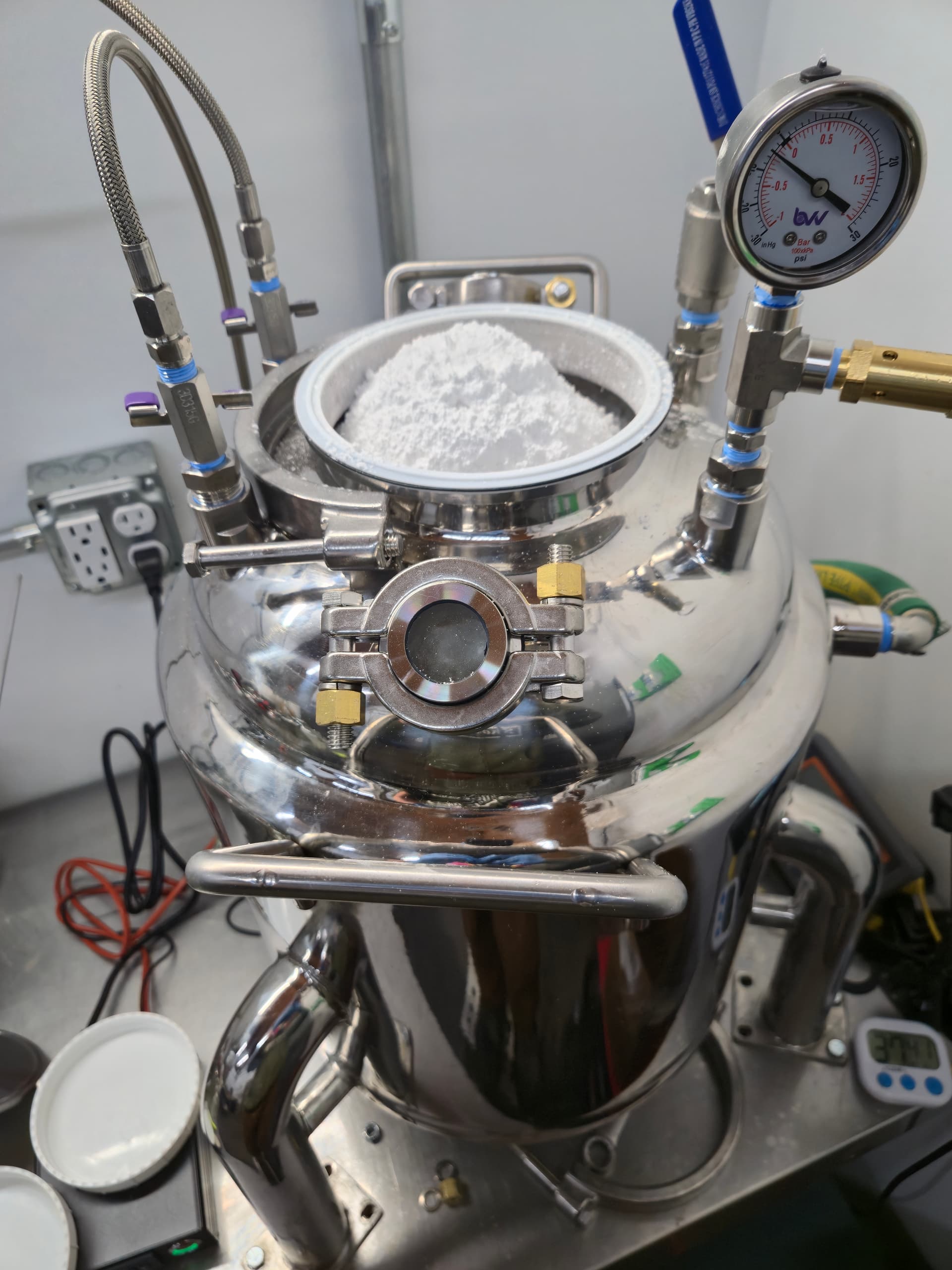
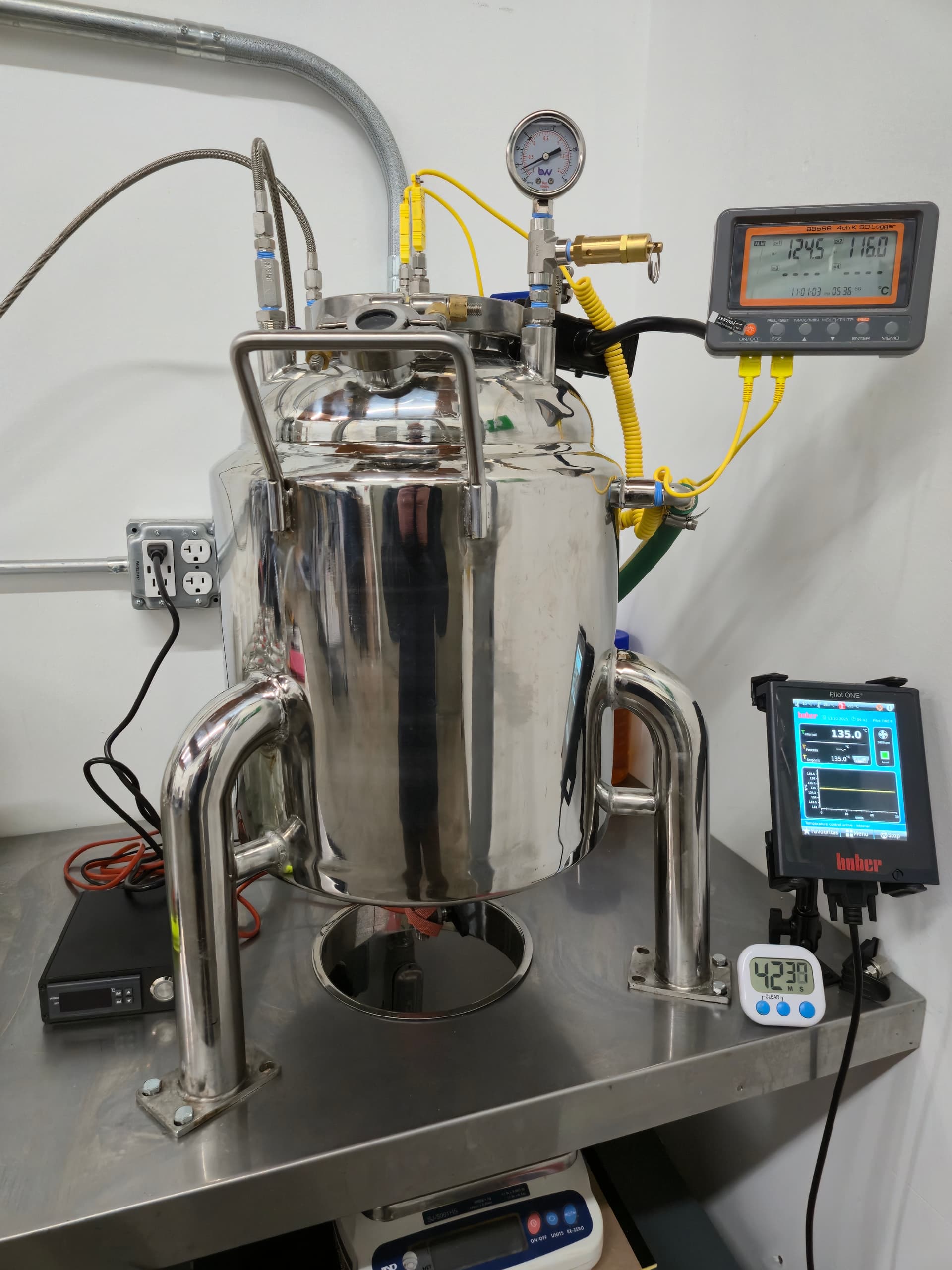
I loaded 15ish kilos of THCa isolate in it before I left on Friday. Set the temp to 85C and left the vacuum pump running. Came back Monday morning and the pile-o-isolate inside had compressed a wee bit, but hadn’t melted. The central TC goes down about 12” and was only reading 30C.
Sooooo I bumped the temp up to 150C until THCa was almost fully melted (about 2 hours), then dropped the temp to 130C. Bubbles stopped bubbling about 5 hours after dropping the temp to 130C. Internal TC’s never read over 130C.
This week I’m going to try bumping the temp somewhere above 85C until almost fully dissolved, then drop down to 85C and let it run over the weekend again 
No troubles harvesting the goodies at all. Works better than expected!
Nice, I am assuming you are using an inert gas to blanket prior to decarboxylation as well? Any issues with oxidation on your decarbbed isolate? Or are you going directly into formulation?
Since we are not trying to retain the residual HTE on our fuge’d THCa, we are performing the entire process under vacuum. We are actually trying to remove the residual volatile compounds during the process so they don’t degrade and create undesirable flavors in the final formulation. Nitrogen is used when the process is complete to pressurize the vessel for harvesting the goodies. After harvesting, we go straight into formulation.
This is where agitation may help. Although it’s non-trivial to mix before you achieve melted.
Reactors are seriously underused in our industry.
And customers i consult for will fight me on buying one. Its the most versatile tool in your lab motherfucker!
Every lab should have 3 at this point. Just saying.
I’d like to believe that I am the most versatile tool in my lab thank you very much.
Does anyone have a link or  for a reactor like this and/or this size? I’m having trouble finding one that isn’t astronomically expensive, but this design looks perfect as a jumping off point.