SharkMouse Farms Drying Method

Haven’t seen this on here yet, so I thought I’d share. Anyone played with it?

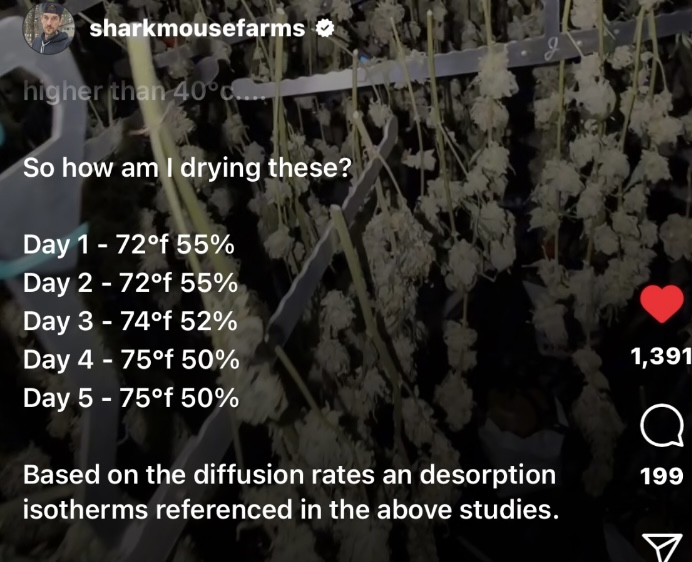
“We want to begin our dry phase in a precise climate of 72 degrees fahrenheit, or 22.2 degrees celsius at 55% relative humidity and a 1.2 kPa, over the course of 48 hours. This is considered our phase 1 of drying and will begin that process of evaporating that surface moisture, while pulling the inner moisture of your flower toward the surface through adhesion. After the initial 48 hours, we will increase our pressure slightly, as a transition to phase 2. By increasing the tef, or mp and kPa to 74f, or 23.3c, and 1.39 kPA respectively, while reducing our rh% to 52%, we increase the rate of transpiration, while not overwhelming adhesion, leaving that chain intact as that moisture is pulled closer to the surface. After a 24 hour adjustment period. We move into the final phase of our dry, which is phase 2. Increasing temperature and VPD to 75 degrees fahrenheit or 23.9 degrees celsius, and 1.5 kPa for the final 48 hours will reduce the remaining moisture content in the near-surface layers down to a final dry moisture content of 10%.

We are now off the rack, ready to buck and trim in 5 days, limiting degradation to the highest possible degree to the overall flavour profile of your harvest.”

6 Likes

This is the dude that converted his grow room into a tissue culture workshop yea?
Stick to slow drying your dope but this might work for the tent grower

Yes

Commercial facilities care about time. Low and slow works fine for the tent grower…

This isn’t about trying to save time though

2 Likes

I follow him on instagram, I usually enjoy his content but I occasionally do question what he does but I am still fairly new to cultivation so my opinion should matter as much as a grain of salt.

I feel like this is a process that will tend to lend a ethylene presence in your flower as anything above 65°f typically ends up causing to much transpiration to quickly and with humidity being that high with temps in that range you’re likely to see possibility of spores as it’s a warmer acclimation and in dark room typically for up to 4-5 days. IMO you’d have to add much more ancillary equipment like the uv scrubber from mammoth to ensure your harvest isn’t fucked.

I’d rather hang dry properly for 12-14 days then buck down and trim while burping totes/ cure tubes. Temps at 60°f and dehu on till you reach an equilibrium and can stand on business with 45-50% humidity consistently. Keep those volatile terps as much as possible and help those compounds cure nicely.

MAKE WEED TASTE GREAT AGAIN!!!

If ya don’t wanna click the link…

“The area for the largest potential Improvement in your cultivation remains The post-harvest process, The practices we as growers have adopted, evolve from decades of trial and error experience that aimed to achieve 2 main goals. Secondary metabolite and volatile compound preservation, and safe storage conditions.Nearly all of the steps in the workflow we’ve employed to get there are based off anecdotal logic. Regardless of how flawed that logic has come to be.

Drying your fresh flower in conditions in the 60f/60% rh range, known as the “low and Slow” method contends that if we dry our flower at the lowest possible temperature,and lowest vapor pressure possible, that we can slow the rate of evaporation in that flower, preventing them from reaching their dry target before compounds like chlorophyll and sugars have a chance to degrade, while mitigating excessive evaporative forces that can pull out those secondary metabolites and volatile compounds. In our heads, the idea that cooler temperatures will prevent the oxidization of those precious compounds. And knowing that a safe water activity (aW0 of 0.64 is necessary for not only safe storage, and the prevention of mold and yeast, but also to ensure ideal consumption conditions as to prevent overly moist, or over-dried flower. These ideas, align with the notion that “Low and slow” is the ideal way to achieve those conditions. If we add to the fact, that out of context, the formula Water activity is equal to equilibrium relative humidity divided by 100: (a w = ERH/100) where ERH is the equilibrium relative humidity (%) ie. 0.64= 64%/100, it all seems to indicate that 60/60 is the right move!!!

The problem is, thats not how thermodynamics work!

According to Fick’s first law: Movement of particles from high to low concentration (diffusive flux) is directly proportional to the particle’s concentration gradient. What does that mean for us?

The evaporative forces of the surrounding environment are directly proportional to the density of the material it has to be pulled from. Diffusion works a lot like osmosis. Areas of high moisture will move to areas of low moisture until it equalises. If youve ever run the “Low and slow” method, you’ll recognize the “dry” flower feel after only 2 days. Then several days later, its back to moist again. As the moisture on the surface of the flower evaporates into the ambient atmosphere, the principal of water adhesion is still applied. Surface water getting pulled out of the flower, draws moisture from deeper within the flower toward the surface. But those same evaporative forces, based on ficks’s law, overwhelm those adhesion forces the deeper into the flower material we get, at at some point, that chain breaks, and that internal moisture is now being pulled out with significantly less force than it was at full moisture content %. While the concentration gradient has increased, so has the membrane thickness ( the amount of layers of flower the moisture has to diffuse through until it gets to the surface.

This specific condition creates 2 problems.

The biggest being that internal moisture content itself: when that water adhesion chain breaks, the moisture content within that flower is still in the 30% range; far above the % necessary for botrytis to proliferate. with a relatively high moisture content of 30% inside the te flower, mold growth could potentially occur within a matter of days to a few weeks. The combination of moderate temperature, moderate humidity, and high moisture content creates conditions that are favourable for mold proliferation.

Mold spores ARE present in the environment and can settle on the flower surfaces. Given the high moisture content inside the flower, mold spores may germinate and begin to grow more rapidly under these conditions. The 60% relative humidity provides additional moisture to support mold growth, especially if the flower’s moisture content is already elevated. Once we break the water adhesion chain, that internal moisture is left to sit for another 10 days, very slowly working toward the surface and the chances of proliferation increase exponentially with time.. After weeks at those conditions, and even if your flower passes CoA, your flower is MOLDY! As of 2023, States like Michigan and Maryland allowed for 100,000 colony forming units per gram of dried flower. In all likelihood, most home cultivators, drying their flower in uncontrolled environments , in these conditions are exceeding those CFU’s 3x to 5x over; not quite visible to the naked eye, but a definitive health concern.

The other issue that comes with “low and slow is the direct contradiction of its intended goal of terpene preservation.REmember how we discussed Fick’s law, and how water at the surface gets pulled out faster than the water in the middle? This leaves our flower in a position where those compounds on the surface and near surface layers are being entirely dehydrated the the interval between the atmospheric pressure breaking water adhesion, and the time it takes diffusion to reach those dehydrated layers. Going well below your intended aW in those layers, volatilizing a lot of those compounds in the process.

What about the cool temperature? Doesn’t that mitigate the volatilization? No! The single most predictable constant in this equation is that once we chop the plant down, the PSM numbers are going down, never up! Heat, Light, oxygen and time all have a significant impact on how, which and to what extent these compounds volatilize.

The behaviour of individual terpenes was

analysed and were grouped based on their evaporation behavior against drying temperature.

Terpenes such as caryophyllene oxide (average content among all the drying conditions is 0.16%

or 1.6 mg/g; standard deviation- 0.01%) , sabinene (0.01%; SD- 0.001%), and α-terpinene

(0.002%; SD- 0.0002%), ocimene (0.001%; SD- 0.0001%), α-humulene (0.001%; SD- 0.0001%)

were decreased with drying but stable with the increase of drying temperature. Terpenes such as,

myrcene (0.006%; SD- 0.0005%), terpinolene (0.006%; SD- 0.0002%), α-pinene (0.02%; SD-

0.002%) and β-caryophillene (0.03%; SD- 0.001%) decreased gradually with the increase of

temperature. Terpenes such as, Guaiol, Nerlidol, g-terpinene, geranyl acetate, p-cymene, linalool

were almost completely evaporated with drying, leading to a significant decrease. All the

remaining terpenes that were analysed were not observed in fresh hemp samples itself.”
1 Like

I’m old school, gotta hear that stem snap🫰

I typically dry a minimum of 10-14 days, then into totes for trimming. Did things a little different last round, trimmed and jarred in several intervals, and the flower that made it to jars first actually seemed to have (slightly) more flavor (verified by others who didn’t know). Never saw a tote. I’ve noticed this multiple times in the past as well.

With that being said, I’ve got flower from 5 months ago in a tote that still feels fresh to the touch (gets my fingers sticky/greasy) and smells/tastes like it was harvested 3 weeks ago. I know what works for me, and I’ve spent years dialing it in. Always skeptical to try anything different, but you can’t argue with data/results.

We never stop learning, and it would be a disservice to myself to simply dismiss every new tech, even if it goes against what I’ve thought to be correct.

7 Likes

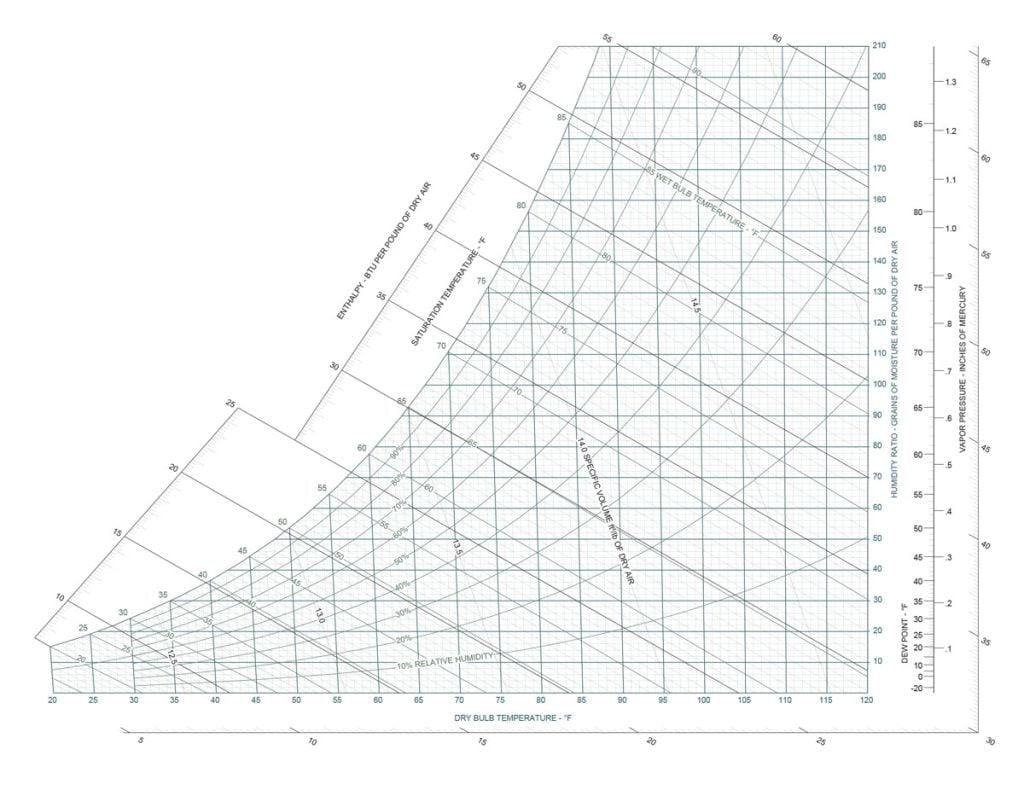
Always been curious about drying to equilibrium and its effect on flower. The important thing is to look at dew point not rh% (ex. If you cool a volume of air at 68F at 60% humidity to 60F, the rh% is now 80%, the dewpoint is still the same.).

The main hypothesis is that if you keep tight control on the water vapor pressure in the room, the plant will dry to the ideal level but also won’t overdry. The logic being large fluctuations in humidity cause trichome heads to rupture. The other aspect is microbial growth. To me, there isn’t a direct correlation between rh and microbial growth since microbial growth has more to do with the product water content. For this reason, it seems like drying in a shorter timeframe limits microbial activity and the higher temperatures (and I think vapor pressure) facilitate this.

72-75F seems warm to me, (I think 68 is the max, since that is the minimum for many microbes to consider optimal) but using the q10 rule where metabolic activity roughly doubles every 10C or 18F, total microbial growth would be less if done quickly at a higher temp since 2 weeks is a longer timeframe

The final question is about quality, I’ve been told always keep the temperature below 68. I figure this is due to enzymatic processes that take place that break down sugars, or facilitate microbial activity. Not that hard to stay below so why not. Hard to know without some proper studies, but the 75F just seems a little too warm for my liking, even if it is for 2 days.

This is tricky to maintain on a small scale (need to control coil temp of dehu, or tied to moisture sensor) but on a larger scale, this is just a chiller and fan on a controller that turn on/adds cooling/dehu on a sensor.

I’ve heard 1.42kPa (dewpoint 55) as ideal, but I find that a lot of flower feels too moist and spongy, I’ve found a dewpoint of 53 is ideal for handling flower.

3 Likes

In a grow that doesn’t have proper hepa filtration that is changed and vents cleaned every time you harvest or move a harvest into a room to cure and dry you will always have chances of spores landing and germinating. This is a given. Which is why I prefer to stay within a colder temp as the warmer temp will allow for the vpd fluctuation even if you turn on lights for a moment to check your cure rates etc and see how the stems snap. Which is another reason I have multiple points of humidity check always recommended that way you can have a average across the board and find your dew point by tracking your 24hr data seeing if you raise real RH% overnight or not. If so then you will need to run you dehu full blast till reaching that equilibrium which typically takes atleast 3/4 days to properly achieve. Then I suggest decreasing in rh every day till reaching 45-50% depending on how the snap is on stems and presence of ethylene in the nose. Which is another indicator of having a higher dew point than RH% as this will indicate you have moist bio that doesn’t have enough cfms around it to keep constant fresh air meaning you will fall to the demise of spores that will begin to germinate.

By day 2/3 you should have very little to no presence of ethylene given you’ve now taken control over the moisture content and allow it to be decreased efficiently but effectively enough to not degrade your compounds will allowing others to convert.

This is something I preach about in curing as you’re now converting your sugars and other compounds into the prime profile and cannabinoids we all enjoy. This is just like a fruit and needs to be done with care and parameters. Too fast and it ends up not being as tasty and has a dull harsh flavor as you entrap ethylene (green house gas that smells like hay) which the moment you cut a plant starts emitting. To slow and you won’t remove the proper amount of moisture to not allow germination of spores and growth. Even at these temps below 68 it can happen. Which is why you need the proper amount of cfms and dehumidification to ensure your space is being evacuated within a good time frame and allows for the process of conversion and cure to take place.

Even in my small curing setups I won’t start to trim or buck down flower till it’s at a Rh% of 50 for 4-5 days this way I can ensure once I begin burping the batch I won’t have as many issues with my final curing.

however if you want to have a chance at some crazy color hash and heightened profiles and on occasion more hash dumping hang dry for 3-4 days allow enough ethylene to be removed and allow for chlorophyll & sugars to convert and this will give you some of the dankest purple “fresh frozen” runs.

1 Like

Finally, someone else who uses the ripening as a framework.

This has always been a curiosity that hasn’t been answered in a satisfying manner. I’ve heard ethylene being dismissed as not contributing but it seems to be an important with most plants for ripening. Removal of ethylene seems like it’s important both for ceasing enzymatic activity (and apparently hay flavor, learned something new!). I’m glad to hear you say it helps develop flavor since like ripening of fruit, some ethylene is necessary, otherwise it tastes green.

The part I’m curious about is the optimal temperature for the activity of said ripening enzymes; 68-70 is where many normal microbes enter optimal proliferation, but I wonder if the optimal temp for cannabis is also in this zone as well as the required water activity for said enzymes.

Cfm is likely neglected as well as well as air tempering and sterilization.

Something I know of people doing is drying in an equilibrium environment, but also leaving it out on sheet trays for a period. Seems like that would be a way to remove excess ethylene even if drying is done sooner. Flavor may be lower quality.

Fascinating stuff. Thank you sir, great post.

1 Like


This is psychrometric chart for anyone wondering what I’m talking about regarding dew point vs rh. Dew point/vapor pressure is the y axis which is why it’s more useful to refer to that instead of rh, which is a sloped line curving upwards.

The cool part about it is if you know any 2 measurements (dry bulb, wet bulb, dew point, humidity, specific volume) you can derive all of the other previously mentioned values. So you can get away with using rh, but dew point is more descriptive and straightforward as 75F at 50%rh has more moisture than 60F at 70% rh. (Dp = 55 and 53 respectively).

4 Likes

So I will say I’ve been in one facility that cured at 37°f ac temp and relative temp was around 40-41°f with a RH% of around 40-45% depending on what part of the room either top side or bottom. They also had the most amount of cfms I’ve ever seen in a cure room which sent me down the rabbit hole of temps and curing parameters 8+ years ago. Their flower comes out so trichome covered and the profile stays almost live in a way as it preserves those VOC’s within precision but you also have to run cure for almost a month or more. I’m pretty sure they did a 25-26 day hang and then bucked down and trimmed within the same environment and kept everything in deep coolers. Their rooms are made of literal walk in freezers for cure rooms like massive, so they do this at scale but imo you’re gonna need to run that room on a cure 5 times a month so you’d need 5 of those rooms and by that time that amount of tons to keep all that at temp and cfms needed is so mind boggling your power bill is to high to profit imo.

But that’s that boutique type $120 a 1/8 on market shit. All hype.

I’d rather achieve a much ripened profile which is going to hit 10000% harder than a cRyO CuReD style flower as it’s allowed those compounds to become enriched via conversion. For much less capital not to boot as well.

From what I’ve seen in the last market I was in though it’s all about the clients you’re holding. One guy can be selling their absolute best at 800-1300 per lb and the guy you sell to can turn around and flip your batch to 3200-4300 per just like that. On market. Not bm. Shits insane to me. But to each their own. Make your shit work where you can and don’t give up to make the best you can out of what you have.

I’ve also seen a few facilities one being one I built and another being a stizzy spot used the perforated bakers tray tek and it honestly always leaves flat spots and doesn’t help flavor, imo they tend to have more of a sugar convert to starch which sadly you can’t efficiently remove the ethylene from a flattened surface that’s lying down, only the top side will allow for it to be removed via cfms pushed through. Even perforation has contact!! :man_facepalming:t3: but the flower does in turn have that harsh salty hay taste 100% of the time. Which is also why I’m very wary of machine cured flower.

Hash on the other hand that has been gone through lyophilization in a FD does tend to loose some flavor presence as comparative to air dry tek, but it just cuts down on your drying times so you can push bulk.

Give me a massive deep freezer with plenty of space and I’ll show you some of the most decadent hash ever.

2 Likes

It’s funny how all the things we’re skeptical about, are the very things his method aims to address/alleviate…

Honestly, none of this is really new. We’ve known about these processes for a long time, and I’ve heard the fruit analogies many times. 5-7 day dry is nothing new either.

What is new is the specific parameters he mentions, and how the laws of thermodynamics correlate.

3 Likes

Ethylene is the ripening hormone (as you both know), it induces chlorophyllase production, which catalyzes chlorophyll degradation. It does not directly relate to any hay smell, but it may indirectly contribute to it.

Ethylene itself is said to have a faint sweet odor, hard to detect when masked by other odors…

Chlorophyll itself is also odorless, but the breakdown process releases VOC’s (aldehydes and ketones) that can contribute to the hay smell.

2 Likes

I’d say it generally relates to the smell of chlorophyll not being broken down properly and ethylene allowing the smell to stick around as it does tend to either have a sweeter side or a more bland side nonetheless a grassy hay smell is produced and infused into the bio of not removed properly within a certain time frame.

I found the correlation many years ago and searched for why their correlation was.

As soon as you harvest, the moment you cut & or bruise any part of the plant meaning defol as well you create a source of ethylene gas as the plant begins to heal itself and convert its hormones into the compounds we desire. If not done well it will always lead to a degradation of your VOC’s.

I will say however most of these places that sadly have not yet figured out the proper cure tend to have a harsher salty taste to their flower, which is one reason I tend to say it’s ethylene as it will give you the sweet salty starch compounds out of your chlorophyll when not removed to allow for proper conversion of sugars and chlorophyll.

It’s the reason why you can smell fresh cut grass. VOC’s being released.

It’s not the ethylene per se, but when cell walls are ruptured it induces ethylene production, which activates enzymes involved in the biosynthesis of VOC’s.

Ethylene acts as a signal molecule (it plays many important roles throughout the plants life). The VOC’s being released are the plants defense mechanism. They can be used to alert nearby plants of danger, make itself less appealing to predators, or attract beneficials if necessary.

So yes, ethylene is allowing the hay smell to stay around as you say, but it isn’t necessarily the smell of chlorophyll not being broken down. Think freeze dried herb.

2 Likes

As a refugee from ye olden days of prohibition, hot and fast was always the norm. I never understood cold and slow. It was rare for a crop to be perfect and never have a trace of pm, botrytis, aphids, thrips…my thinking was that I wanted to kill all of that as soon as possible, which is alluded to in the sharkhouse method.

I’ve only experienced hay smell with the passage of time. And thus learned to store in glass jars instead of zip lock bags. Also the screw top lids for buckets are far superior to bins in keeping out air. And of course like everything else with weed there is variation between strains. I’ve had flower last over a year and still smell like cake, versus some other strains only last a few months before turning into hay.

3 Likes

Totes should really only be used when the flower is still in a state where you’re not necessarily trying to keep it air tight yet. Turkey bags inside of totes can work in a pinch, but it’s still not ideal for bulk storage or longevity.

1 Like

I’d like to revisit this old thread…

Anyone using AROYA’s AQUALAB 4TE or AQUALAB 3?