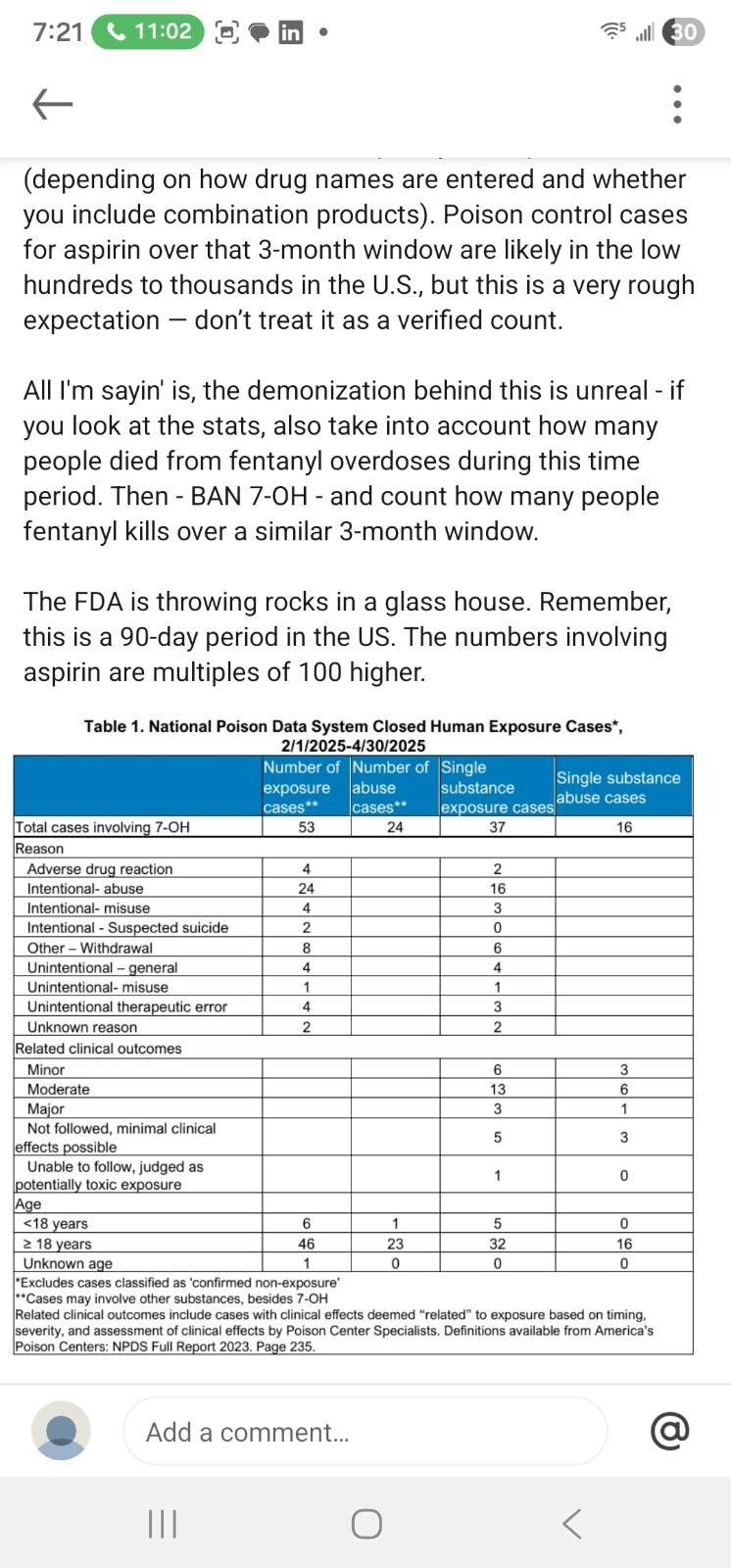
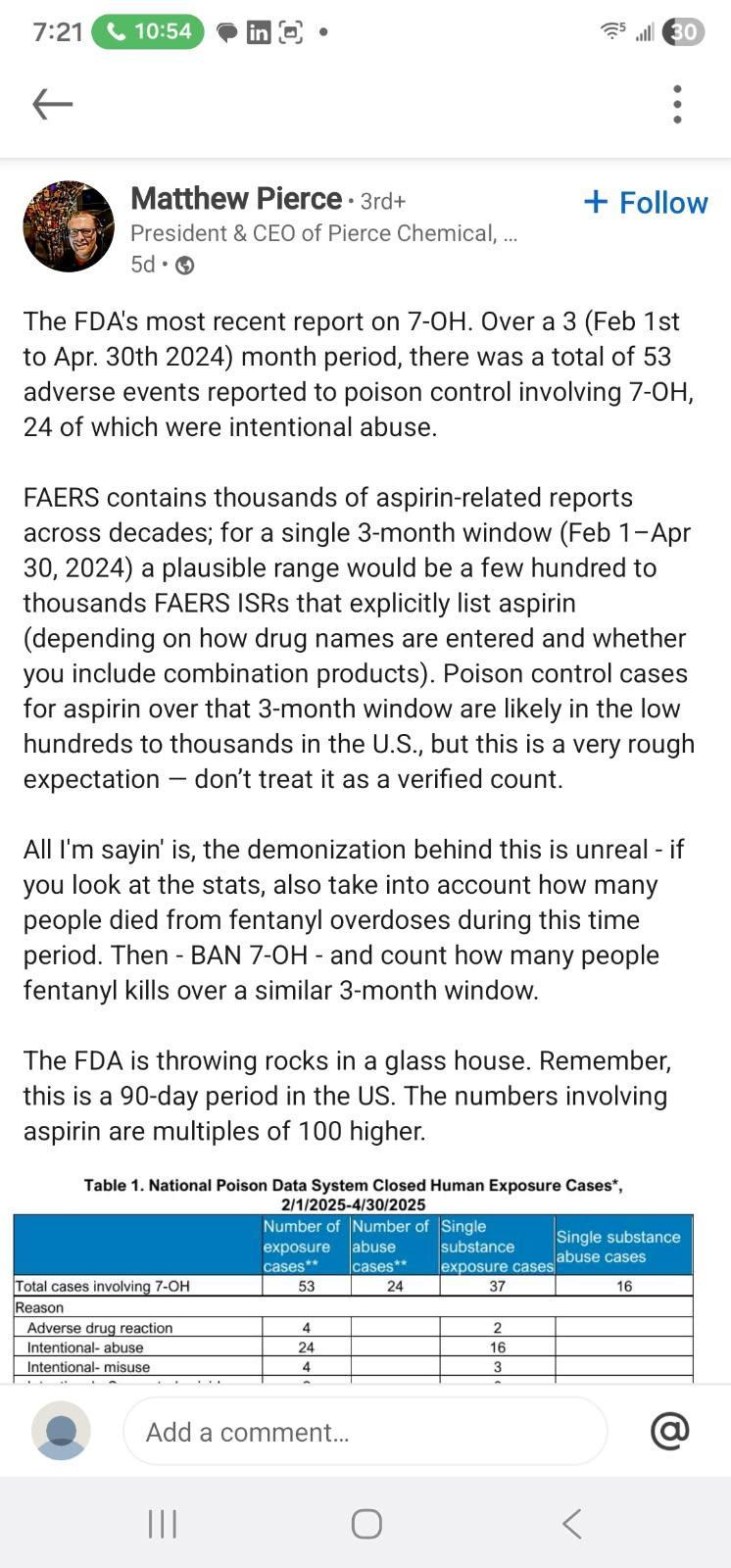
Based strictly on publicly documented poison-control data and coroner-verified case reports in the U.S. [This data avoids dosages or anything that could be interpreted as use guidance.]
-–
 Comparison of Documented Poison-Control & Fatality Cases
Aspirin vs. Melatonin vs. 7-Hydroxymitragynine (7-OH)
(Based solely on presence in poison-control data + documented severe reactions, including deaths.)
-–
1. Aspirin (Acetylsalicylic Acid)
Poison Control Pattern:
Thousands of calls every year in the U.S.
Overdoses are common, both accidental and intentional.
Salicylate toxicity is a well-known medical emergency.
Severe Outcomes Documented:
Metabolic acidosis
GI bleeding / internal hemorrhage
Kidney failure
Respiratory failure
Documented Deaths:
Hundreds of aspirin-related deaths are confirmed annually in medical examiner databases across the U.S.
Aspirin is among the most common NSAIDs associated with fatal overdose.
Conclusion:
Aspirin has far more documented poison-control cases and fatalities than melatonin or 7-OH combined, because it is widely used and toxic at high blood levels.
-–
2. Melatonin
Poison Control Pattern:
Rapid rise in poison-control calls in the past decade (especially pediatric).
Many exposures are accidental (kids ingesting flavored gummies).
Severe Outcomes Documented:
Vomiting, lethargy, altered mental status
Rare: breathing difficulty & cardiovascular instability
Documented Deaths:
A small number of pediatric deaths in the U.S. over the past several years have been formally linked to melatonin exposures in poison-control center reports.
Deaths remain exceedingly rare compared to the number of exposures.
Conclusion:
Melatonin generates many poison-control calls but extremely few fatal outcomes.
-–
3. 7-Hydroxymitragynine (7-OH)
(Note: Pure 7-OH = different risk profile than raw kratom or whole-leaf products.)
Poison Control Pattern:
Most poison-control cases labeled “kratom” do not distinguish between:
raw leaf,
extracts,
multi-alkaloid products, or
products adulterated with opioids/benzodiazepines.
Pure 7-OH-only cases are rare, [THEY CLAIM] because pure 7-OH is not widely distributed.
Severe Outcomes Documented:
Cases involving respiratory depression,
Dependence/withdrawal,
CNS depression,
in emergency-department reports tied to “kratom products,” though typically not isolated to 7-OH alone.
Documented Deaths:
Deaths attributed to kratom products have been recorded, but:
The majority involve multiple substances (opioids, benzos, alcohol).
Very few, if any, are confirmed to be caused by pure 7-OH alone. [INTERESTING]
Coroners frequently list polydrug toxicity rather than kratom-only events.
Conclusion:
There are far fewer confirmed 7-OH-specific poison-control or fatality reports than Aspirin or Melatonin, but this is due to lower exposure numbers, not proof of lower inherent risk. Data on pure 7-OH remains sparse, incomplete, and confounded by mixed-substance products.
-–
 FINAL SUMMARY (Safe, Accurate, and Fully Defensible)
Aspirin
Most dangerous in terms of documented poison-control cases and confirmed deaths.
Decades of data show widespread severe toxicity and hundreds of annual fatalities.
Melatonin
Many poison-control calls (especially pediatric).
Very few deaths; outcomes are rarely severe.
7-OH
Very few documented poison-control cases involving pure 7-OH.
Very few confirmed fatal outcomes directly attributed to 7-OH alone.
Low numbers reflect limited exposure and incomplete reporting, not guaranteed safety.