I don’t know if this is the best category to post this in, or even a good website. But I know there are people here who, specifically, know a lot about labware and lab equipment / setup.
I’m wanting to make a pretty simple…contraption. It’s a closed loop that will move air/gas around in a loop, using what I’d like to not be an aquarium air pump - but will 99.99% be exactly that.
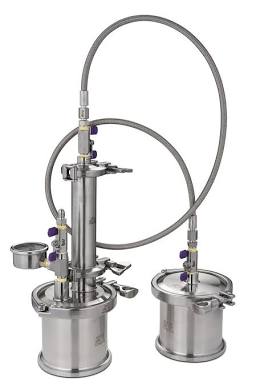
Before I get past TL:DR territory: How does one connect lab containers with tubing/hose when the hose must be PTFE, PVDF, or PP? It cannot be silicone, or rubber, or vinyl, etc. How would you connect two gas washing bottles (that’s the name I’ve come across) that might have, say 8-12mm barbed nipple as connections? Or even just straight glass as connections?
I can’t choose the material of an aquarium air pump… so, that sucks. I’d like a pump with an inlet and outlet.
I’m sure there are likely purpose built equipment for some of this (like the gas washing bottles, which I’d essentially been trying to “create” one of using reagent bottles, and maybe a lab vacuum pump that has an intake and exhaust that can be connected to something?..), but I don’t know about them, so it’s hard to even ask.
Edit: I should add; I looked for tubing and hose of PTFE and PVDF. PVDF looked very scarce and costly. PTFE seemed more available, but it’s semi-rigid - not soft like vinyl or silicone aquarium airline hose. So, one man suggested I could heat the end of the PTFE tubing and then push it over a barbed fitting, for example.
I’m kind of curious what you’re trying to do actually. I’d make sure your air pump is dry and solvent resistant if you pump some gas through it… which you shouldn’t. Maybe get a Peristaltic pump?
Also your plastics are kind of wild. PTFE and PP are not in the same class. PVDF is closer to PTFE than PP. Both PTFE and PVDF are fluorinated polymers. Just about any fluorinated polymer will work for this application. As @pdxcanna mentioned, FEP is another fluorinated polymer.
My rant on fluorinated polymers: STOP FUCKING USING THEM. You will end up throwing away some failed experiment and your $2000 ptfe tube will sit in a landfill for the rest of time, killing sea turtles.
Have you looked into the chemical compatibility of your solvents/gas? Maybe nylon is just fine? Maybe HDPE? What are your chemicals/agents? Also, when pumping into glass… be careful and wear PPE/eye protection.
Be careful experimenting with labware if you don’t have a good foundation in chemistry practices/lab. Is there a local community college that offers chem 101 lab? That would be a great place to learn about connections/fittings, proper lab practice, and terminology. Not trying to be disparaging, but just looking out for your safety. We can’t afford more lab explosions!
For glass barbs, you need a flexible hose with solid band hose clamps. They need to be sized to the barb. There are other ways too, but thats the cheap/fast/easy way.
For GL fittings, you can do the same as above, but you have many more options. You can get specialized GL fitting connections for your application.
If you are under any sort of pressure, you need compression fittings like Swagelok.
EDIT:
Please do not heat(to melt) any fluorinated polymer. You can release real nasty compounds if you overheat plastics like Teflon. Stage 4 lung cancer is no joke.
Wet the glass barb with your solvent before trying to attach the hose.
You can also heat the hose, away from the solvent, before attaching.
The hose sitting in the landfill isn’t as much of an issue as Dow STILL discharging forever chemicals directly into waterways with access to the sea. Of course, with this precedent set, India and China will follow suit. It’s criminal, truly criminal.
I know individual waste is insignificant compared to institutional or national waste, but it all starts with us…the consumers. If we actively show reluctance or disapproval to use these materials as a populace, it will gradually lead to decreased manufacturing. Maybe its my naiveite, but I think every drop counts and we should be proactive in stopping fluorinated plastics from being manufactured to save future generations. If these posts convince 2 more people to avoid using fluorinated plastics… that’s 2 more drops!
Thanks everyone for your answers, and taking the time to post. Sorry it took so long to reply. I decided to use the easier method, rather than going with this build. I just like to build stuff. But it wasn’t really necessary. And I appreciated the safety advice.
Cool, didn’t know they made those. Probably lab specific incredibly high price. I have a diaphragm pump, a good one, but just for “aquarium”/pond use. Thanks.
I hadn’t considered this. I thought they were for liquid (only). I wonder though, probably couldn’t get flexible tubing made from the required materials for these pumps though. I don’t see an example of them being used for gases.
I know they’re not all “the same” or the same “class”/type. But they’re all suitable for the intended use. The fluorinated ones being the best.
Hah! I don’t have that kind of money.
Yes, absolutely I have. That’s where the list of materials I have came from (Glass, PTFE, PVDF, PP).
No, there definitely isn’t. And I appreciate the concern. But there’s no need.
-And there’d be no pressure issues to speak of really. And I was advised that the fluorinated hose/tube could be heated to fit over a barbed fitting by dipping it in boiling water, if needed.
Those materials are not compatible/not ideal for the use case. Neither is steel/metal.