also using a huber cc902
Soo….you’ve got a Huber on your solvent tank, but no thermal probe in there (right?), which means you don’t actually know what is going on in your solvent tank.
I highly recommend solving that. you can use pressure to figure temp, but you have to make some assumptions that are often invalid. Eg no N2, or “known blend”.
If it is moisture in your chiller fluid, and circulation has slowed because “slush”, chiller will read same temps as always, but solvent won’t be getting as cold.
It’s often easier to implement a temp probe on the solvent injection side. also recommend. Such a sensor may have alerted you to the issue sooner.
A refractometer will at least tell you where your heat transfer fluid is. Unless of course you’re going the MeOH/EtOH route, which I advise against. I suggest you let the system thaw then circulate for a bit before sampling.
You might also just try a flow test. open the system at the return line and time a bucketful. The chill and repeat. Possibly at various temps. You would then know what “right” was and could check that off the list next time this happens…
Edit:
For $35k it should list flow…and raise its hand if things get slushy. Are you using Huber’s fluid? Not certain the refractometer will solve it. you’ll have to dig that part up.
Unless you have lost the lid, it should take quite some time to pull water into that chiller. Still sounds like the most likely explanation.
5 Likes
LMFAO I agree with you on everything and yes no probe to actually know my temp of actual solvent and solvent tank. And yes temp on chiller kept reading same temp so I was confused. I also have been using the fluid I got from huber. I was wanting to get more of it but its pretty expensive going through them.
also how would I go about adding a probe to injection side? And any ones you’d recommend?
1 Like
You can just add a T inline with a thermo probe on one port. If you are running swagelok parts we have all the pieces available including probes and readers. You may need adapters with other types of fittings but it’s all pretty painless to source.
6 Likes
thank you @BizzybeeTeam: exactly who I was gonna call in…
see also: Any Way to Measure Actual Inline Solvent Temp?
…and this (tee) is how I got at solvent and collection temps via the 1/2" compression fittings on the bottoms of the tanks. NOT a stock swagelok part.
you can purchase bored through fittings for thermocouples from a variety of vendors. eg
8 Likes
That fitting is awesome! We typically run reducers but that’s nice and sleek.
3 Likes
Yeah, reducers like this absolutely have their place (almost anywhere!!)
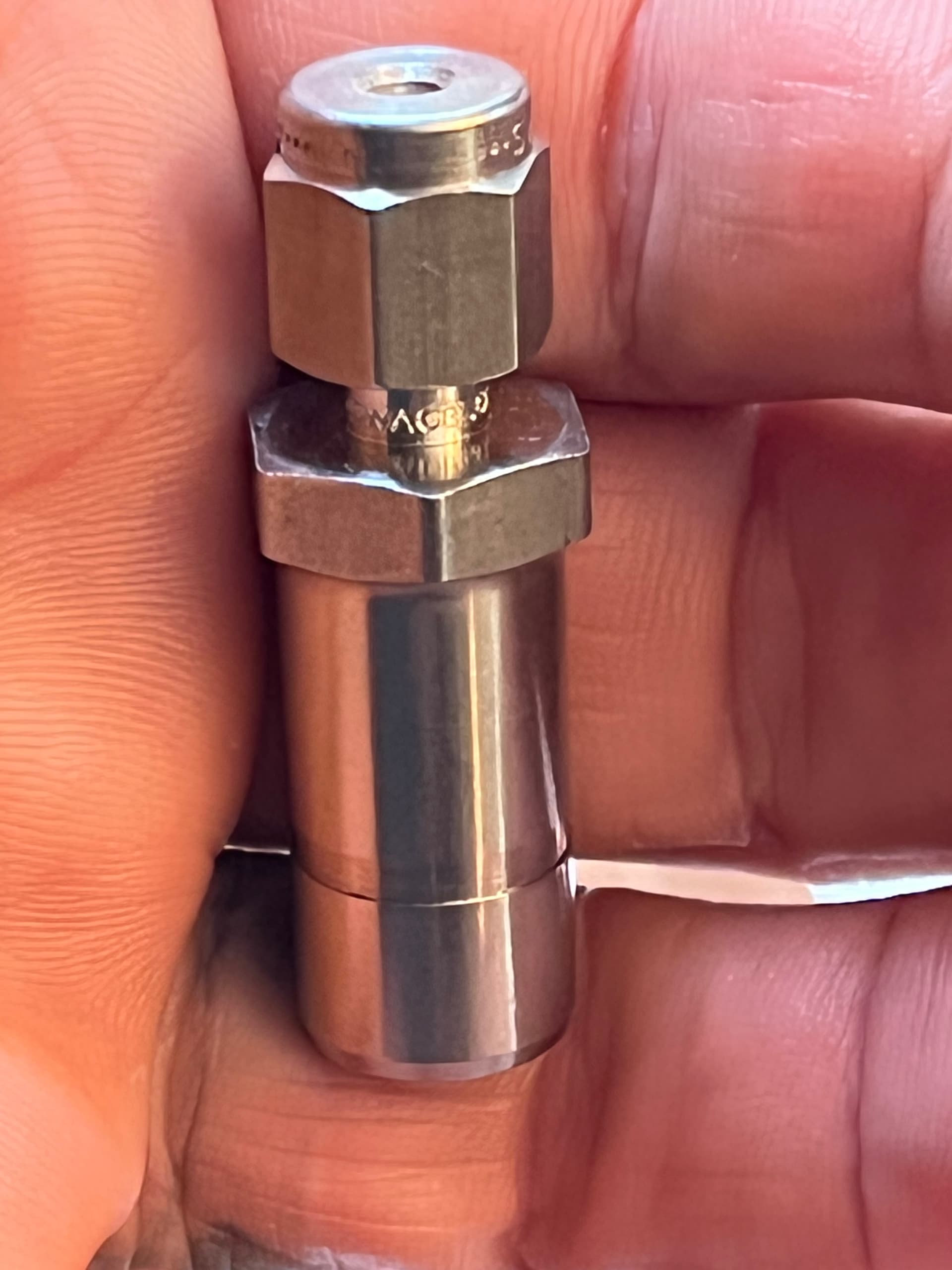
you can get the 1/8” compression x npt for less $, so where I was taught (chemistry machine shop), you either drilled and tapped or machined then welded the fitting anywhere the researcher wanted to put a probe. Usually as a retrofit.
for the fancy tee above, I think I used a 1/4 x 1/8 reducer similar to the 1/2x1/8 in my hand. Machined a flat spot, drilled a 1/4” hole. shortened the fitting on the lathe, then handed them off to my mentor to weld.
10 Likes
That’s super cool, really clean execution also! That’s such a great background to have for this industry. You sir, are a boss!
5 Likes
Damn you guys are awesome! Im gonna run through some options and see what I come up with.
These guys have good gear at good prices…and they will answer your questions.
2 Likes
When nitro makes its way into the solvent tank, you gain pressure. Either bleed the nitro from collection before recovering or crack a bleed on the solvent tank you are recovering into until the nitro has all passed.
Only other thing I can think, is you don’t have enough cooling(condensing coil or chiller) to keep up with the faster recovery thus some tane is coming over as gas, thus building pressure.
1 Like