Looking at pTSA in DCM for D8 results from this paper.
Did anybody try this combination?
DMC can be distilled easily having a low boiling point if I understand correctly, so there would be no need for a Rotovap?
Also, DCM could be used to deprotonate the cannabinoid and then pTSA to allow the reaction to proceed right? (Total reaction time 36h at Room Temperature)
Thanks!
if d8 is the goal why not just use heptane and ptsa?
dcm is a real pain in the ass. and yeah youd probably still need a roto vap. and honestly a cold trap on that rotovap too since some dcm is going to blow right by that condenser.
Does anyone on here have a lot of experience with large amounts of DCM?
2 Likes
Basically searching for a SOP not involving rotovap.
For small volumes DCM i thought could be removed thorough distillation with a mild heated water bath.
@Kingofthekush420 posted a paper a long time ago that compares a bunch of different acids and solvents. I cant find the paper right now, but I’m pretty sure it’s got some data on dcm.
So do you not have a short path?
Cause if you do you can use that to distill any solvent. Doesn’t have to be a low BP Solvent like dcm…
1 Like
The one he posted is the same one
1 Like
It will work, but honestly there’s not really an advantage over heptane. Here’s why:
- its not very good to come in contact with and will break through your gloves
- its very volatile so you will undoubtedly expose yourself to its vapors
- its a low boiling solvent and for this reason its not a great candidate to absorb the exotherm of cyclizing CBD to d8
- its denser than water so during your quench (water washes to deactivate/extract the PTSA) your organic layer will be on the bottom instead of the top. So if you’re doing multiple water washes in a sep funnel or a reactor, youll need to drop out the entire reactor’s contents for every wash and then return your DCM/cannabinoid solution back in after every single wash.
There’s just no advantage over heptane that justifies the switch to a chlorinated solvent.
Edit: you will definitely still need to rotovap
9 Likes
Also, 36h is obscene for this reaction. There’s no reason for the actual reaction time to be much longer than 1-2 hours. Our SOP is like…45-60 minutes and truly its probably done in 15 minutes but sampling/sample prep/HPLC method makes it so I can’t realistically stop the reaction faster than 45 minutes.
3 Likes
I was going to add 36 hours is ridiculous…
And for what the price D8 is why not just buy it
1 Like
I’m in Europe and D8 is illegal here, basically for now I don’t have access to a rotovap and only to a spd.
Thought of heptane and pTSA but it seems particularly difficult to remove without one.
Oh boy. Well, you can distill solvent in a short path too.
What size batch are you looking to do? I was picturing a big reactor, but it sounds like now we’re maybe talking about a couple hundred grams?
3 Likes
Yes a 250/500ml spd, basically for personal use only.
I see. So what kind of equipment do you have for performing the reaction?
What I’m picturing is you run like 100g in a small flask on a hot plate/water bath with magnetic stirring and a condenser. Just throw everything in, run the rxn for like 2 hours at 50-70C, work it up in a sep funnel, and then just let the heptane evaporate off in a water bath until its a thick gel consistency. Then distill that.
You won’t recover your solvent, and its not elegant or what you might consider a smooth/convenient process. But ultimately, it could get you a couple hundred grams of product without spending much money.
2 Likes
Thanks for taking time to reply!
This is my setup plus 6cfm 2step pump, a 200mm condenser and a 500ml separatory funnel.
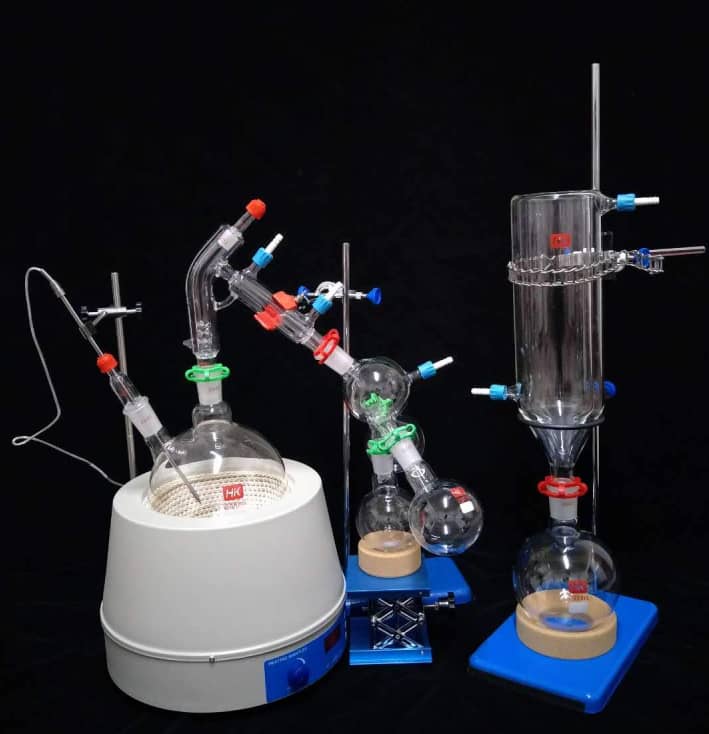
How hot should it be the water to let the heptane evaporate and could a Soxhlet do the job?
Honestly, you could do the reaction right in your boiling flask using that heating mantle. You’ll need a different condenser (Liebig condenser will work) for the reaction since a short path head doesn’t make any sense for a reaction.
If you use the mantle to evaporate off you solvent, you could just set the mantle to like 70-80C. You’ll want to run the reaction and evaporation under argon or nitrogen, you can use the inert gas to blow off the solvent faster. Same temps work with a water bath, but you’re going to have to keep refilling your bath.
My disclaimer is that this is obviously not optimal conditions for doing this chemistry. This wont be the worlds best delta 8 or yield, most likely. But I think you can get to the finish line safely. Up to this point I’ve made the assumption you’re working in a fume hood or have some lab experience - you really should be doing this in a chemical fume hood or somewhere with good ventilation, especially since you intend to just evaporate off the solvent.
2 Likes
Anecdotal note;
I have a few contacts whom did explore the DCM method.
I know of some that scaled it up as well.
Not a safe process at all using DCM, and I highly discourage ANY use of it.
There are safer ways.
Labs are rarely designed with enough CFM air exchanges to handle bulk masses of open container of DCM safely.
Very easy situation to get caught in highly narcotic fumes/gasses.
It may sound hard to get into those situations, but anything larger than a 20L reactor really will expose you to large enough quantities to require dedicated exhaust/exchange airflow to ensure you don’t get exposed to high PPM of DCM in the air.
There are rarely any pharma/synthetic processes that use DCM, in ANY open container capacity.
Most applications using DCM are in fully closed loop processes.
Open processes are mostly limited to smaller 5L-100ml solvent bottles, opened ONLY under/within fume hoods.
1 Like
If he just wants it for personal use and only does small batch sizes, a RT reaction is a pretty safe and good route to start. You wont produce this nasty dark brown tar and you just need a stir plate and an Erlenmeyer Flask.
With dcm you can’t really go too much higher than RT anyways… but if he’s using heptane in a short path flask he should be fine doing a quicker reaction and most certainly wouldn’t produce a black tar going a heptane ptsa route.
1 Like
True. I would avoid DCM in any case. It’s not worth it.
3 Likes
Agreed it’s a rough solvent to work with especially without the proper set up, ventilation, Ppe, etc.