Nice, I love to see high PPFD for cloning!  I run 150-200 PPFD for the first few days in domes, then increase to 300 PPFD once rooted. When using domes it’s hard to run high PPFD because it heats up the dome interior too much.
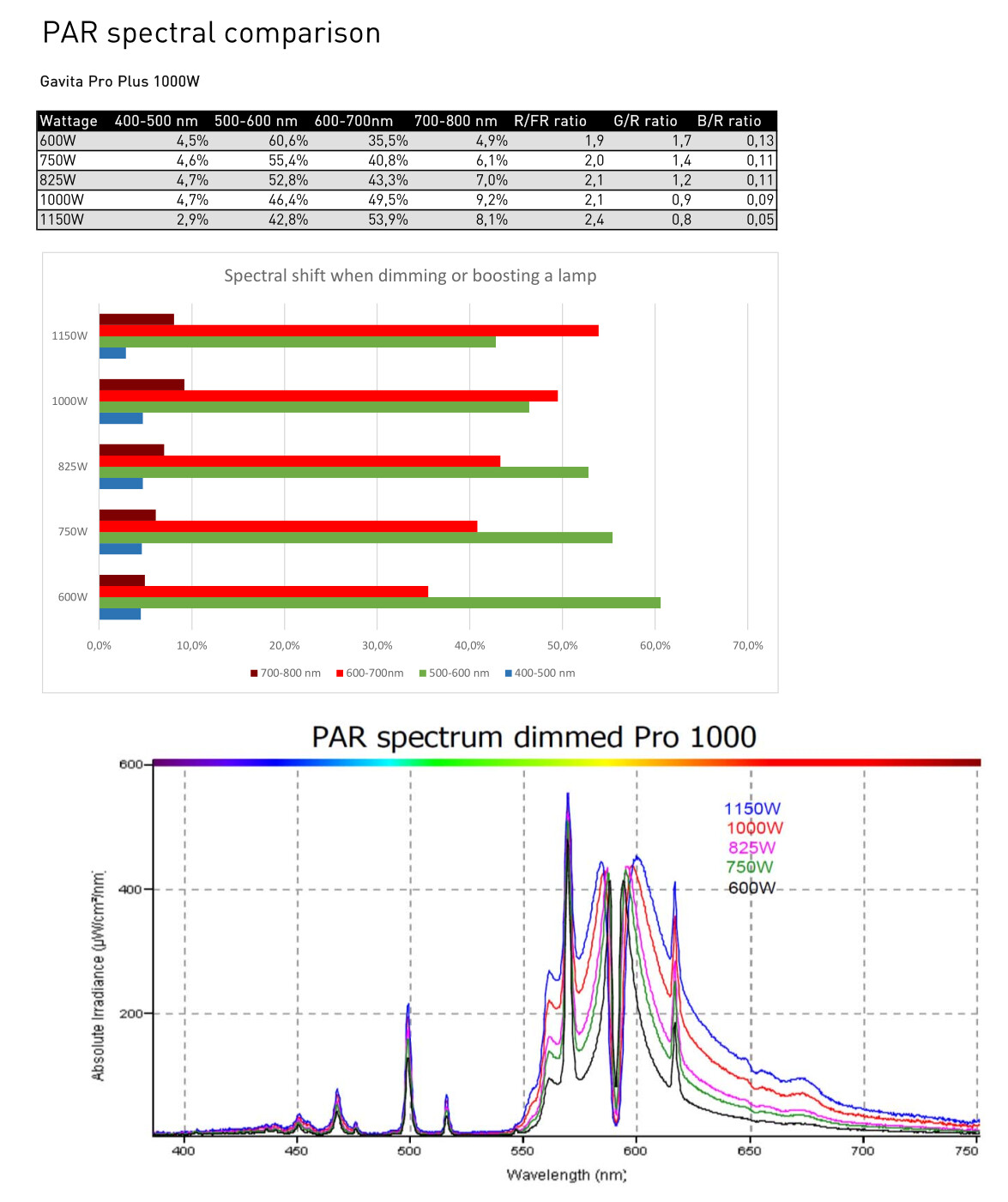
And FWIW, running DE HPS above the lamp’s rated wattage significantly affects the spectrum. It makes the spectrum redder. Running the wattage below its rated wattage makes the spectrum greener. That’s why growers shouldn’t adjust DE HPS wattage.
At 1150 watts, the Gavita lamp goes from ~48% red (other data) to ~54% red! And plugging 54% red into the equations I created for PPFD, using your listed 1200 PPFD, (1200*54/100) gives you ~648 μmol/s/m2 of red photons. That explains why you see photobleaching because many strains will bleach at >650 μmol/s/m2 of red. And, some canopy spots would have gotten greater than 1200 PPFD. So, those spots would have received >700 μmol/s/m2 of red, which is very likely to cause photobleaching.
For comparison, at 1000 watt, ~48% red, and 1200 PPFD, on average your canopy recieved (1200*48/1000) = 576 μmol/s/m2 of red. So, even at spotes with higher PPFD, the red μmol/s/m2 was likely below 650.
One critical environmental factor most growers underrate and don’t measure is air speed voleicy. At high PPFD, it must be at least 1 m/s at the canopy, but 2 m/s is better. And intracanopy must be >0.3 m/s. Otherwise, the leaves will overheat, and bad things will happen, or at least growth and health will suffer.