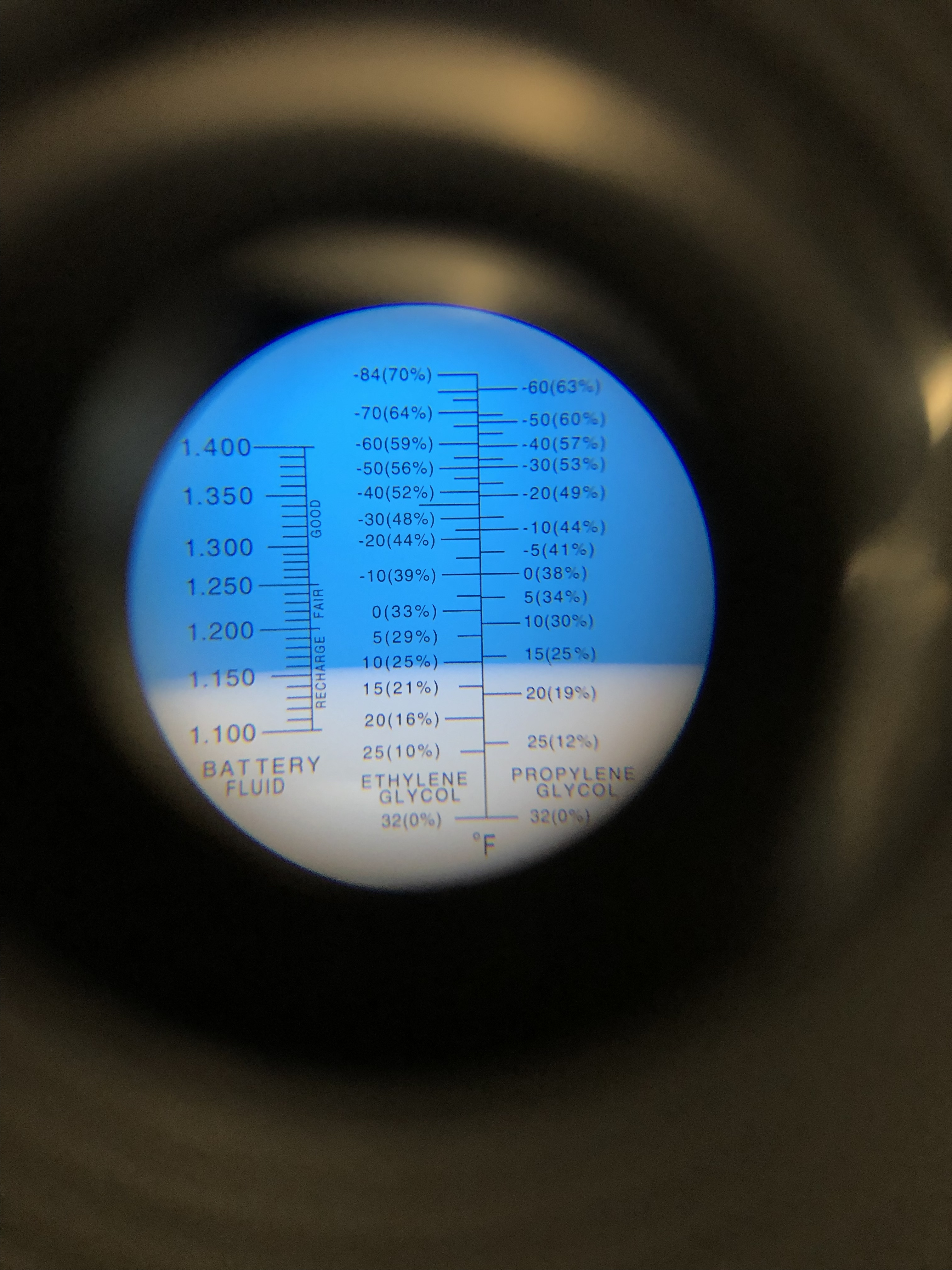
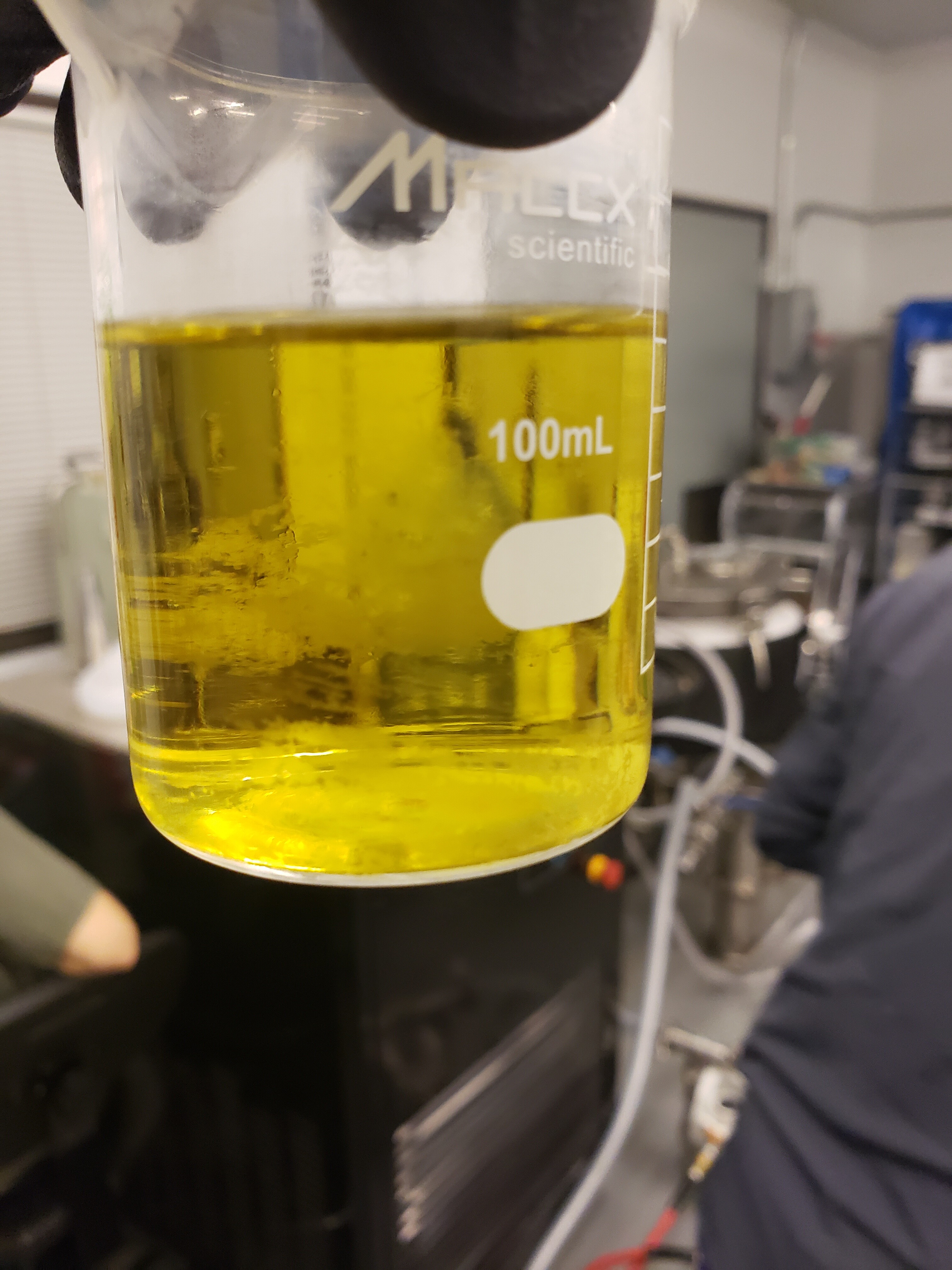
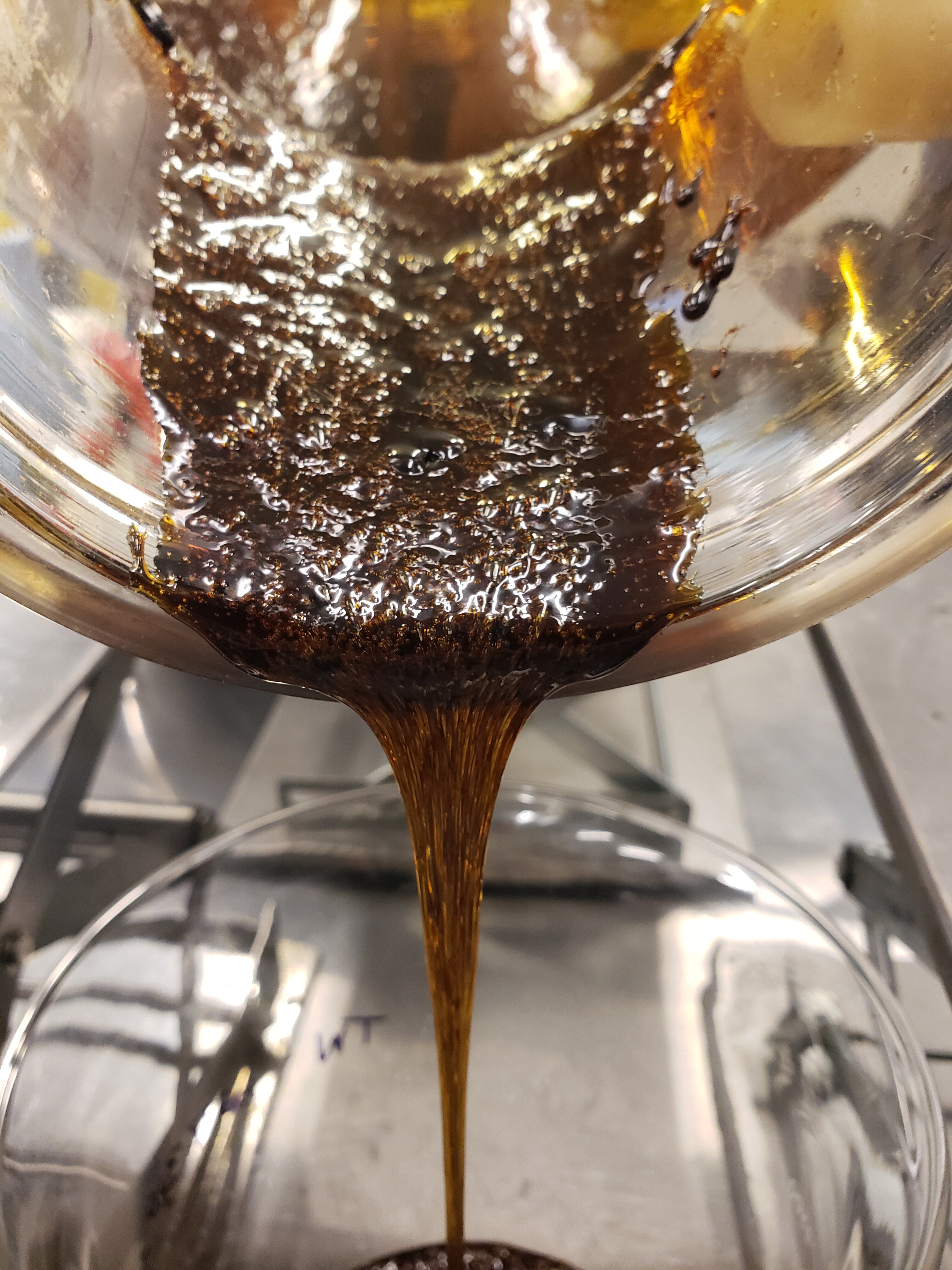
Looks like I found at least part of my problem, it was usually throwing the fault right around -8c and this mixture of prop glycol should start to freeze around 8.3c but I assume the contact points in the chiller are actually quite a bit colder than the reading at the output of the chiller causing the solution to thicken up and restrict flow.
I’ve also noticed when the temp drops to around -8c right before the low suction fault gets thrown the pumps also stop flowing as fast. They usually run around 35-38gpm and they usually drop to less than 25gpm. The chiller calls for a minimum of 30gpm.
We finally got all of our parts and did our maiden voyage. Our ethanol was prechilled at -80, much colder than is necessary, but we intend to increase that temp once we collect data from the initial runs.
We are using two diaphragm pumps from sambocreek and a jacketed chinese fuge with a triclamp CIP spray ball that we had welded on. We set up a circuit using a 35gal drum (all we had) and we balanced our outlet to push beyond our inlet. We put in about 4500g of biomass and 10gal of EtOH. Then we set our fuge to 1600rpm and ran for 5 min.
Post run we definitely had full saturation of the biomass/bag and it didn’t appear to flood the fuge. We definitely need to make adjustments to our plumbing, but all in all it was successful.
I might have to do some experiments like this as well. I usually extract at -80C in the cup15 the classic way but I do have a CIP spray ball attached that I will rinse my biomass with clean ethanol several times during the spin dry cycle as I’ve noticed that helps to significantly pull out some residual THC.
I’ll probably also start at -80 and see how this works. Instead of recirculating the ethanol is there any reason why I wouldn’t want to just run 10-15 gallons of ethanol through the biomass and right into a collection keg so it’s all only going one direction instead of recirculating? Doing it that way with my current setup looks like it’s going to be easier and require less reconfiguration. Maybe I’ll try it anyway and see what happens.
We are using a 36gpm pump. We didn’t run full bore during our initial tests and we observed semi-optimal saturation. Once we got a reducer to plumb the outlet we ran it as hard as we could.
We had the same question, and are working on an answer. The guys in this thread have more experience running this way, buy my opinion is that a linear flow of 10-15 gal won’t result in fully saturated ethanol. Based on our observations 10gal reached full saturation for us at about 3min
Well right now with my spray valve, it would take me about 3 - 3.5min to fill the centrifuge with 15gallons of ethanol.
So if I run the cup15 on manual spin dry at 1600 RPM and let my current pump set-up pump through the CIP spray ball into the fuge while it’s continuously draining, it would be a 3 minute extraction run.
How much recirculation time have you found works best?
I’m using 200 proof non-denatured ethanol as well. I’ll be running some potency tests doing it this new way vs the way I have been and I’ll potentially send out some samples for some other analysis as well, including residual THC left in the post-extracted biomass.
Is there any other data that might be worth collecting that you guys would be interested in seeing that I could contribute? If we have several people doing the same set of experiments it makes sense to have multiple people collect data from similar repeatable experiments, or to test for different things to cover more variables in a shorter time.
I usually aim for 5 minutes, I suppose 3.5 minutes will probably work well. I guess your pumping is slower then. I would try and pump like 15 gpm while you’re at 5. I’m sure your results will still look good though. Basically, recirculation is necessary because I try and pump at rates comparable to the whole volume of solution.
Fair enough. Trial and error is the best teacher in my opinion. I have the ability to set up a recirculating pump system as well if I need to. I’ll just run it like this and see what happens and I’ll share my findings when I have some to share.
At the slower speed we had dry patches in our bags starting at the mid and going downwards - even when running at 800rpm. Once we increased flow we were able to increase RPMs.
We are waiting on analytics of the raffinate to determine which method has worked best.
We received the potency analysis for the raffinate (our UPLC is not in a space we can operate it) and I calculated our extraction efficiency. I am taking this with a grain of salt because we couldn’t effectively weigh our raffinate due to moisture and inconsistent bag tare weight. Also the starting biomass was tested as “Flower”, but it was pretty shakey because it was what was left over after trimming/packaging - so I don’t think the results are like=like. Anyways, here are the results in a nutshell.
Run 1: Our starting biomass was tested at an average potency ~25% for a total of 1003.1g THC / 1179.7 TAC. Our raffinate tested at an average of ~5.5% for a total of 222.1g THC / 255.5g TAC. If I’m half as good at math as I think I am that means we extracted about 78% of the THC and 80% of the TAC.
Run 2: Our starting biomass tested at an average potency of 27% for a total of 751.5g THC / 883.9g TAC. Our raffinate tested at an average of 3.8% for a total of 128g THC / 144g TAC. This means we extracted 83% of THC and 84% of TAC.
Run 3: Was an outlier that we tested just to collect data. This run was at feeding ethanol at 1/3 the max pump speed, 5 minute recycle time, and 800rpm in the fuge. We knew it didn’t go well based on saturation, but we sent the samples off anyways. Starting biomass had an average potency of 25% for a total of 813.6g THC / 947.7g TAC. The raffinate had an average potency of 18.8% for a total of 732.4g THC / 806.6 TAC. This means we extracted 10% THC and 15% TAC.
In conclusion, I think my starting biomass results were a bit higher than what was actually in the material and it definitely does not pay off to run this process slower. Run 3 was immediately re-ran under adequate process parameters as we could tell the EtOH was not saturated.
We are waiting on our oil to come out of the rotovap so that we can test it and trace all of the THC (our ASE 100 is a POS). Once we have the oil results I will do a mass balance and see what we actually recovered. I hope this information helps somebody.
For reference, we were able to get >=99% extraction from biomass to solvent. The raffinate was testing at close to ND IIRC.
I don’t remember the exact parameters, but that was on something in the [400…600] g range of input material at ~6% THC with I believe [45…90] seconds of recirculated solvent flowing at [10?] LPM and something like [-20°…0°] C, and 1L solvent per kg input final rinse.
Sorry for the fuzzy details, this was many moons ago.
I definitely think with slightly warmer solvent we could get a better efficiency (-80c). We failed to do a final rinse, thank you for reminding me. That will definitely improve yields.
I tried this a few times and quickly found it was not the right way and you will either use a ton of solvent or you wont pull the majority of the goods. I suggest finding the minimum amount of solvent you can recirculate and then do a final spray with clean solvent at the end to keep solvent volume down.
The theoretical ideal is that you do something like this:
N kg batch size
Extract with N*[2…10] L recirculated solvent
Rinse with N L virgin solvent - or less if you’ve got the analytical tools required to determine the proper fraction of N for your application - Your solvent tank now has N + N*[2…10] L solvent in it
Send N L solvent to solvent recovery - Your solvent tank now has N*[2…10] L solvent in it again