I did a consultation with @MagisterChemist to do what you are talking about. He is probably one of the most knowledgeable people out there on the use of membranes in this industry. Highly recommend his services.
5 Likes
I think your process could benefit a lot from a THCa detector. You’ll be able to modify your recipe in the moment. I’ve got a white paper coming that is going to make the case for extracting with saturation points visible.
4 Likes
@ddec6 Appreciate the recommendation, do you happen to have any data to exemplify your difference in extraction efficiency pre and post membrane usage? Or how your recovery rate has changed?
@alexsiegel It 100% would. I am a huge fan of your work and I definitely see the value in the THCa detector. I highly respect what you are doing for the community, and I hope to make a strong case to acquire one at some point.
3 Likes
After running and designing smaller setups i have to say this sounds interesting. im in industrial ethanol so im not looking to steal ideas. i run some cryo 10lb tubes on occasion for head stash but not interested in any other projects aside from CO2. i would love a pic
Keep in mind, the hydrocarbon system is HUGE! It does, at the smallest level, 10 lb/min and scales up to many 100s of lb/min cheaply. I’d make a smaller one, but there just isn’t any – that’s as small of membranes as they make.
So, for the “average” butane system, eliminating CRC doesn’t look like a huge economics, but the scaling factor is very significant.
Also, CRC absorbs terpenes and changes the flavor. With membranes, nothing gets absorbed, just passed into the permeate maintaining the original ratios.
Now, what you write about temperature is all very true. You can run warm and yet get a result similar to if you had ran cold. I had always thought of this more from the other direction, that if you don’t need to get cold you can prep runs faster, but it’s also true from the other angle, that if you never cooled down, you also don’t need to warm back up to do recovery. So really you’re improving the speed from both ends. I suppose I thought about the cooling side more because big heaters are a lot cheaper than big chillers.
As far as efficiency, at one point in the ancient past I used BHO as a distillate feedstock (this was when distillate still went for $10k a kg), and I did exactly what you said, squeeze every drop out with warm extraction and then use various remediations to get it up to snuff for distilling. This was before I ever touched a membrane, but I frequently made 99% TAC distillate with this method (in fact, my very first post on Future4200 was on this topic).
6 Likes
I’ll post some as soon as I complete the new setup.
I do all my extraction at 40°F and my recovery rate is 85%. That is with pre and post testing the biomass. My recovery rate is currently 33 lbs min with pure n-butane. The membrane setup uses a separate solvent so it doesn’t affect the extraction efficiency in my setup.
By using a THCa tracker you can eliminate the need to potency test before and after extraction. You’ll be able to tune your run in real time and respond to more THCa without the issues with homogeneity and cost to do LC potency testing
1 Like
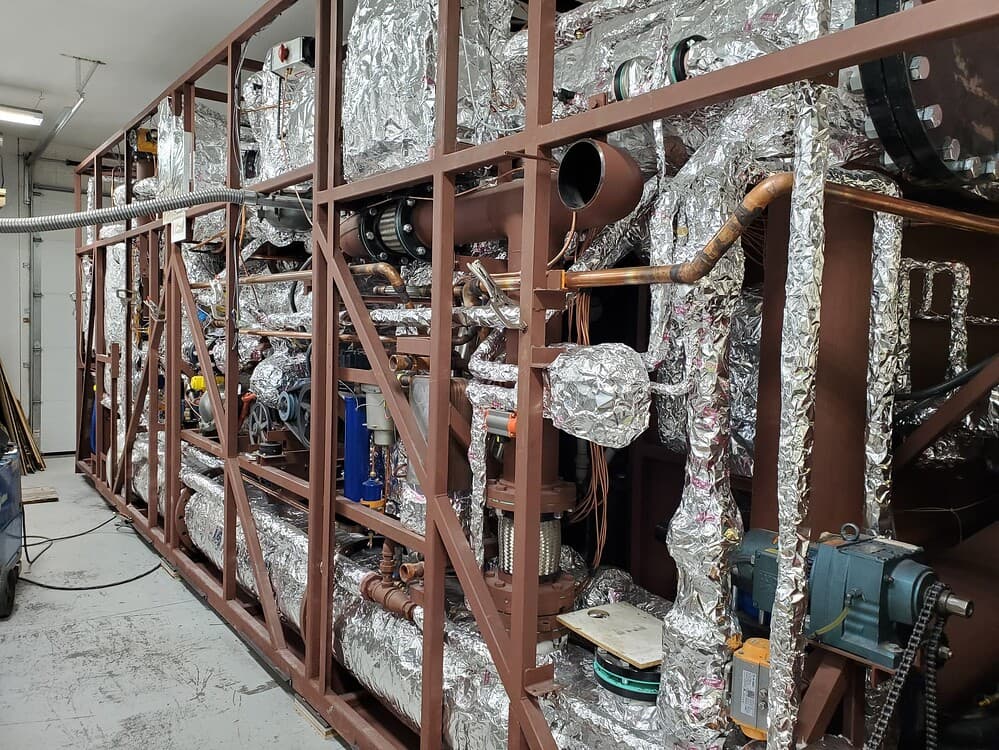
Super cool build. This feels way closer to a continuous process plant than a normal/typical hydrocarbon extractor.
Can you break down the flow from hopper to crude tank in simple terms? I’m really curious how the soak section, auger, rinse, solvent removal from the biomass, drying gas loop, recovery side, and condensers all tie together. Any more pics you feel comfortable dropping would be wonderful.
Also curious what your background is, because this doesn’t look like something built by someone thinking only in standard extractor terms.
1 Like
Thank you. I’m an inventor and armchair engineer. When I was asked if I could build a machine that is continous and automated I wasn’t even familiar with how the hydrocarbon process was currently being done. I designed the process to be as hands free as possible. Most of the current “automated” processes are electronically controlled valves given the current equipment was never designed to be automated. What I did was the old GM clean sheet design. I think Illuminated extractors is probably the most advanced system for sale out there and the machine I build is nothing like there’s. I’ll dm you some more pics and details shortly.
4 Likes
I appreciate the kind words…
We should at least talk a little bit because what you created is pretty cool and might have some solutions already built in that we might be looking for in the future…
My behemoth r800 can process 300 lb of dry bio per hour but I want to push those numbers well above that for some non-canabis processing…
I want to build our Leviathan next which is designed to do 100,000 to a million pounds a day.
3 Likes
I would definitely be interested. I have a design figure out that would be modular so it can be shop built and shipped. It would have a built in containment design just like the current one. It would be able to run 1000 lbs an hour of dry bio with a single operator. The operator is more or less there just to monitor for system errors. No socks or columns to load or unload. We have made improvements to the current machine, but are limited to a max design of 400 lbs an hour of dry bio. I’m currently working on my dewaxing membrane and isolation setup. It should be able to process 25 kg an hour. Also fully automated.
1 Like
Very cool. The clean-sheet angle makes a lot of sense now.
What were the main bottlenecks you were designing around from the start: operator labor, solvent recovery, biomass transport, drying, containment, or something else?
Also, what is actually limiting the current machine to roughly 400 lb/hr dry bio?
The limiting factor for the current machine is the physical size. I was trying to design a system that all you had to do is load a hopper with biomass and occasionally change filters. The loading and unloading of socks and columns doesn’t lend itself to automation and is the primary bottle neck I wanted to avoid. I also wanted the system to be plc controlled. There are no valves or switches the operator controls. Lastly minimize the amount of labor required.
5 Likes
Ignore this response.
This is some fantastic work. I am super curious about your continuous feed system and think it’s some real innovation in our space. I’d love to see more pictures too! Especially of the auger- how do the seals hold up?
1 Like
Thank you. I’ll get some more pictures up as soon as I’m running again. Material selection for the seals was a bit time consuming given butane’s ability to dissolve lubricants. There are no leaks and the seals will most likely last the life of the machine. The goal is to be able to toll process from bio to iso+hte for around $3~$5 a pound of dry biomass. Also if it is fresh material the iso will be the acid forms. No decarb.
Any chance this is back up and running yet? Would love to see more pics or hear how it’s performing in real use.
Also curious how the seals have held up and how the dewax side is coming along.
2 Likes
The extraction machine is ready to go, but we haven’t been running it since I started on the dewaxing and isolation process. Progress is slow as usual, but I’m getting it figured out. Setting it up as a continuous process makes everything more complex. Hopefully will have it done soon.
3 Likes