That is a very good description and I believe I didake that distinction. There’s a great book on the evolution of the math of emergence that was developed in Los Alamos but Murray Gell-Mann, I forget the title but it’s really good
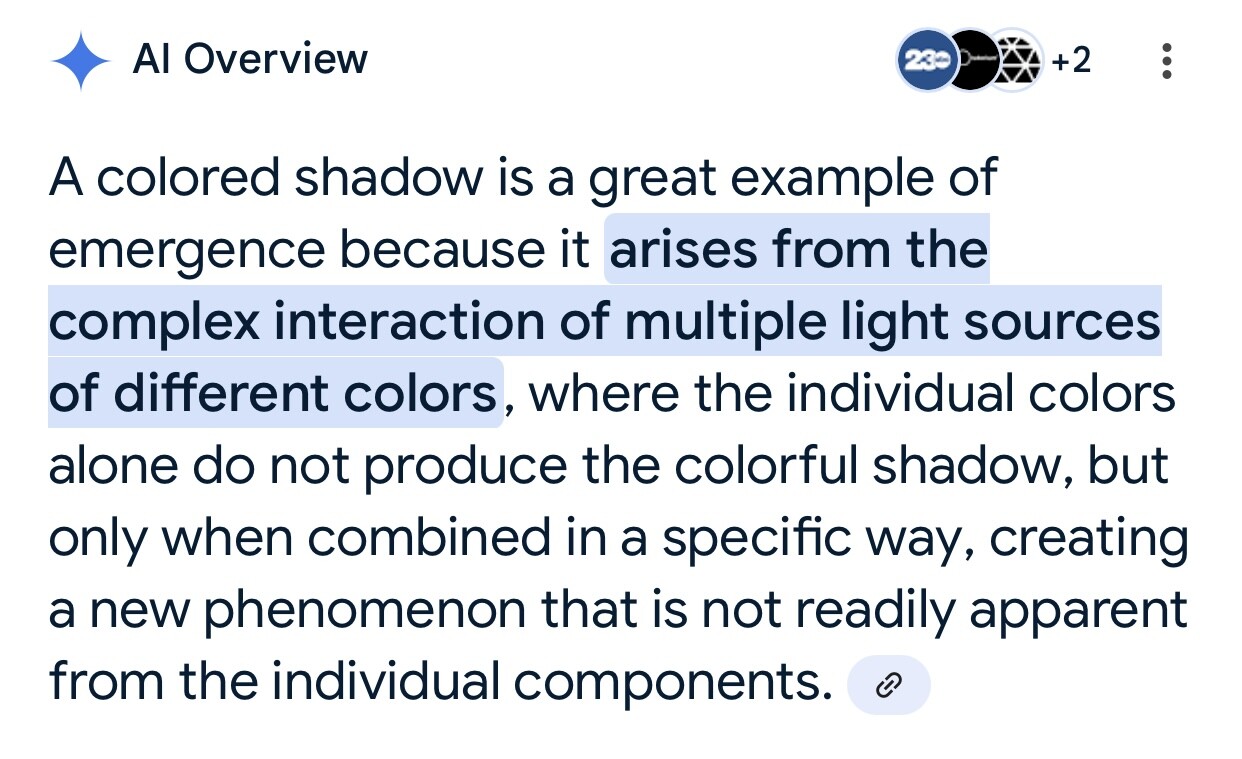
Perhaps you have a set of observables occuring in a normal 4 space. Perhaps you have a complex system doing the observation, e.g., the human visual system.
Now you ask yourself how is it I can observe colored shadows? (With humor)
1 Like
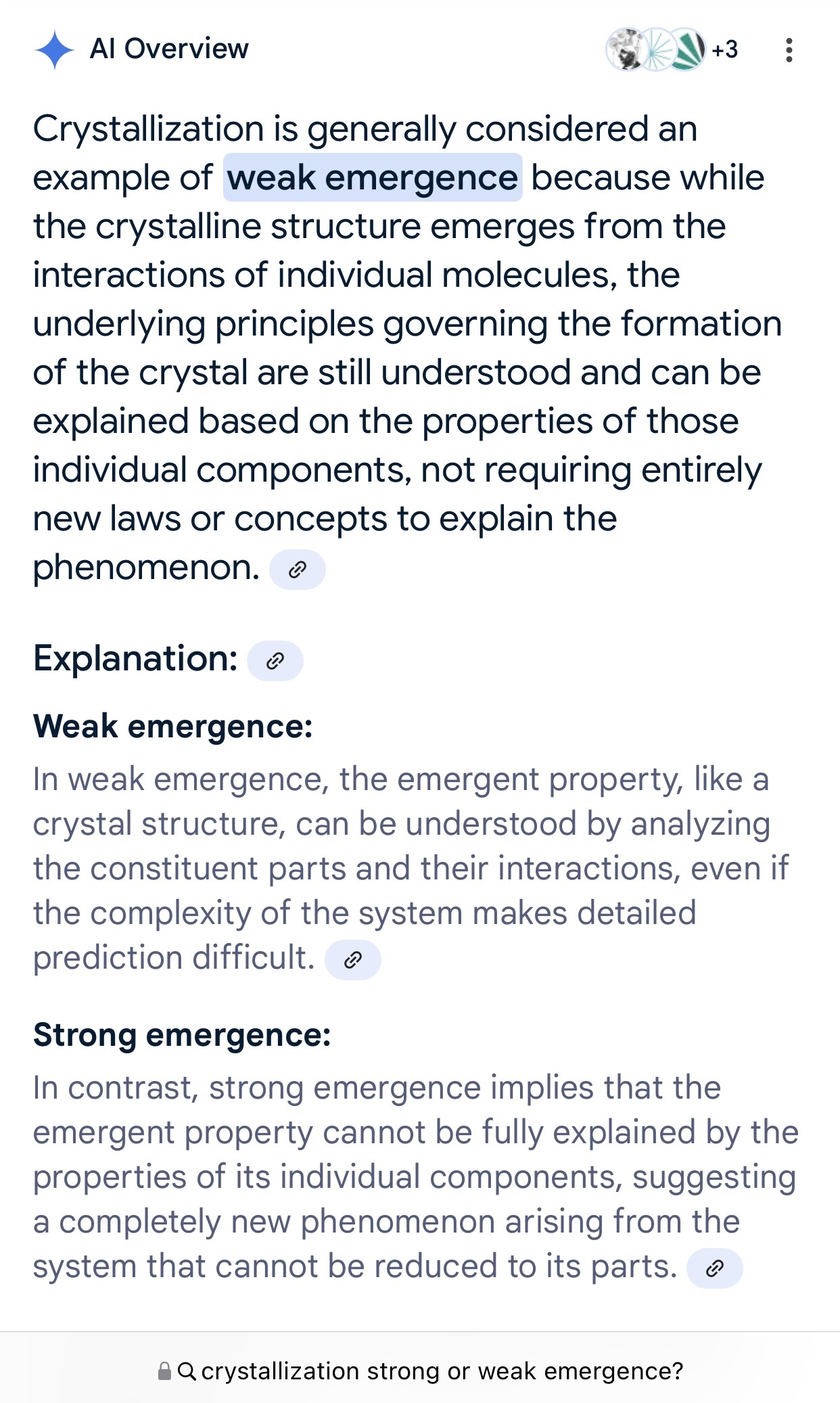
My question about complexity and the consideration of non equilibrium systems associated with crystallization being emergent , is just an query to set the terminology of the model parameters considering the dissipation dynamics associated with the crystallization process.
We have a open system and non equilibrium with associated “emergent ‘ quantities .
@cyclopath’s question concerning my total remark “Your body is running at 37C…does That answer your question. I think if you are looking for emergent forms in high dS/dt flow situations…you might find a “window” of
Temperature “allowance.” “ It is not the greatest analogy, perhaps its meaning is more obvious.?




Merry Christmas and Happy Hanukkah !
2 Likes
The emergent snowflakes are a nice touch! 
3 Likes
Yep. Not the definition I would expect a trained chemist to be using.
On the other hand, I’m a professed “not a chemist”, and the definition I’ve got is from long ago and far away.
Sure. “Non standard use of agreed upon vocabulary” could absolutely qualify as a “language barrier”.
3 Likes
Multiple words can have multiple meanings, depending on the context they are used in. The context I used it in would remove it from the one definition that means “a substance that increase reaction rate or lowers the activation energy of a reaction without being consumed” and puts it in the other definition. I didn’t realize that this thread was a venue of peer review? Granted, for peer review there is far less scrutiny than message board users nitpicking over vocab and semantics because they have nothing else really to contribute.
If you didn’t know what I meant cause I used the word catalyst no in the rigid definition of the more technical chemistry definition, then perhaps there isn’t a language barrier. Perhaps you have autism? I can’t say I"m not a trained psychologist. What I can say is many people did understand what I meant. But alas, you are the type of person, when you want to build the tallest building in the county, you build yours and knock down every other that is taller.
if you’re aware that catalysis refers to something so specific, why would you then intentionally get creative with its application when posing a question that has nothing to do with catalysis? Wouldn’t it instead have made more sense to be as literal and accurate as possible with your word choices?
If you think hardcore peer reviews don’t insist on extremely accurate verbage, you’re mistaken. If you called running a flash column “pressure/gravity catalyzed chromatography” everyone would sort of understand what you mean, and then call you out on using the wrong words.
This reads like…you knew you were misusing/stretching the definition of a technical word but @cyclopath is a jerk for saying “this question, as written, makes no sense and leaves a ton of room for interpretation.”
4 Likes
Step 1: Ask extremely vague thermochemistry type question on public forum
Step 2: Get bent out of shape when people - who are trying to understand the vague request so they can help - expect the words used to have the most common chemistry-related meaning of those used words
Step 3: ???
Step 4: Profit … ?
It’s a good thing that all things are necessarily subjective, and that it is impossible for there to be any truly objective meaning in this world.

In the interest of keeping this post at least quasi on-topic, I’ve done a LOT of practical and theoretical research into crystallization, and I’ve never come across a process in the wild that matches what I understand from OP’s description.
So… get it hot?
If you need it to be hotter and/or mitigate evaporation, add pressure?
I’d suggest staying under the critical point, though.
2 Likes
Feel free to read it that way…
I had another in mind when I said “sure, let’s call it a language barrier”.
Although if “losing one’s shit” is actually indicated by
I might indeed be on the spectrum (rather than just high functioning Australian as I usually claim).
I’ve done enough digging that I’ve run into chemistry references that were only available in German…
Don’t recall what I was looking for, but it was clearly over my head…
I’ve never claimed one needs “educated” to contribute…but I’ll absolutely stand by “we need a controlled (defined) vocabulary to have meaningful discussions”.
Provably not me…. Much fun as I find demolition, I’d far rather use the bits already onsite than start from scratch.

3 Likes
Two reasons, one, online forums tend to be more colloquial than you chemistry classroom, and for that matter, so does all of the real world, where people use shorthand cause its easier to communicate and no one has time to play the semantics gauntlet game. Two because that word literally does mean multiple things so I was using it in the least technical sense because literally the reaction starts, is initiated, or is catalyzed by heat. That is literally the dictionary definition. Also, remember I said catalyzed, I never claimed heat was a catalyst, if we want to get literal here.
I know they do, the two papers I authored had like 150 rewrites/edits I had to do. Such a pain in the ass. But at the end of the day, solar panels cause regional climate warming, regardless of any of those edits.
And yea I wasn’t misusing the world catalyzed.
This actually has me thinking now, what kind of reaction could have heat as a catalyst? Like heat gets added, reaction starts, heat is not consumed i.e. neither endothermic, nor exothermic. Probably nonsensical, but hey it’s interesting where your head goes when you have an open mind.
I understand get it hot I was asking for a more fundamental/theoretical resource to help understand from first principles. Hence the entropy mention. If you’re not aware of any reactions that go like, I’d like to point you to https://chemed.chem.purdue.edu/chemed/bodnergroup/PDF_2008/23%20LeChatelier.pdf that was posted by WhereAreTheStones. Seems like he understood what I was talking about. Weird. And even if he professed he had no clue what I was getting at, he gave me the resource I was looking for, so it seems like my extremely vague wording of a question did actually work.
I already had this “discussion” many times on this fourm. Unfortunately the empty can rattles the most is the best way to describe the junk science that comes out of some users here. If you really authored papers, post them or the DOI here. Mine are posted and easy to find.
3 Likes
lmk when you read it so i can take the link off. not super into doxxing myself, but you can vouch for me now.
1 Like
Yes, and you should now have the correct search terms to find more information if desired as well.
1 Like
yup, I do, thank you.
1 Like