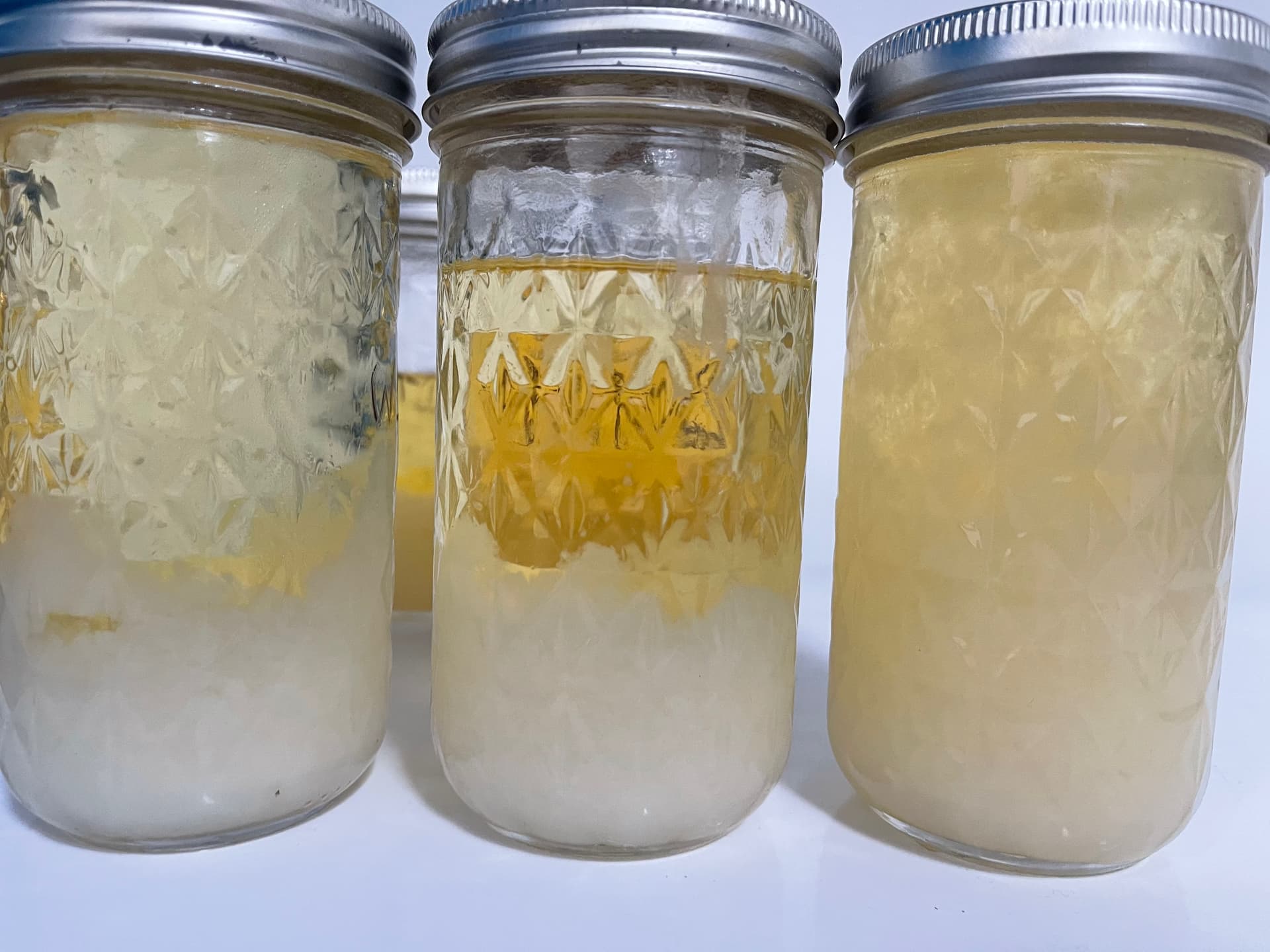
From what I’ve experienced, if I inject new gas in a miner and leave it at room temp or lower, it will drop out crystals like this overnight. They come out beautiful but turn to chalk in a day or so.
Even if I just add a little bit into the solution, it will drop out overnight. Whatever is in the new gas it causes it to drop out. Now if I use the recovered gas, it will not drop out anything. I tried this multiple times to confirm.
Now for the fast crash where it drops out like this:
I’ve never seen it happen unless I was working with isolate. Imo I think that it could be two reasons. One is that it’s happening due to ppl having an overpowered recovery side as to where the heat cannot keep up with the cooling rate of the solution and when working with high grade biomass, it can crash just like isolate does when it goes past the cloud point. The other is that too much media or silica could’ve been used and that concentrated the amount of thca by removing d9/terps causing it to happen like when I work with just isolate.
To summarize things, I’m not seeing “fast crash” extract resulting in diamonds that Medusa out after being harvested, therefore I don’t see how it could be the same impurity if so. The Medusa I can repeat by simply adding “new gas” to a solution and letting it sit for 24hrs. Have you experienced either phenomenon yourself?
Thank you for your take on this @Waxplug1 ! I am especially intrigued by your idea about the CRC potentially concentrating the THCa when it comes to fast-crash… It is entirely plausible that said F-C results vary by the extract, strain/pheno, and other variables of the essential oil being adsorbed by CRC media.
As for your medusa notes, I’m going to hazard a guess and say that your gas recovery procedure or equipment could be outgassing the impurity from your butane. This falls in line with others’ experiences indicating that the impurity may have a lower density than butane and thereby it rises to the upper strata of the liquid body if allowed to rest without stirring. Alas, without knowing more about your process, could THAT be another potential explanation for your observations?
Would you mind describing your parameters and procedures? For example, do you off-gas N2 before recovery? What temperatures & pressures do you use in each step?
I don’t see how off gassing could be a reason that I dont experience it with used gas. The solution at that point has already gone through the adsorbents when I crc and a mol sieve when I recover so it’s the same as passing it through a column of alumina prior to extraction like it’s being recommended by the others. If it’s really removing it prior to extraction like some have reported, why not just add alumina on the bottom of the crc? I use alumina on the bottom every run and if I add new gas to a miner, it will drop out rocks. Also, if I inject liquid from the new gas tank it will still do it considering what @BigM mentioned about the impurity being in the headspace or upper last part of the tank. I get the same Medusa results through out the whole tank.
Are the guys that are using alumina stopping the fast crash with it? Or the Medusa with it?
I do a passive recovery so there is at most 20-30psi in my recovery tank. I don’t off gas the n2 prior to recovery I recover along with till the end. I use a 50lb sleeved tank to recover with, once it fills up I take advantage of the higher pressure from the nitro to simply add more nitro and dump into my bigger(100lb) solvent tank. I do this by adding a tee or 3 way valve allowing me to redirect my flow from the coil to the 50lb tank or from the 50lb to the 100lb tank
Another point that leads me to believe this is the cause is because whenever I shake a solution that is at the “cloud point”, the agitation causes it to drop thca out. Similar to how the reactors work to crash cbda. Now in the collection pot for us, the solution super saturates as we get closer to the end of recovery. If we recover too fast and it reaches the cloud point due to improper sizing of the pot(not enough surface area to provide the heat energy)(and potentially injecting cold) and it’s being agitated by the bubbling of recovery, I can see how this would cause the fast crash either in the pot or when it gets to off gass/agitate even further which is in the pour out(keep in mind there is no heat being added back at this point)
i dont think my fast crash is chalk? It seems 2 seperate issues. From what i read bars form fast and turn to chalk on some vs sugar and sauce on other fast crash.
All good to note! Thanks @thumper and @Waxplug1 ! I’m taking every rhetorical anecdote into account for the hypothetical as we find remedial methods to refine the theoretical so we can find a practical aim for the empirical evidence to confirm this veritable kick in the industrial testicles!
I can make fast crash repeatable, pour wet leave the lid off you get the sand within an hour, no crc.
Try that with your “medusa gas” because I for sure have fast crash and it will do that, I haven’t harvested any stones I’ve made with this gas so I can’t confirm if those will chalk.
I can Confirm the honeypot issue is related to heat and or back pressure, I tried a recovery at 75 and it got really cloudy, not until I stopped recovering, then increased the heat to 85f and pressure built up that it melted in, I now stop collection and let pressure build to ensure its all melted then finish recovering slowly, it doesn’t help much but it isn’t cloudy at pour time.
I can get bars, or facets depending on temperature.
Leaving the lid off and allowing the gas to escape is causing the solution to not only super saturate but to also lower in temperature. This will make it crash thca out due to those factors, not due to an impurity
Fair enough, it’s just never happened for me until now it would lose its volatility once it cooled, this just keeps boiling rapidly till its all crashed or the tane is all gone.
I agree I think we should all have an injection pre filter either way. The recovery process recovers gas, terpenes and moisture as well that will go into the next run if not filtered
If I could keep it cold prior it’d work. But I do flush it through activated alumina and 13x prior to distilling. But it doesn’t always have the same efficacy for some reason.
I’ve recently heard of a grass supplier who is investigating pre-treatment of gas. The overhead is extreme. Beyond the C1D1 booth and extractor, think of the costs in clean tanks, tank cleaning for reuse, hazmat storage… Has anytime else considered this? Is it viable as a business, do you think?
At the end of the day, I’m still of the mind that bringing this process in-house is the most reliable way to assure your own solvent integrity. It kills me that cost and trying need to be added to a process that is already impacted by the difficult market. The hits just keep on coming.
I truly believe in ion exchange resins ability to pull undesirables out of a process stream. I’m hoping here in a couple weeks we will have some data regarding their efficacy in our use cases, but I wholeheartedly agree that in house gas purification will be essential to the process. Unfortuantely it will require more equipment, but ideally it will be able to be used in-line and would just be absorbed (hah) by the capex on system planning. Once OEMs get ahold of it, new units would probably start shipping with it already integrated. I know you and Graywolf and many others have stressed the importance of gas pretreatment. Hopefully the Medusa issue is what will push the industry in that direction. Maybe operators aren’t concerned about mystery oils, but they sure as shit care about their diamonds chalking up. Maybe this will be a “get 2 birds stoned at once” situation.
There are absolutely many operators like you and I that care very much about the quality and condition of our solvents, materials, and equipment, but I would wager that there’s a good bit that don’t. If they are already forced to implement something to fix the fast crash issue, I would bet they would see the value in adding other stages of filtration to the system to catch the other undesirables. Especially if it could be made easy and inline! I am super interested to know what other contaminants may exist in the gas because I definitely feel like “there’s a bead for that”!