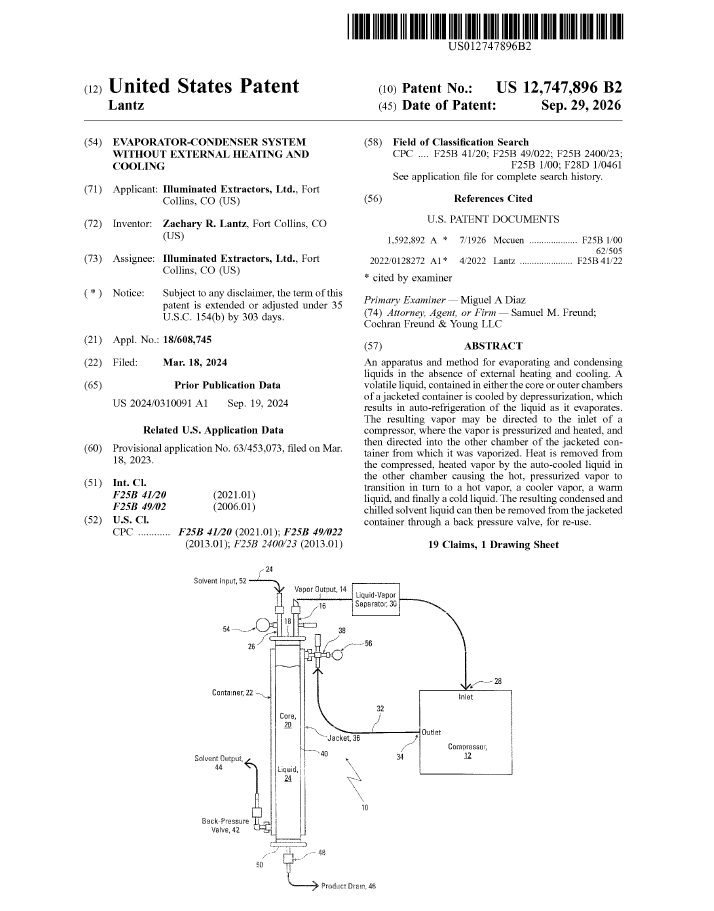
U.S. Patent No. 12,747,896 has officially issued, covering Illuminated Extractors’ evaporator-condenser technology.
Getting the grant was exciting.
Reading what the examiner actually wrote during prosecution may have been even better…
Because anyone familiar with this industry already knows what comes next:
“It’s obvious.”
We hear some version of that every time one of our patents issues.
“That’s just thermodynamics.”
“Refrigeration has existed forever.”
“Anybody could have done that.”
“The examiner just didn’t understand the technology.”
The prosecution history for our newest patent makes that argument particularly interesting.
During examination of U.S. Patent No. 12,747,896, the USPTO went all the way back to a 1926 refrigeration patent while evaluating our evaporator-condenser architecture.
The examiner acknowledged that the older reference contained portions of the architecture, but concluded that it “does not disclose the remaining features of claim 1.”
Then the examiner addressed the obviousness question directly.
The conclusion was that modifying the prior art to arrive at the claimed invention would require “improper hindsight,” and that the necessary modifications would alter the references’ principles of operation or likely render them unsuitable for their intended purposes.
The examiner’s conclusion:
“Thus, a preponderance of evidence supports the allowability of the claims.”
All 19 claims ultimately issued.
This was also examined by Miguel A. Diaz, a senior USPTO examiner who reviewed our earlier heating-and-refrigeration patent, so this was not his first exposure to our thermal architecture or the refrigeration art surrounding it.
Of course, the underlying thermodynamics are old.
We didn’t invent evaporation.
We didn’t invent condensation.
We didn’t invent compressors.
The invention is how those known principles and components are arranged, controlled, and operated together.
That is something people often miss about engineering:
Once somebody shows you the solution, it can look incredibly obvious.
The harder question is:
Where was it before they showed you?
If it was already known, show the prior art.
If you thought of it years ago, show what you built, published, patented, sold, or otherwise put into the public record.
Saying “I could have done that” after somebody else did it isn’t quite the same thing.
The examiner examined the prior art.
The examiner went back nearly a century.
The prosecution record specifically addressed hindsight.
And all 19 claims issued.
U.S. Patent No. 12,747,896
We build what comes next. 

ILLU.11USU1 - Issued U.S. Patent No. 12747896.pdf (594.2 KB)
 Now go sue fluxwerx