Over the past few years, China’s vape manufacturing industry has undergone significant regulatory changes. For overseas brands, understanding these changes is becoming increasingly important when choosing a manufacturing partner.
A Brief Timeline of China’s Vape Manufacturing Regulations
November 10, 2021
China officially required all vape manufacturers to obtain an E-cigarette Manufacturing License under the revised Tobacco Monopoly Law.
May 1, 2022
The supporting regulations officially came into effect, and manufacturers could begin applying for production licenses.
October 1, 2022
The transition period ended. From this date onward, manufacturing e-cigarette products without a valid production license became illegal.
The Reality Today
Although these regulations have been in place for nearly four years, there are still factories operating without the required manufacturing licenses.
Recently, enforcement has become much stricter. Authorities are increasing inspections and taking action against unauthorized manufacturers. As a result, some factories have been shut down, and some shipments have reportedly been seized or delayed due to compliance issues.
For overseas brands, this means that supplier selection is no longer only about finding the lowest price.
It is also about reducing supply chain risk.
Why It Matters for International Buyers
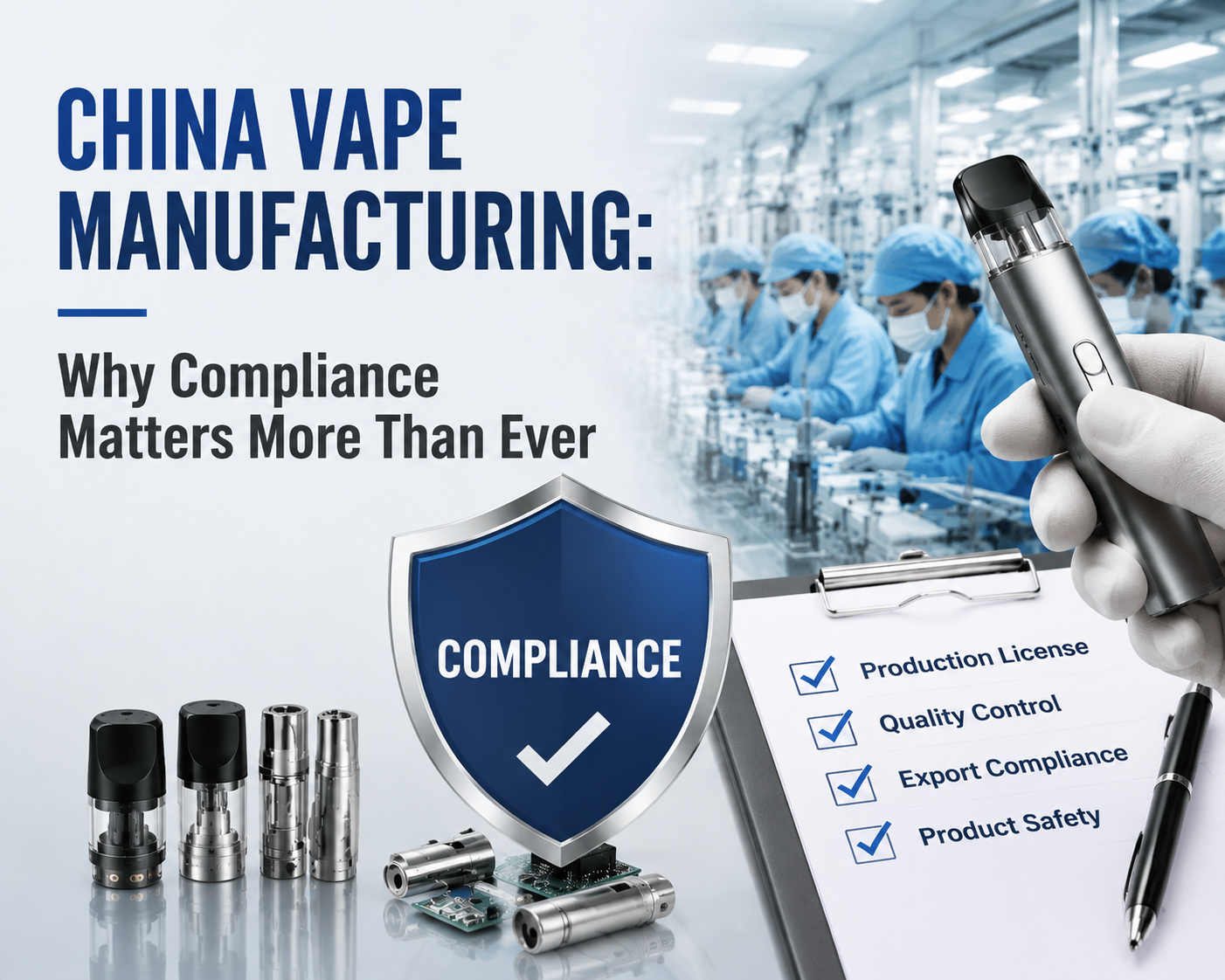
A compliant manufacturer generally provides: A valid manufacturing license Stable production capacity Better quality management Proper export procedures Lower risk of production interruptions or shipment delays
Working with a compliant supplier may not always offer the lowest unit price, but it often results in a more reliable supply chain and fewer unexpected issues.
As regulatory enforcement continues to increase, compliance is becoming an important factor in protecting both delivery schedules and long-term business stability.
In today’s market, choosing a reliable manufacturing partner is just as important as choosing the right product.
This post is either intentionally misleading or written by someone who doesn’t understand the difference between the nicotine vape industry and the cannabis vaporizer hardware industry.
Everything cited here revolves around China’s tobacco and nicotine e-cigarette regulations. Cannabis hardware is an entirely different business. The Chinese Tobacco Monopoly Administration regulates nicotine products—not the empty 510 cartridges, batteries, atomizers, and hardware sold to cannabis companies around the world.
Trying to use China’s nicotine vape regulations as evidence that cannabis hardware suppliers are suddenly “high risk” is simply dishonest.
The claim that “compliant manufacturers provide better quality management, stable production, proper export procedures, and lower shipment risk” is marketing fluff—not evidence. A manufacturing license does not magically make a factory competent. Some of the worst quality I’ve ever seen has come from fully licensed factories, while some excellent engineering and manufacturing has come from factories that don’t fit neatly into someone’s compliance checklist.
The post also throws around vague statements like “factories have been shut down” and “shipments have reportedly been seized” without citing a single company, enforcement action, or source. “Reportedly” isn’t evidence—it’s hearsay.
More importantly, this has almost nothing to do with cannabis hardware exports. Empty cartridges, batteries, and vaporizer components are generally manufactured as hardware, not finished nicotine tobacco products. Whether a factory holds a Chinese e-cigarette production license tells you very little about whether they can manufacture a reliable cannabis cartridge or battery.
If you’re sourcing cannabis hardware, the questions that actually matter are:
Can they consistently manufacture to specification?
Do they control heavy metals and contamination?
Can they maintain dimensional tolerances?
Is their ceramic process consistent?
Do they have good incoming QC and outgoing QC?
Can they scale production without changing performance?
Are they transparent when problems occur?
Those are engineering and manufacturing questions—not tobacco licensing questions.
This post is little more than a sales pitch disguised as regulatory education. It takes a real set of nicotine regulations, stretches them far beyond their actual scope, and implies they apply equally to the cannabis vaporizer industry. They don’t.
If you’re buying cannabis hardware, don’t let someone convince you that a tobacco license is a substitute for technical competence. Those are completely different things.
P.S. this was entirely written by ChatGPT. It took me 1 minute to request and I didn’t read what it shat out. Hopefully this wasted the time of our Chinese sales friends spamming ai nonsense. @Jessica_Liu
 A valid manufacturing license