The amount of random posts from people who don’t even know enough to have the right vocabulary but somehow through osmosis or some shit know enough to correct people who’ve been doing this a long time is absolutely staggering lately. The recent ones just seem like straight mental illness like the kid who worked for fisher thermosci
3 Likes
This topic is quite dead since August last year but i have a theoretical question.
Why forming in some cases the iso 4 thc ?
hi all!
I’m trying to get a stable reaction using food grade zeolite. Yes, I have read this forum and the attitude of some participants towards zeolite, but unfortunately for me this is the only available method of producing thc.
The essence of the problem:
it never gets a stable result, it feels like my mixture is a bunch of unreactive cbd, I would have given it up if I hadn’t gotten the desired sativa effect a couple of times.
I tried: different ratios, different temperatures from 100 to 175, an inert atmosphere, 10 different zeolites. Sometimes, the result is in the air, sometimes completely wrapped in aluminum foil (by the way, one forum managed to perform a 100% conversion using 150°, 30min, 1:1). In my opinion, the air does affect the reaction, but there is something else.
What I think:
- I have never changed CBD. I’m sure it’s 99% pure, but I suspect it’s the main problem. Is there a lot of water? how to get rid of water in cbd?
- I have never checked the PH of zeolite, they say it can be raised using ordinary soda, is that true?
I know that you are very smart people, so you will help me.
Let’s say I removed the water from the cbd, raised the pH of the zeolite to 9, and used an inert atmosphere. What is the time/temperature and ratio of cbd:what zeo should I have to maximize delta 9?
By the way, I’ve never tried to remove zeolite, what kind of solvent do you recommend using?
Pffff so you can get zeolite but
No hcl acid ( cement cleaner at the hardware shop )
Citric acid at the bakery division supermarket
Sulfuric acid pool cleaning equipment shop
Phosforic acid. At the agricultural or welding shop
Heating cbd to > 100C will dry it
Depending on solvent you can buy near pure calciumcloride non parfumeted as dehumidifier refill bags at the hardware shop
Magnesium sulfate for sale at the pharmacy veter known as epsom salt
Activated carbon at the aquarium /pond shop
Methanol at the radio controled toy shop ( fuel)
Ethanol at the liquor store 96%
Dcm paintstripper in Eastern European countries
Naoh at the hardware store pipe de clogging
ISO propyl alcohol at the pharmacy
Hexane heptane can be distilled from regular gasoline
Pentane / petroleum ether at the camping shop ( Coleman)
2 Likes
Sulfuric acid in heptane is how I used to make d8… was gettin up to 96-97% potency but lab wanted 98-99% so we switched over to the pTSA method. Its more cleanup but higher potency.
HCl tended to make a 50/50 mixture of d8 and d9 but wasnt able to push to completion… lots of cbd left over also. Was considering doing it as HCl vapor…
1 Like
It’s easier to buy from me.
Nearly everything in my store in german quality available.
Place a link or contact please might help some
It is not an online store, without website. Local distributing
1 Like
Did you dry ptsa to anhydrous form?
I wasnt the one running the pTSA reactions, dont think they bothered too. It was back in the day at our sister lab… They went a bit molecule crazy. If it could be made, we made it.
1 Like
tried even phosphoric acid?
Some people said it gives 50%\50% d9 d8 nearly every run. not dried
Guessing by my logic - then if not fully dried - still would be good to dry.
Tho i reeeally want to know how bad oxygen env. would affect D8 %.
My guess around like… adds + 5-15%? (I guess…)
And if dried nearly complete and with argon. Then it’s D9 fully, as one master jedi said before about phos.
2 Likes
Yeah I did phosphoric as well, similar results…
Will likely go back at it one day… Have been giving my GC an upgrade (TCD + PID + Dual coil + Selector valves). Once that is done it is time to work through the vacuum leaks on the MS since everything else for it is working. But before I can do an actual injection I need to rebuild one of my dry scroll vacuum pumps.
Ptsa or anhydrous ptsa or ptsa loaded on silica or beads is to strong of an acid to get high d9 repeatable
70% + is what I call high d9
There are some triflate acids with a bit better yield but ok non as good as
Triisobutyl aluminium and all of it s Nices and nephews
Borontriflouride
Alcl3
Or hcl gas / potasium butoxide
These are the known well yielding reagents
Adding catalyst or protection groups can enhance overal yields
Disilizane , palladium , and some others I don t remember at the moment
2 Likes
Oxigen doesn t seem to make much of a difference during reaction time
It in storage and shelf life where it s a isseu
But working dry and blanketed is always adviced
1 Like
Thank you. I red a pdf where ( in microscale) ptsa in toluene was used but not in catalytic amount but in ca. equimolar amount. Does it make sense? Just a wild idea: in this case ptsa can work as a drying component too, because ptsa is very hygroscopic…?
Alcl3 only works in dcm am i right? In my country dcm is prohibited and can not bought by a privat person.
bro i would re-watch your choice of reagent pick alcl3 - i was googling all internet and future4200 across, and it all shatters when the god itself (hi rog), says that almost none of cleaning methods relatively work, and even says he’s done with alcl3 sop. 

Big problem is after-quench. Cl-THC (chlorinated thc), and aluminum micro-(almost-nano) size fraction.
Chlorinated THC - can be removed via My first try in converting CBDP to THCP - #66 by Roguelab

Aluminum with with activated carbon CRC column. Or just column i guess
Carbon is not for Chlorine
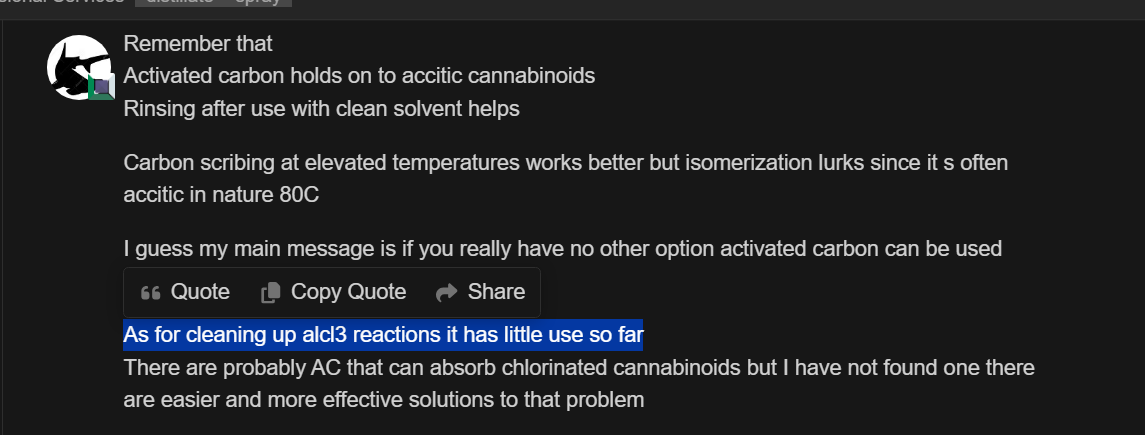
I mean, after that i didn’t need to be told twice. It’s better to use different reagent i think\ or i guess.
I heard here and there that there’s some good ways to clean it. And that people somehow do manage to clean their stuff with questionable by Masters words methods, like carbon column.
But when i ask for details on how they do it, and would it even work - they ask for money to “guide u”.
Honestly it’s not enough informed method - like. Almost any other methods - can be easily quenched without hard access reagent. Like… This potasium. That is used in…
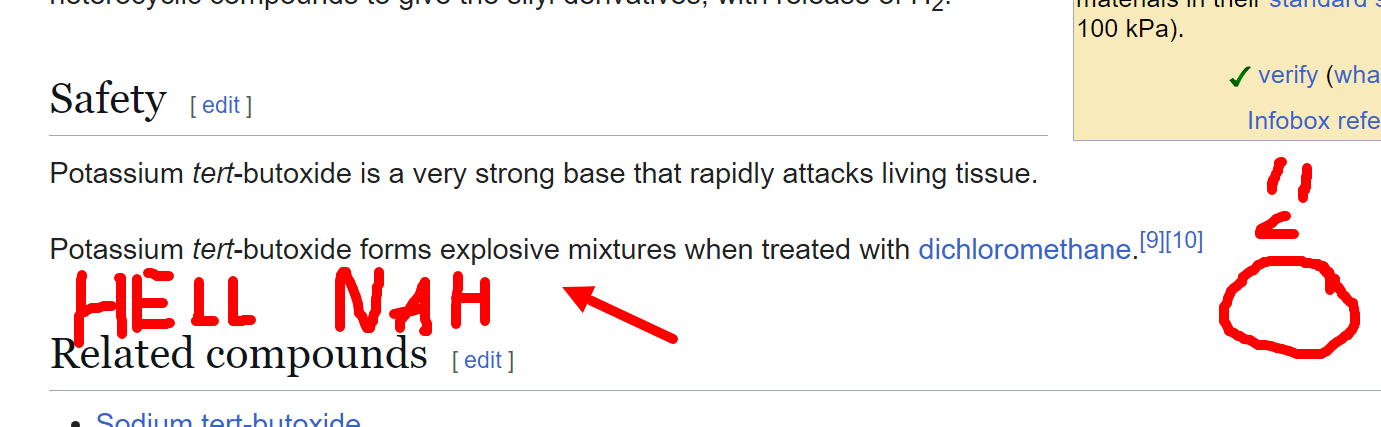
Some high tier stuff idk
1 Like
also i hope rogue is not trying to get rid of competition and competitioners by saying - go and add some potasium to AlCl3… Which is usually always in DCM (alcl3 dcm reaction)
Rogue - @Roguelab
i think you should’ve mention about this in that message.
Or i hope it’s ok and nothing to bother about.
For some frame of reference, that’s ~550g pTSA for a single kilo of THC.
3 Likes
Tolueen works as does chloroform
Pretty sure xileen should work as well
1 Like
Listen the alcl3 quench has been solved with easy accessible reagents BUT it is not my find
And I promised to not mention or offer this path way to the public
Look at dechlorination of phenols in the papers and you will find answers yes it s gona cost you some r and d or pay a consultant
I have given an example of a reagents that can dechlorinate wich is potasiumtertbutoxide or amylate
These reagents are called super bases
Final spoon
4 Likes