My experience in using butane propane mixtures in a refrigeration loop have given me results that reflect a temperature glide like the 400 series refrigerants. What little information is out there says it is a azeotropic mixture. When I ran some 70/30 mixture in a loop it had the vapor pressure of a 40/60 mixture while running which would indicate a temperature glide. While static it matched the pt charts for 70/30.
From what I understand a azeotropic mixture like the 500 series refrigerants can’t be separated by fractional distillation. Just like a 95/5 mixture of ethonal and water. I was also albe to separate the 70/30 mixture to 90/10 with distillation. Any experiences or thoughts?
2 Likes
1 Like
Agreed. My experience is the propane starts to boil off first followed by the butane. As you said not one completely then the other. Which gives it a temperature glide that gets more pronounced at lower temperatures.
A true azeotropic mixture like R507 the liquid gas composition stay the same percentage respectively at all boiling points.
1 Like
Damn I miss when this place was all about discussions like this.
7 Likes
I would assume most everyone notices that bho residual solvent tests show butane if anything even though they run a blend. Is the science as simple as precisely measuring the temp and pressure of a stable room temp solvent tank without N2 or push gas, then from an equation calculate the solvent mix % by volume?
I think about this often.
2 Likes
No, unfortunately it is much more complex than this.
The vapor pressure of a given mixture is a weighted formula of the vapor pressures of each component within the mixture. Let’s say you have two pure components in an IDEAL system (spoiler: the system is never ideal)—you’d use Raoult’s Law to determine the vapor pressure (or move backwards to determine the composition based on the vapor pressure).

Where p*a represents the vapor pressure of a pure component a at a given temperature and xa represents the mole fraction in the mixture.
If you think about the mixture in a collection pot, you have near countless molecules in there, cannabinoids, terpenes, esters, ketones, etc…
So even in an ideal situation you’ve already got an immense amount of work to accurately calculate the vapor pressure.
Now, if you introduce non-ideality to the situation, it becomes much more complicated, but that’s a book’s worth of writing.
There is a potential cheat code, it has to do with the calculation of the ebullioscopic constant—search it in the search bar, some dude broke it down at length, very tricky stuff but he seemed to have it figured out. I gave up, because it didn’t have much financial return in the grand scheme of things, but it’s an interesting topic.
6 Likes
Determining the mixture ratio looks good on paper, but isn’t practical. At STP (20C / 68F and 1 bar / 14.7 psia) N-but is @ 17 psia and Pro is 108. Those conditions can be achieved, but it would take more time and effort than anyone outside of NIST would be willing to invest.
Better way would require a precise pressure gauge and 3 tanks, one N-but, one Pro and one blend of the two made with the LPG’s in the first 2 cylinders (same chemical profile). Allow the containers a couple days in the same temperature controlled room so the contents get to the same temperature and measure the pressures of each with the same gauge. Those hard numbers can be used to calculate the % of components on the blends. Those readings create a standard.
While the components of the blend may vary slightly as the blend boils off, the top pressure in a closed system is still very consistent % wise. The pressure will vary all over the place because temperature has a huge impact on vapor pressure. In order to determine the %ages of the blend after it is boils from the extractant it needs to be transitioned back into liquid place then allowed to warm to the same temperature as the 3 cylinders that were initially measured.
Even if there are 5,000 ppm solvent residue in the extractant when processing is completed. The 5,000 will remain butane heavy at or about the same ratio of the starting solvent blend.
You can’t separate the components without fractional distillation.
1 Like
If there is any degree seperation of the two liquids during boiling even if they remix to the same ratio after condensing back it would make the mixture a zeotropic mixture. Given this is in a closed system.
Partial pressure has a major effect on the boiling point of a liquid. If the gas composition changes so will the boiling point. An azeotropic mixter will maintain the same liquid gas ratios while boiling. If its 70/30 in a liquid state it will be 70/30 in gas state.
Butane and Propane do seperate by fractional distillation. It’s how they are separated out of crude oil and from each other at a oil refinery. By all of this it would make it a zeotropic mixture.
1 Like
Yes, lowering the partial pressure above a liquid will also lower the boiling point and vice versa.
Henry’s law states that “the amount of gas dissolved in a liquid at equilibrium is directly proportional to the pressure of the gas in contact with the liquid’s surface.”
Raoult’s law states that “the partial pressure of each component of an ideal mixture of liquids is equal to the vapor pressure of the pure component (liquid or solid) multiplied by its mole fraction in the mixture.”
Dalton’s Law states that “the total pressure of a gas mixture is the sum of the individual pressures of each gas in the mixture.”
It gets much more complicated though because as Phil already stated
2 Likes
You need to understand, propane/butane mixtures do not form an azeotrope.
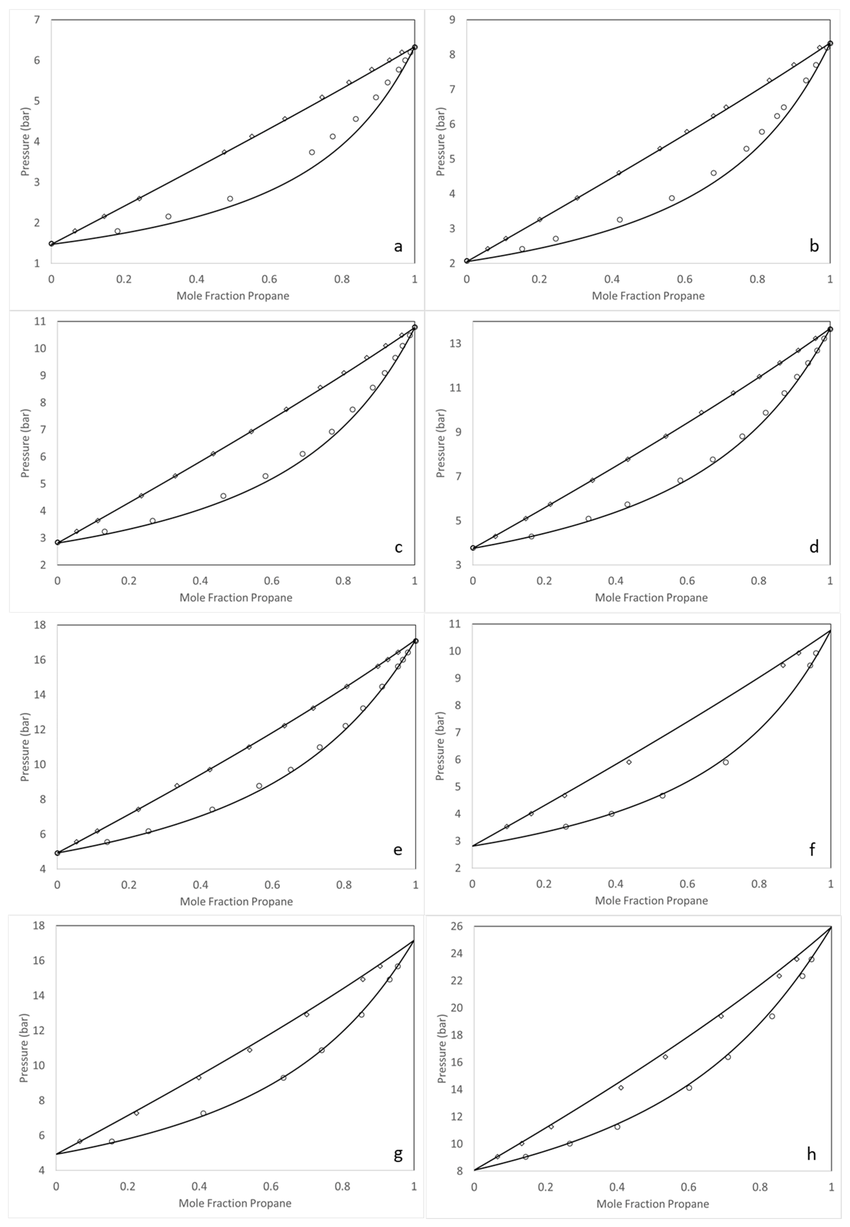
Also, fractional distillation columns are constant flow unit operations. A collection pot is a batch evaporator—two different sets of design heuristics, calculations, etc.
There is no degree of “separation” butane and propane are so similar molecularly that they’re essentially in the same solution (this is a guess but I’m fairly certain it’s true).
The best thing you can do to determine your mixture is get your solvent at a constant temperature, ensure there’s no inert head pressure and measure the vapor pressure.
You can do the same in your collection pot if you close the recovery port, but you have to correct the vapor pressure using something like the ebullioscopic principle or integrating non-ideality of the situation in some fashion or another.
4 Likes
that was my assumption based on seeing this: