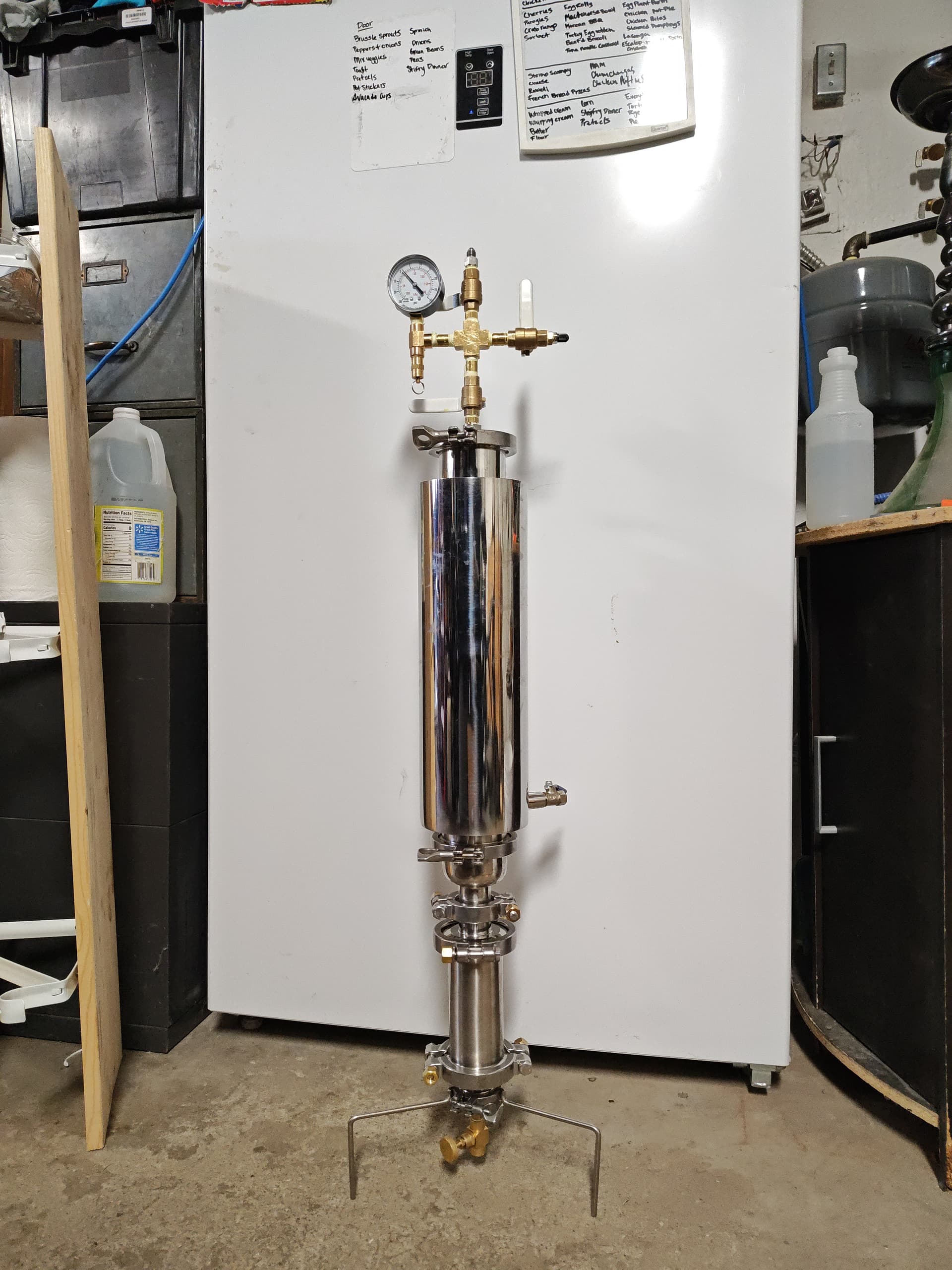
Before proceeding further you need to study the laws of thermodynamics and hydrocarbons under positive and negative atmosphere and why these laws/ specifications are important to a systems operations. This alone will help you solve an issue you’re creating while also giving you insight on what you need to proceed with doing moving forward for both active and passive.
Another spoon shall be instead of using “compressed air” use a clean “lab grade”,(don’t get run of the mill gas with unpredictable qualities)“food grade”, inert gas such as nitrogen or argon to create your positive push to assist in pushing the tane through, with the auxiliary butane tank you can also daisy chain into it and push your tane fully through with the inert gas (create head pressure). This will allow you to push/throttle your tane, carefully though as channeling may occur if crc isn’t packed well. If you haven’t followed thermal dynamics to this point it will be futile against your assist push anyways. As stated earlier you’re adding a oxidizer to a hydrocarbon that was otherwise in a negative atmosphere chamber, once you introduced compressed o2 into your column it immediately started to boil/evaporate your solvent and then condensed back onto the column walls not pushing further into your warmer surface area having crc section. If you’d like a bit of safety precaution to this add a inline ball valve above and below so you can vacuum each section down and close them separately, thus allowing you to open them in sequence allowing for a natural pull through to each section as you fill to equilibrium safely as you proceed from injection to “recovery”(openly shooting into collection, which should also follow thermal dynamics to have a better yield chance, but please do this inside a safe UL listed exhausted area if you dont have a booth/fume hood). But as also suggested please obtain means of knowledge on a closed loop and the additional proper equipment to run one.
Please tell me you atleast have a dual stage recovery vacuum safe for hydrocarbons?
Do you ground yourself and the equipment you’re using?
Are you wearing static proof clothing on a static proof flooring cover?
Is the table, counter grounded?
Is the ancillary equipment for evaporation/ purging UL listed?
Please use PYREX which is borosilicate glass. Not pyrex which is normal lesser quality “silicate glass”. Do not use silicone, whether it’s “platinum cured food grade” or not. Terpenes and hydrocarbons will wear it over short time and leach especially with evaporation/ purging. If you’re weary of Pyrex use a stainless steel container that is grounded while injecting into. Either way ground everything.
if you freeze your column prior to extraction are you doing so with your crc connected or not? (Applies to thermodynamics flow).
I’m also guessing that your tane is not as cold as your column with dry ice which then initiates a slower flow as well or possibly causing stall and evaporation/condensation from hitting the warm crc below with additional o2 pushing in create rapid evap.
surely there’s more but these are just a few things you should be addressing to not only solve these issues but proceed with a safer environment and product.