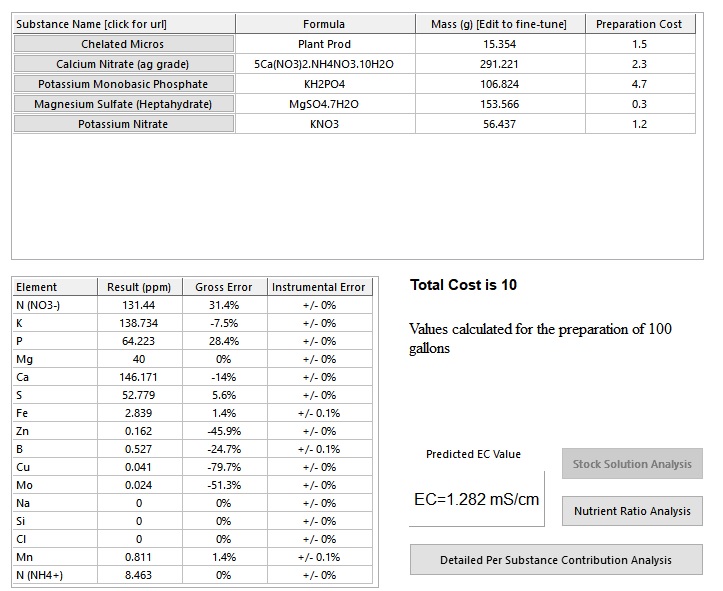
I know you use spreadsheets, but I’m having trouble getting Ca over N levels using ag grade Cal Nit in Hydrobuddy.
2 Likes
Ag grade cal nit, at least Yara and Haifa are 15.5%N, 19%Ca. If you use cal nitrate as your only source of nitrate, you shouldn’t have any problem keeping Ca above N.
3 Likes
Whoops, that was a fat finger typo on my part with a new HB Linux install. Thanks for all your help.
1 Like
That doesn’t show something like additional acidic components.
I wonder if Kuo Labs could parse it further or reverse engineering could be done by Dr. Daniel Fernandez. He made a copy of a commercial product for me for $150/hr.
I’d throw some cash down on it just to learn more about formulation.
5 Likes
A nutrient analysis won’t show pekacid(pentaphosphate), citric acid or pretty much any other complexing acid. The pentaphosphate in pekacid just shows up as phosphorous.
I doubt they are using citric or any other organic acid because the silicate they recommend to use to increase pH would overcome the organic acid rather quickly.
@AgTonik What pH does this mix you posted above in hydrobuddy mix to?
2 Likes
I’m going to send another sample for testing from a bigger batch to make sure the numbers are similar, I’ll have the results next week.
2 Likes
I’ve checked 2 batch tanks locally (it’s easy because they literally give athena away locally to large operators in exchange for Instagram posts) and seen 2 different K values at the same N value. More than 10% variation.
4 Likes
Not in the 4’s. I need to get my life together and change my RO filters and I could tell you. I’m guessing 5.5 or so from the MKP.
2 Likes
That 4.1 pH is the first tell for an acid being present. The way to verify it is to have all the data. @Medicine.grower test doesn’t include nh4 or S.
If we have all of the data, we can convert it mEq. mEq gives us the data we need to see if a nutritional(N,P,S) acid is present. You see the acid due to seeing an imbalanced charge in the solution. Anion mEq should equal cation mEq if only salts are present. When you add an acid anion mEq becomes greater than cation mEq.
That is the main reason I run a spreadsheet, I’m sure all of my constants are the same as hydrobuddy, but I can see results in ppm, mEq and mmol at the same time. mEq is nice because you can compare your work to Steiner’s ranges as a sanity check.
4 Likes
These are the analysis I have access to, if there’s more you guys want to see over the greenhouse g2, just let me know.
analytical-lab-fees (1) (1).pdf (88.5 KB)
2 Likes
We can pretty much assume the nh4 by using standard cal nitrate ratios. It would be nice to see so4, but I only see it listed for water analysis, nowhere for nutrient solution analysis. Ideally G3 would get so4, but it is specified for water, not nutrient. Ask them what to request for your last sample plus so4.
With that, I can clone it using pekacid and mkp by modulating the pekacid to get to the known final pH. Pekacid may not be exactly what they are using for the line cleaning aspect, but I can tell you from experience that pekacid will deliver on cleaning emitters and lines. We can also clone it using any other polyphospate line cleaner you guys choose, I just go to pekacid because I have it on hand. What I can’t solve is the cleanliness. Haifa and Yara both have insolubles in their cal nitrate, and I haven’t seen any SOP that is clean.
3 Likes
Has anyone tried running additional inputs? Budblood, big bud, stack, karma
I have a new client using Athena and it seems like maybe it’s not complete for the transition phase.
I’m going to feed the roots first and see how the plants respond
3 Likes
I personally haven’t had good results with athena.ag nutes in dirt, coco and Rockwood seem to crush it when using high ec but dirt it does no justice. I talked to a sale rep and they told me its meant for coco so anyone using athena should definitely switch to coco. I would put money on hgv nutes ran with powersi over athena.ag nutes ran with powersi. As hgv will make a batch of nutes perfect for your water and dirt after sending water and dirt in for testing.
1 Like
Transition is like a gawky teenager. I give them a shot of calcium acetate before I flip and they look much better than before I started doing did that. What are you experiencing?
3 Likes
I’ve only done 2 flips so far with the Athena, but I have not had any issues.
My run off the first 2 weeks of my last table was hitting high as almost 5 ec run off with big dry backs and no issues.
What read/ watched about the Athena they say don’t add anything if you think there’s a deficiency up your feed ec.
3 Likes
Seems like they are low on phosphorous, the client has just replaced there lead grower and there new guy switched them to Athena. They are in soil coco blend. I’m getting the well water and slurry tested to see what I’m working with.
4 Likes
Is it perfect? No. What you probably see during transition phase is what @AgTonik pointed out, Ca. If you go by the athena feed chart, you are changing the Ca:K ratio overnight. The plant doesn’t change its Ca and K needs overnight, it’s actually pretty gradual.
Get them on a salt recipe, even if you copy something existing. IME it’s a lot easier to explain in black and white that I add value by being around even if it’s just because my consultation fees are less than what they will save in input costs.
6 Likes
I’m just a plant nerd that loves fertilizer. I’m not doing any work with any facilities right now, but I would love to hire you to consult somewhere down the road for your expertise and being super helpful here.
5 Likes
You wouldn’t even need me. Just start running tissue or sap analysis and do what the girls tell you they need.
6 Likes
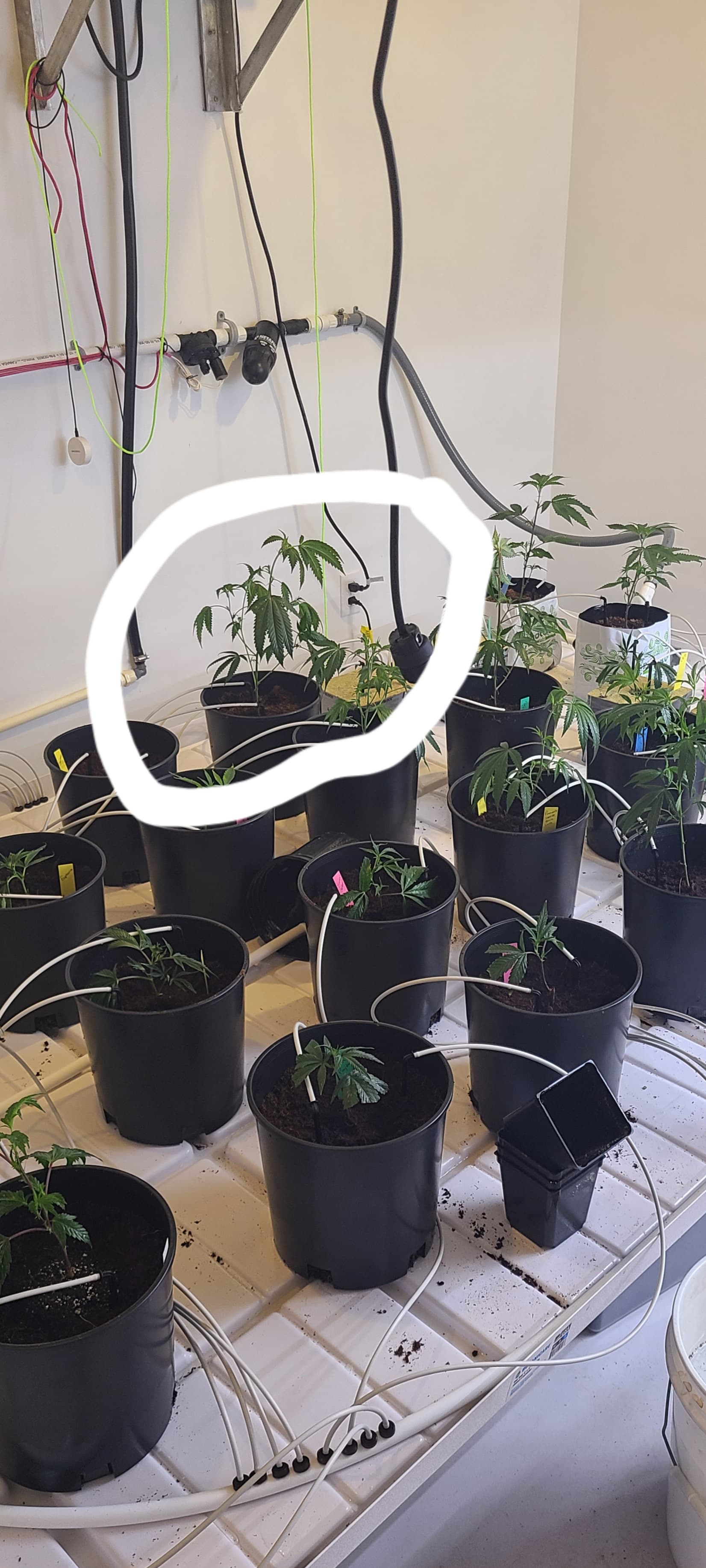
Here’s the first plants I vegged with athena.
2 gallon pot 3/4 full of canna coco
Drenched the coco with 2.0 ec
After the first dry bank I fed 2.7ec for a week
2.4 ec for the next week, then just been running 2.0 for the last 2 weeks.
Under 4200k cmh
80°, 60%
28 day difference in between the pictures, I can’t even believe it.

9 Likes