I encourage you to read this paper below:
I think youll understand where im coming from as it confirms quite a few things i said early on and talks about the stability of quinones
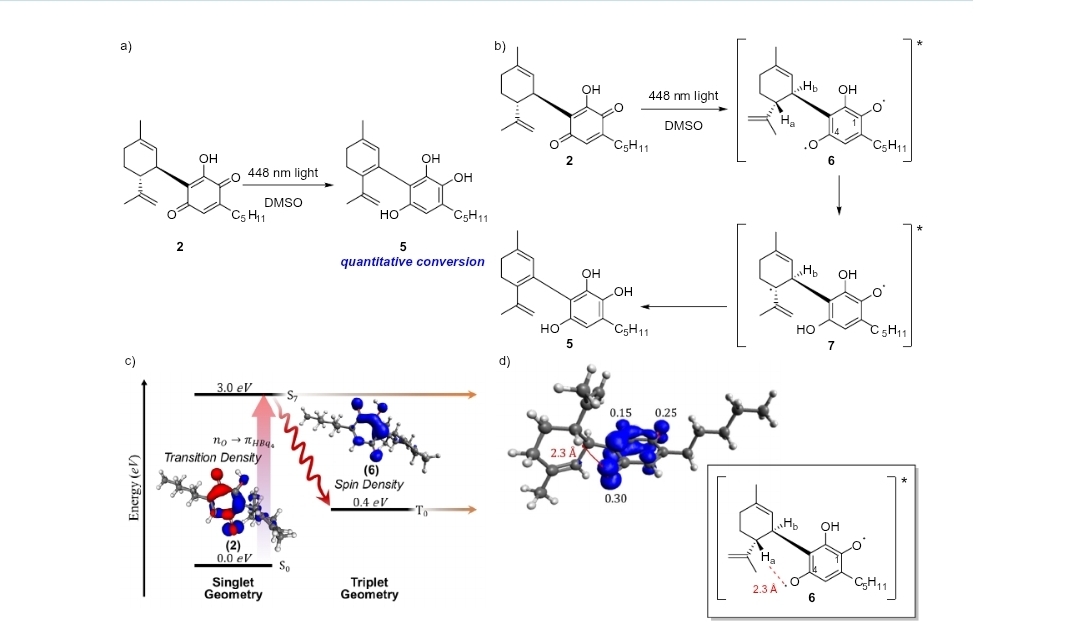
“Because our above experiments showed that the photochemical process is concentration-independent and does not lead to a photo-degradation of CBD (1), further reactivity of the diradical species is probably dominated by an intramolecular process (6–7, Fig.3b). The formation of 7 from 6 must therefore proceed by either direct hydrogen atom transfer (HAT) or proton-coupled electron transfer (PCAT). Given the structural constraints, it seems most likely that the intramolecular reactivity of 6 is facilitated by the close proximity of the oxygen atom with the largest spin density (4-O) to Ha on the limonene group (rOH ≈ 2.3Å, Fig.3d). HAT and/or PCAT via this pathway would proceed via a favourable six-membered transition state. Alternative conformations of the diradical species do not permit other protons in the molecule, such as Hb, to be accessed as easily from either 4-O or 1-O (6, Fig.3b). Intermolecular hydrogen abstraction processes have been observed for other benzoquinones such as chloranil29, and 2,3-dichloro-5,6-dicyanoquinone (DDQ)30. After formation of 7, several pathways to hydroxyquinol 3 (Fig.3b), including both HAT and oxidation/elimination mechanisms, are feasible.Collectively, these observations indicate that selective photoexcitation of the hydroxyquinone tethered to the easily oxidized limonene moiety leads to quantitative conversion of HU-331 (2) to the hydroxyquinol 5 via intramolecular radical processes. Given that 5 is formed as the sole product in solution upon photoexcitation of HU-331, we propose that the formation of 5 is the critical species through which the large array of decomposi-tion products observed in MS analysis of light-stored CBD (1) solutions is generated (Supplementary Fig.S32). Because this photoexcitation readily occurs in visible light, the reaction may be proceeding in ambiently stored CBD (1) solution products that contain HU-331 (2) as a common impurity.”