I think you may find things will go faster for you if you separate your processes instead of combining them. For example assemble all the boxes required before placing product inside, then place all the product and seal, then place your stickers. If you have square/rectangle labels on a sheet, you can use masking tape on table edge so you can slightly fold the label sheet and stick all your labels onto the masking tape, then just use your fingers to pull the labels off and place on the box instead of grabbing the sheet and pulling a label off every time.
15 Likes
These are good tips. This is where I’d call my packaging vendor and seek input. Need a guy? I’ve got a couple.
1 Like
With the right sourcing, some patience, and good advice, I bet you could get it done in the $100k-$200k range, but I would be shocked if it came in less than that.
Count each separate thing you have to do when putting them together.
It looks to me like:
- Open the box
- Slide the disposable into the box
- Close the top
- Close the bottom
- Apply top stamp
- Apply bottom stamp
You need a system that will do each of these things. It’s not one system, it’s 6… at least.
@terplord420’s advice is good. Break it down into the individual steps. That will help you find different things you can do to speed up each piece.
6 Likes
My statement was for illustration, not accuracy. I have no idea what that would cost. I’m glad for an estimate that is much more informed.
1 Like
Ten cents per touch is a good estimate of labor cost
4 Likes
Do you consider your wooks quality? Ie, do they hustle, work with a sense of urgency, do they have a fire under their ass? Are they under direct supervision?
Might not be the case with your crew but in my experience 1/4 to 1/2 of the people one tasks with such jobs take it for granted and just kind of ‘fuck off’ half the time. Getting your packaging team honed to only the ‘all-stars’ who get the game at hand and work to trim off those half-seconds at each step is valuable. Track individuals’ production per day, make them accountable to minimum amounts, even put individuals’ numbers up on a dry erase daily, those can be good motivators. I realize that’s tough to do given population in certain regions and at low pay that might be a lot to ask, but yeah. wook quality over wook quantity and all that
13 Likes
You can do this in a really positive way that is incentiviing. Packagers can make the hourly rate plus piece bonus. Of course there’s an expectation of production per hour, not of they excede that while maintaining quality, they get a bump.
Maybe the expectation is 100 packages an hour and there’s a $5 bonus per every additional 30 hour. I am just messing up numbers, but you get the idea.
If you ask people to go faster, have QA in place to check. Crooked stickers drive me crazy. Faster isn’t better if it’s worse.
5 Likes
IME people packaging your stuff for you are gunna be pissed when you micro manage them and post numbers on a white board. Even more resentment will come from trying to implement full time task tracking.
That’s a real quick way to a toxic work environment.
I think the solution is implementing some lean manufacturing practices. Set your employees up for success and let them know your job is to make their job as easy as possible.
12 Likes
Well then you guessed well, because I bet any north american company that makes equipment worth buying would fall in that 400k-500k range.
My estimate was based on high quality offshore equipment.
1 Like
Can’t you find some sort of labelling gun for the stickers,
If there small?
1 Like
Yes this. I noticed when you start holding people accountable to production or comparing to faster employees they start to shut down or give up
Oh I’ll never be as fast as xyz
We are in a snowflake generation and not everyone wants to come to terms with the reality that they’re inferior especially having it displayed on a white board
This is how I set times, I personally do the task let’s say packaging carts. I’ll do it for a day or a few hours then the standard is 75% of what I can do
Trimming is a good example when you hire a trimmer they don’t think it’s possible to trim 4 zips an hour and hover around 1-2. I’ll sit down with them for an hour and bang out 4 zips just to show them it’s possible. Then they usually go from 2 to 3, and since they’re paid per zip instead of hourly they are happy.
11 Likes
After high school I kinda floated through life for a few years working for a temp agency. Took a few production positions, and I was always getting out packed, out folded, out everythinged by the little asian ladies. Just sayin.
7 Likes
Link? Info? Thanks!
I love boxed carts and pens, but bags would be a lot faster (and cheaper). 50% clear front panel to see the contents.
If you want to stay with boxes:
@ky_cbd mentioned lean manufacturing (created by Toyota), and that’s probably the best comment so far (no offense to anyone in the thread  ):
):
The goal of lean manufacturing is to minimize “Muda” (‘wastefulness,’ e.g., motion/touches, waiting, etc.) and increase efficiency.
For your question, I would ask, are you using the “one-piece flow” or “batch-and-queue” method?
- (one-piece flow) Does a single employee form a box, fill the box, sticker the box, and close the box before moving on to the next box?
- (batch-and-queue) Do you have a single employee form ten boxes, fill ten boxes, sticker ten boxes, then close ten boxes? Or, use multiple employees to form a pseudo assembly line, where the first employee forms boxes, the next employee fills boxes, the next employee stickers boxes, and so on? (Similar to but different than progessive assembly)
The one-piece flow method is up to twice as fast as the batch-and-queue method. So, if you are using the batch-and-queue method now, you can increase the speed by up to 200% by switching to the one-piece flow method.
Here’s a great video example of a single employee making boxes with the one-piece flow and batch-and-queue methods:

Here’s another good video of the two employees using one-piece flow and batch-and-queue methods, plus good examples of Muda:
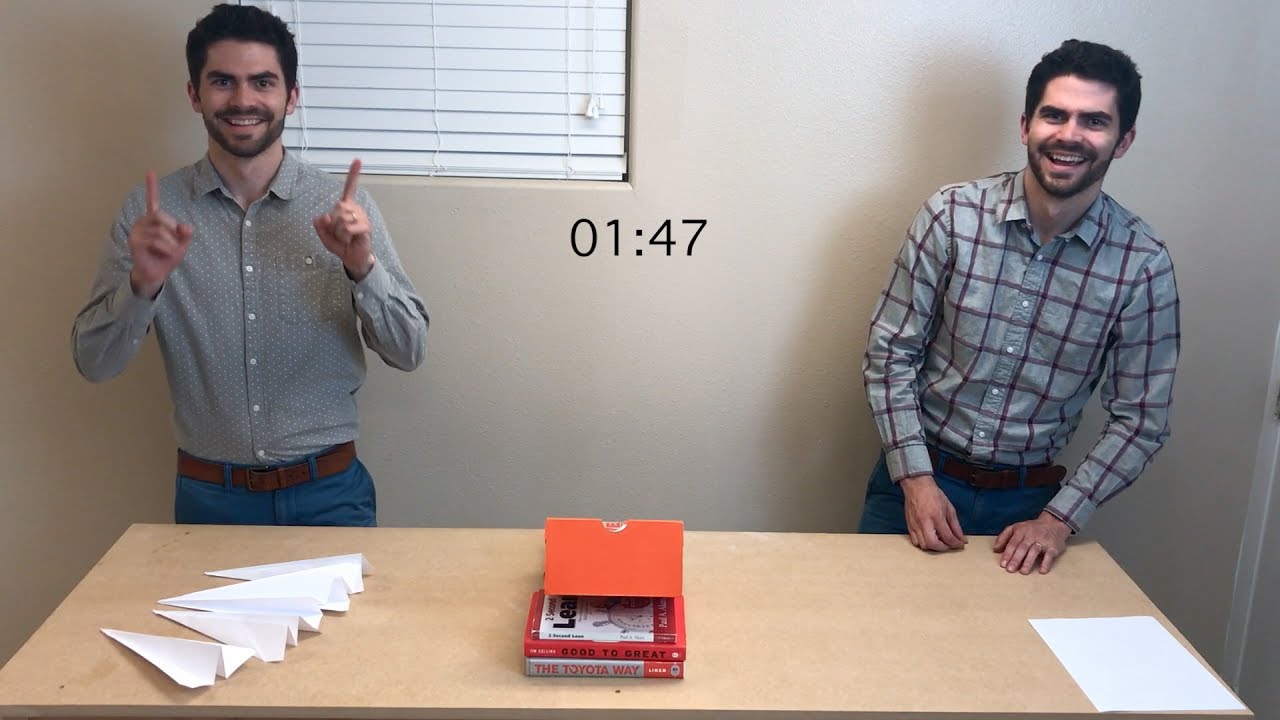
P.S. You should also consider the number of touches in the process. Limiting the touches reduces Muda, increases efficiency, and reduces the labor cost.

Not only for the reasons @anon56994712 listed above but also because it breeds competition and resentment. Especially when management/ownership shows more appreciation to the fastest packager/timmer/etc.
Most owners think it’s best to have a giant whiteboard or meetings to go over who’s the ‘best’ and the ‘worst.’ As if the ‘worst’ will somehow pull up their bootstraps and try to beat the ‘winner.’  All it does is make everyone who isn’t the ‘best’ or close to the best resent those above, doubly if the ‘best’ get perks or extra love from higher-ups.
Better to track on the DL. Then, in a friendly manner, take time with the slowest employees to help them improve (not in front of other employees). Find out why they may be slower, and adjust methods to help them succeed.
Setting employees up for success should be one of the essential tasks of higher-ups.
15 Likes
YES, absolutely, positive reinforcement ftw, creating a ‘team’ atmosphere, always. i have very, very strong feelings about this (which i definitely fell short of emphasizing in my post).
totally agree, setting up a good system where you employees have what they need to be efficientis a must, how else could you expect them to be successful? and giving a bit of room for your people to try things to improve that system is good encouragement, gives ownership and agency.
it’s definitely tough to balance motivation and positivity with accountability. there’s a job to do here, but also, these are people. it’s on management to motivate properly and set up an environment that’s positive and set up for success, and it’s on the employee to be open to feedback. IMO, you have to have both or you simply won’t be efficient or successful. it’s tricky and it’s nuanced.
i appreciate Cat’s words and the post above for an example of that nuance–personal touch and encouragement, while still tracking and addressing those who are falling short of expectations
1 Like
Find a cost that works for you and pay an employee a flat rate Per item assembled.
The major concern in packaging as an employee is the lack of incentives. It just doesn’t make sense for me to bust ass and make 500 boxes/hour when Sally next to me only makes 250/hour and I get maybe .50-$1/hour more or the same as Sally, yet I’m doing twice the amount of work, and Sally seems to be enjoying work more but lolligagging,socializing,and taking multiple breaks.
I managed a team of 8-10 packagers, this is not a job everyone could do. Some people just can’t sit still for more then an hour. Packaging is much more of a mental game then most people understand. It requires a need to meditate while doing the task or IT WILL lead to a resentment for the position as its just not educationally filling.
The only way to motivate employees was to show them what there work gets them, plain and simple. If you get paid per item finished, then Sally can slack off all she wants and it won’t effect me or my work ethic.
7 Likes
This. The right person for the right job is key.
3 Likes
Unless you are doing serious numbers, automation is not worth it. Pricing on these machines is $50k minimum (depending on your circumstance) and there’s a lot of moving parts, so you better be mechanically inclined.
What you need to do is minimize touch points and steps. You cannot micromanage the shit out of your employees and expect it to go well. Instead, you need to put it on yourself (or someone else) to make the packaging process easier. You mentioned stickers. Unless they’re used as a CR measure, why not just have them printed on the box? That removes a step.
You could even consider sacrificing efficiency for overall morale. If this means one person is pre-folding the box and another person is just throwing the cartridge in, then go for it. Being hyper-efficient is not always possible, unless you have dulled-down workers who REALLY need that $/hr.
2 Likes
And what is the yearly cost of a single employee? $50k is extremely cheap for replacing an employee in that role.
3 Likes
I am no expert, but, start adding zeros to that.
If there is a reliable machine that can do that for $50,000, it is a STEAL. In fact, let’s buy it and contract it to OP for $75,000 a year with a 3 year minimum. It would be a bargain for him too. But I don’t think that is even in the ball park.
What’s your packaging throughput requirements (pieces per hour)? Will a semi-auto machine be sufficient for your workflow? Boxed and labeled correct?
2 Likes