Interested in your powder. Send me an email at ptrade80@gmail.com.
Really need a wholesale supplier. How much per kg?
Interested in bulk price for your 7H message me at newblockme@gmail.com
DO NOT, I REPEAT DO NOT ORDER FROM JOLLYROGER710
I don’t know how he is still allowed to sell products on here.
1 Like
Looking for samples.
Gr8fulmgmt@gmail.com
At what price?
Whats your email address?
I think he is out of the game at the moment.
After getting burned numerous times from these clowns and scammers, the only place I would recommend for 7-OH powder in bulk is:
Hello! I’m an organic chemist that has been working for nearly two years on perfecting a clean high yielding synthesis of 7-hydroxymitragynine. Because my process is higher yielding (75-85% versus 40-55%) I can offer pricing that is lower than other vendors.
I’m an honest dude that won’t sell any material before I’ve got the tests results for it. There are several people on this forum that will confirm this, if needed.
I’ve always connected with buyers on here directly rather than making a public post. But considering the news that came out today regarding the HHS department recommendation to the DEA that 7-hydroxymitragynine become a scheduled drug I figured I need to get busy before this window closes.
.
My powder is very pure and has great color. The 7OH content is typically around 75% because other oxidized minor alkaloids like 7-hydroxypaynantheine improve the overall effect significantly so it makes no sense to remove them. My pricing is based off the 7OH and pseudo content since the other oxidized alkaloids can’t be quantified, so you get those additional alkaloids for free!
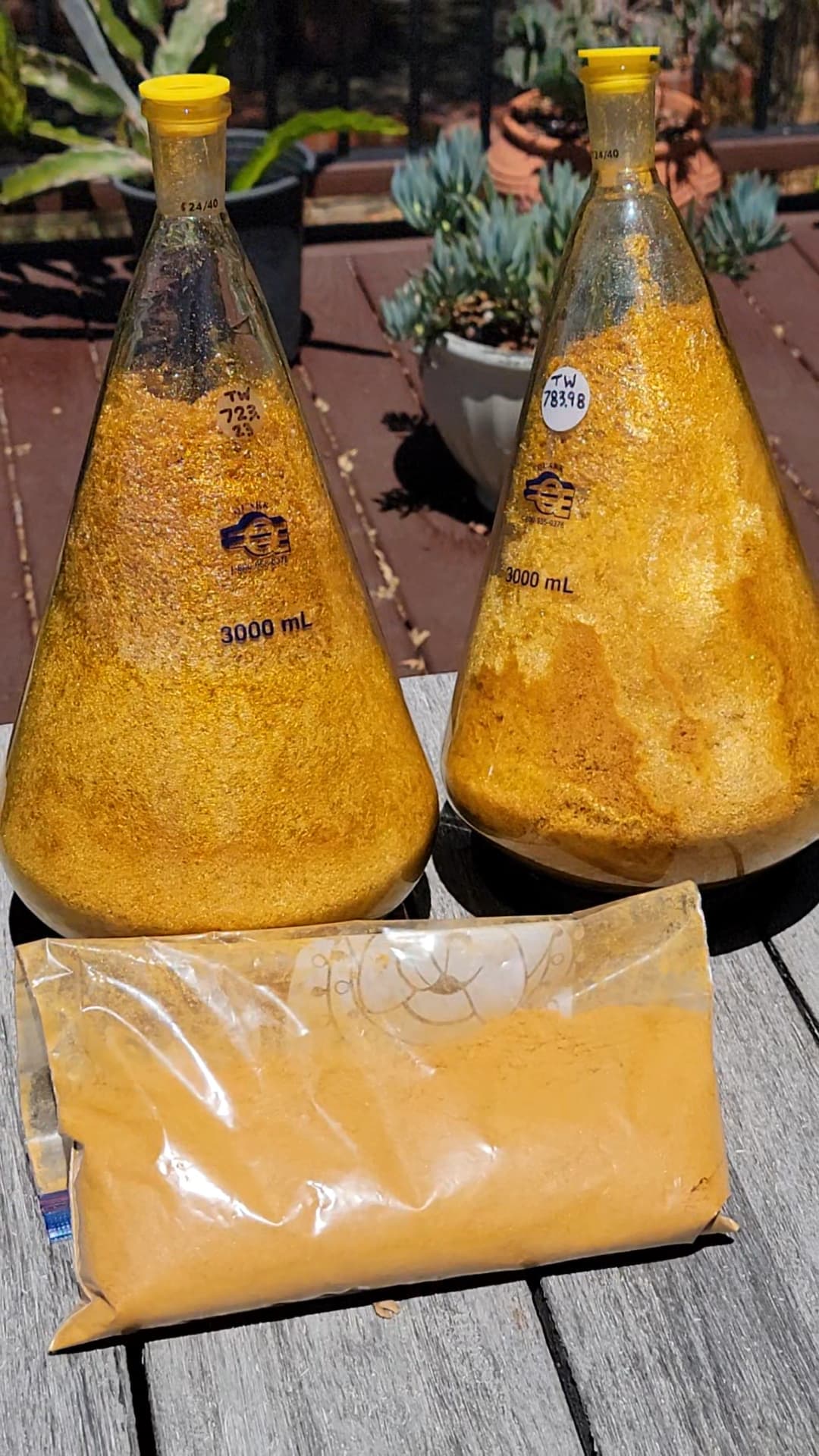
Current Product-
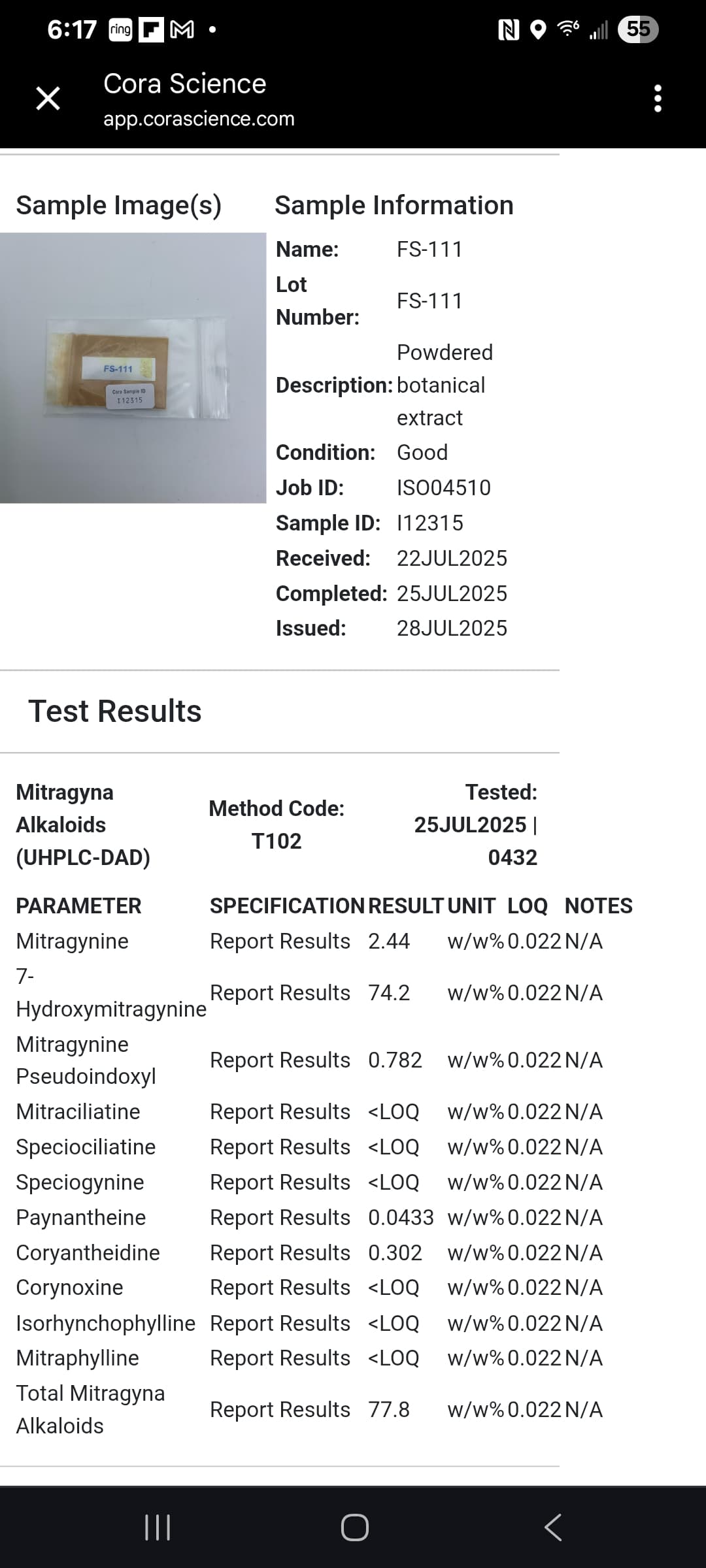
Gold Powder 74.2% 7OH & 0.8% pseudoindoxyl:
1 kg = $21K ($28/g or 2.8 cents/mg of active)
500 g = $12K
250 g = $6,750
100 g = $3,075
50 g = $1,725
25 g = $975
10 g = $460
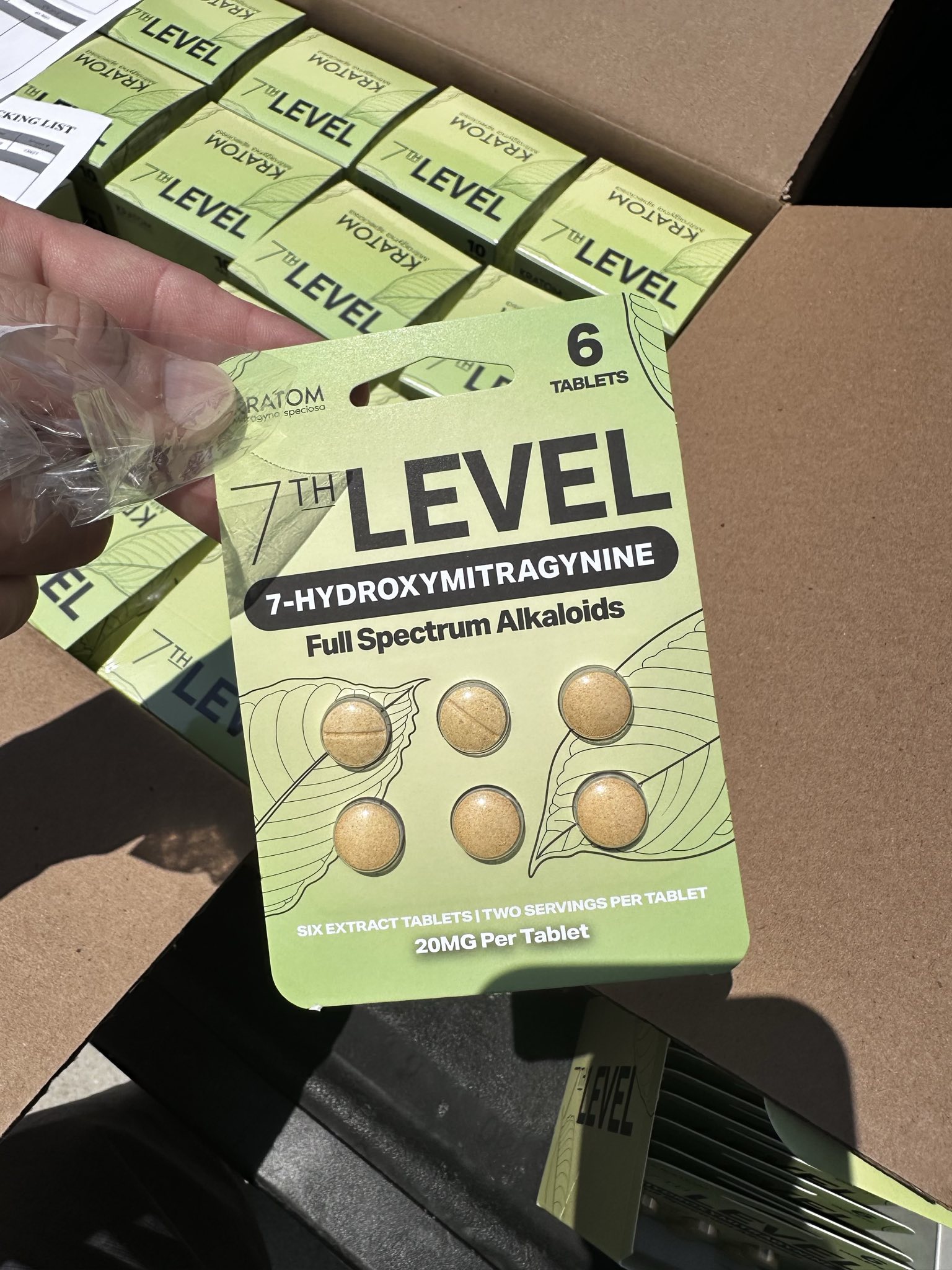
I can also provide bulk tablets and packaged product of my 7OH through partners that I work with.
Best ways to reach me are-
text/call 949-547-7229
email mattfinley@florasciences.com
Need further confirmation that I’m for real? Check out my collection of 7OH stories at my instagram: @organic.synthetic
4 Likes
Gross
1 Like
Nobody seems to have a problem with 50-80% MIT? Whats the difference with 7oh
1 Like
One comes from a plant with a fairly extensive history of consumption, the other is full of uncharacterized byproducts of synthesis
2 Likes
Got some today, can confirm quality. Thank you 
Edit: not one to thread hijack but since you haven’t made your own post yet just wanted to reply so others can see. All respect to jolly - his tabs are great
1 Like
A high purity kratom alkaloid extract will contain predominantly mitragynine, the remainder being mostly paynantheine, with lesser amounts of speciogynine, and speciociliatine. Then there are tiny fractions of others like corynantheidine, mitraphylline, rhynchophylline, etc. Lower purity extracts will also have some plant fats (<–not desireable but also not concerning).
Speciogynine and speciociliatine are both stereoisomers of mitragynine. Paynantheine would also be a stereoisomer except it has an ethylene group instead of an ethyl group. Corynantheidine similarly would be a stereoisomer of mitragynine except that the methoxy group is removed. Mitraphylline and rhynchophylline are both oxindole compounds which are otherwise similar in structure to the other krataloids. There are many other krataloids in miniscule amounts but they all fall into these categories.
One should expect that the stereoisomers and other structural analogues would react similarly and in fact that is the case. 7-hydroxymitragynine is a natural metabolite of mitragynine. Your body does this synthetic conversion naturally in you liver via cytochrome P450 enzymes. And those same enzymes also convert paynantheine to 7-hydroxypaynantheine, speciogynine and speciociliatine to their 7-hydroxy counterparts, and so on. The exception being the oxindoles which are already in their oxidized form and so are unaffected by these enzymes.
(Side Note: This natural oxidation process in the liver is the only reason that kratom gets people high. Mitragynine injected directly into the bloodstream was shown to have zero opioid effects!)
Krataloids are very sensitive molecules which are easily degraded by both acidic and alkaline pH. They are also very sensitive in other respects which I don’t want to get into. These degradation products are all found in aged kratom leaf but are typically excluded during the extraction/purification process.
Now if someone was using an aggressive/unselective oxidant on these alkaloids then they’d get a low yield with undesired overoxidation and hydrolysis products. But I don’t see how any of these compounds would be particularly concerning. (Maybe if reactive halogen species were involved then that might be a different story, but those reactions would have even worse yields.) In my case though I’ve developed a very selective conversion which delivers the target product in unusually high yield and I’ve also developed a purification process which increases the purity to higher than the original starting material (71.3% mitragynine was converted into 74.2% 7OH).
The reason labs don’t identify/quantify100% of the mass in a sample isn’t because it’s just unknown crap. It’s because there aren’t commercially available standards of those compounds to use in HPLC analysis. This used to be the case with mitragynine pseudoindoxyl but then it became clear that labs would pay for this standard and so it was made available and now labs can test for it.
UPLC/MS-MS is a useful tool to identify these other compounds. I have used it for both my starting material and my final product to confirm what compounds were present. As should be expected the second most prevalent compound in my product is 7-hydroxypaynantheine (and it has desirable effects!). The other ion masses at specified retention times all correlated to compounds that were expected (7-hydroxy compounds, oxindoles, pseudoindoxyls, and a tiny bit of unreacted starting materials). UPLC/MS-MS is great for identifying a wide array of compounds, even if they are in tiny amounts. It also provides a good sense of their amounts relative to each other. But it can’t accurately determine the % mass of an analyte in a sample, at least not without using standards. So I rely on UHPLC-DAD testing using standards of each analyte to provide precise quantification.
So where exactly is the gross?
2 Likes
Then characterize the impurities on mass spec and nmr
The iodobenzene that’s alleged to be left behind as a result of the oxidizer commonly used(assuming you use PIFA), the substances you’re aware of but use an inferior testing method to ignore while failing to even name or give the structures/mass spectra of the impurities, acting like it’s safe because it’s made from kratom when it’s clearly addictive
Mass spec is great for identifying but not quantifying. I used mass spec to identify everything present even in tiny amounts. But to accurately determine the % content of mit or 7OH requires HPLC-DAD and standards of the analytes you wish to quantify. Cora offers a testing package of the 5 main krataloids that I listed. If you pay for the expanded panel then they will quantify an additional 5 krataloids, using all 10 krataloid standards that they have, but the only interesting one out of those 5 extra is pseudoindoxyl. So basically you can pay extra to quantify pseudo if you want. Most importantly though, there’s no ability to accurately quantify the alkaloids that would logically make up the majority of the unidentified mass in HPLC testing of 7OH batches: 7-hydroxypaynantheine, 7-hydroxyspeciogynine and 7-hydroxyspeciociliatine. (<-- these are the unknown “imputities” you’re talking about in regular testing. Again, the only reason they are unidentified is because there are no standards available for them. Buyers care about the % purity of 7OH because they need that info to be able to accurately formulate their products with the correct dosage. The %7OH also determines the value of the bulk powder. Doing UPLC/MS-MS occasionally is nice for insights, but HPLC-DAD is a requirement on every batch.
NMR is only useful if you are trying to identify the structure of a relatively pure compound isolated usually either by crystallization or chromatography. NMR doesn’t provide much insight when sampling a mixture of compounds. I actually do have an NMR of some product though because the UPLC/MS-MS lab just included it for free.

I don’t use PIFA. I don’t use any of the processes that have been published. Their yields all suck. Their scalabilities all suck. I didn’t want to get into this line of work unless I could figure out a better way to do it. I don’t have the funding like other operations so this was the only way that it made sense. Anyway, I’m surprised to hear that people are choosing to use PIFA because there are other options which don’t require a difficult purification like PIFA does.
Kratom is addictive, nicotine is addictive, coffee is addictive. I think adults should be free to put whatever they want in their bodies. I don’t desire a government babysitter.
Whether you take kratom or a mit extract, or a 7OH pill what you’re actually experiencing is a 7OH high, along with other 7-hydroxy krataloids that are oxidized either by enzymes in your liver or by organic synthesis.
I have no idea how most other manufacturers are making their product, and the process details matter a lot, so I’m not trying to defend every single 7OH product out there. I just know my shiz is clean and I’ve done every reasonable thing to confirm this.

26% of your product is these 3 substances? Seems like you have them identified despite the lack of standards, show us the HPLC chromatograms
No one is actually using PIFA lol. This dude clearly just saw that one (old) patent where they used PIFA (at lab scale) and presumed that’s the route people use.
I highly doubt anyone has used it at any significant scale.
I find the obvious transition of this being a primarily 420 site, and now having becomed a Kratom site… Quite comical.
The future of 420 is Opioid alternatives according to this sites activity.
2 Likes
Same as D8. or any random peak on any synth Cannabinoid
I like how the OP is trying to make it sound like 7OH is and isolate of a minor alkaloid. its mostly chemically synthesized. and any residue of reagents are not tested for in this industry.
Even now in 2025 I’m seeing large batches of D8 that can and will completely destroy the plastic on my PH meters. and now for whatever reason synth THCa is everywhere.
2 Likes