Cool to hear, I was debating whether to pick up the used ones I’ve found for 1k-3.5k cad
In 2025 what would you guys recommend, I am more so interested in roots blower vs diffusion pump.
I can comfortably run between 40-80micron (ideal vac, operational maybe 150ish) with my stock Welch C/RVpro16’s on my hve. I would like to be able to hit an operational vac of 5-15micron.
I would like to learn more about fractional distillation so I think I need to improve my vac to more effectively do that.
On another note: I have also read that short paths may be more effective for fractional distillation projects, is this true?
I still want more vac regardless. For whatever reason my gut is telling me I want a blower. I am also wondering how loud are roots blowers compared to just a rotary vane. I am also interested in cost comparisons, but I am wondering what would be the best means of upgrading vac capability. I am open to any suggestions and appreciate any input.
@Soxhlet @SidViscous @cyclopath @spdking @RockSteady @Kingofthekush420
Thanks guys.
3 Likes
I like diff pumps because theyre easier to clean IMO, theyre closer to an oil pump to clean vs a turbo is more like a scroll and has to be take apart. The oil itself catches anything that makes it past the cold traps where as with a turbo or booster it get stuck on the blades / gears which requires disassembly to fix.
I used one of the little 150 liter a second welch diff pumps on my spd i would distill around 20 microns at around 1000 feet elevation, that same diff had me running under 1 micron on a wiper.
The thing about spds from MY expeience (and Ive ran a ton of them) is theyre designed to condense vapors in the head. Because of this you dont have as much control as on a wiper because on a wiper the condensate condenses on the condenser itself. On an spd the condenser is more of a catch all. I always had an easier time removing azulene from distillate on a wiper, I could get it out on an spd but i had to run it hot and it took 2 passes vs on a wiper i could push it out on first pass with the heavy heads using hot condenser tech.

I have one of these sitting at my shop i never got a chiller to hook up to, always wondered how far down something like this would get a system
I guess edwards doesnt like links
2 Likes
Lowest I got an spd is with
2x40cfm Edward’s 2 stage pumps and 1 difstak iso 700 20L boiling flask
At 1 -5 millibar
You will have to use high grade vacuum grease
Like krytox
This and working on a head no bigger than NS45-40 the wide bore rigs I have not been able to get below 1-5miliibar
My suspicion is they the gaskets gas out
For distilling terpenes is where a diffusion shines on a spd
You will need a magnetic coupler to implement overhead stirring to create some turbulence in the HTE
At temps below 110C 1 -8 millibars can be achieved
3 coldtrap s I would recomend with the last one being ln2
4 Likes
I got to 5 umHg once on a 5L still with a liquid nitrogen cold trap on an Alcatel 2004a. It was on a fresh pump rebuild where I cleaned out every piece then filled with fresh pump oil with good fractionated pump oil.
I haven’t been able to get lower even with bigger pumps. Got down to 10um recently with an Alcatel 2021i and a dry ice cold trap.
2 Likes
To go lower you ll need a additional pump
In my case a diffusion difstak by Edward’s
2 Likes
My setup pulls deeper if I have everything freshly cleaned, but nowadays I like to go as fast as I slowly can.
I just recently added monitors to my columns, when normally I have always run them only at the cold trap. So I have been interested in the operational vac recently as it’s kind of a new number to me.
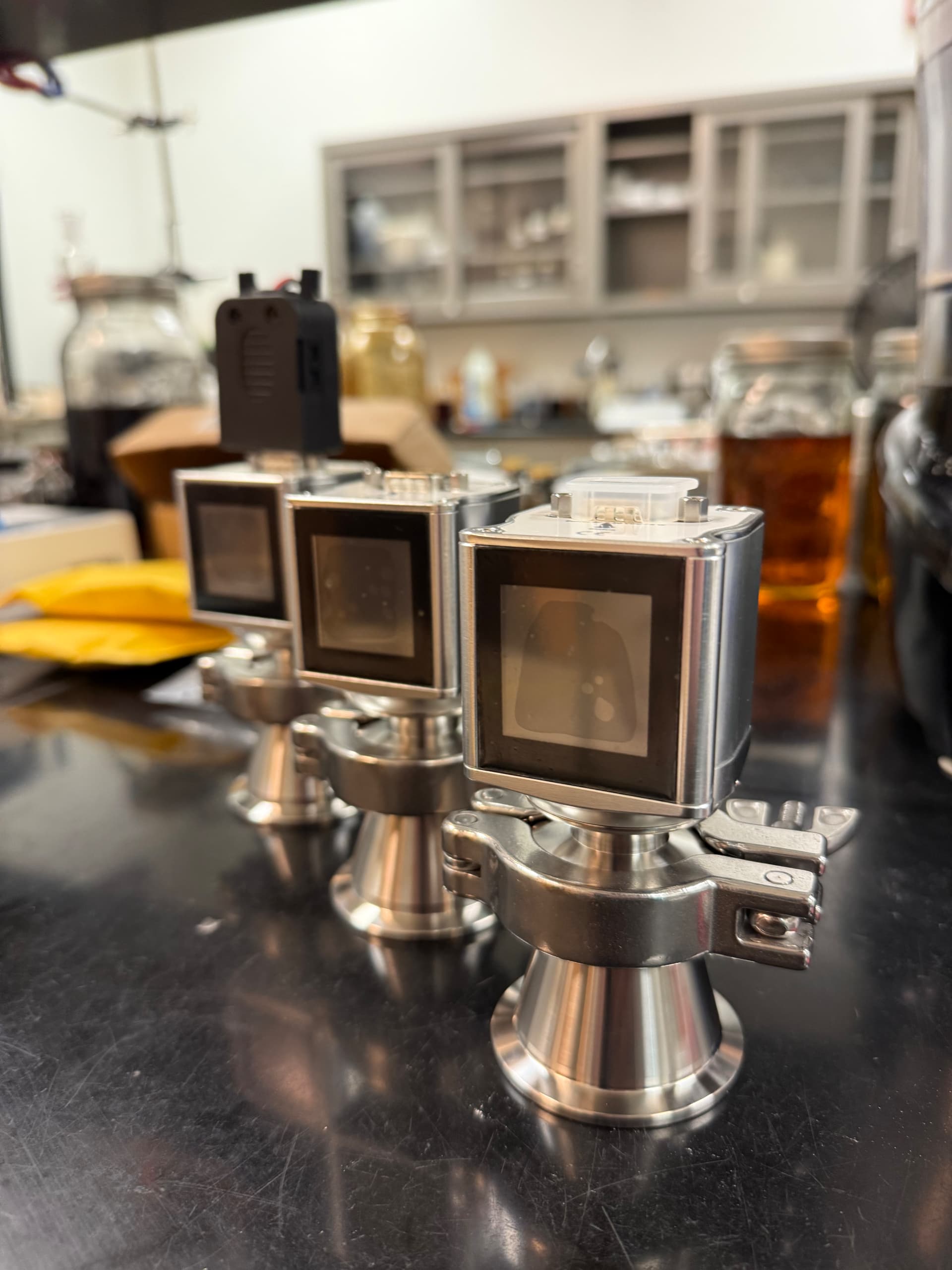
I think I just saw a picture of kd30 turbo vac train and thought it was badass but the comments in this and other threads have me scared of turbos, it made me wonder if people run them without the turbo how do they perform.
I also have been thinking something like
“turbo = fast❌ , turbo = precise✅”
and makes me wonder if there is a sweet spot for throughput & precision and wonder if it’s possible to have “too much vac” when diffusion or turbo possibly becomes not beneficial below certain levels? But maybe that’s not actually a thing.
strong votes in favor of diffstack.
I run immersion probes at either -80c or -90c currently and only single stage.
I am guessing I would need more protection with diffusion
1 Like
Ive actually thought this same thing before, as vacuum gets deeper boiling points of similar compounds get closer together so in theory youd think that separation would be harder but from my understanding the deeper the vacuum the easier separation by different vapor pressure becomes
Im pretty sure me and @TheGratefulPhil had a discussion about this somewhere around here
Maybe he has some time to chime in on the subject, if i remember correctly hes done some experimenting with vacuum depth and separation
I could be wrong though
2 Likes
Thank you, I’ve had this same thought and I thought I was crazy. I consistently see ~5% degradation of d9 to d8 and d10 in my fractional still even if it’s been through the wiper twice
and only distilling 1000ml at a time 90% TAC. Clean glass and mantle at 172, at most, cannot avoid it. Getting 100% cannabinoids with labs that test low but with 5% d8/10
It seems like the residence time of a wiper cannot be beat so perhaps a slightly higher vacuum with very tight temp control could lead to similar separation. I get no isomerization even at 300 umHg (a leaky run)
@zaxlol I also have been curious about local vacuum but I didn’t make it a priority because of the following:
You don’t get out of the viscous flow vacuum regime (gas molecules bumping each other) until you are below 1 umHg so I think it’s safe to assume that your vacuum in you chamber is more or less homogeneous.
Once you get below that point (molecular flow), your vacuum path is significantly more important because the mean free path of gas molecules becomes very long and gases bounce around the chamber without hitting other gas molecules. Depending on the chamber material, the outgas rate (adsorbed gasses in chamber walls) can overtake the pumping action if gasses cannot readily be evacuated.
Many ultra high vac chambers have a flat bottom with a very large opening intended for the full width of the flange of your turbo/diff pump so gasses have a higher probability of being evacuated. Diff pumps and turbo pumps basically use mechanisms that collide with gas molecules to move them to a place with high enough pressure such that they can be evacuated (this action is the turbo blades or the oil vapor).
I’m wondering if ultra high vacuum is even really possible for organic distillation as there are too many components that have high enough vapor pressure (even at LN2 temp) to lock you out of that regime.
3 Likes
Sounds like you’ve done this in the field?
I got this today from turbovacuum.com
Knowing your application and previously inspecting turbo pumps used in that distillation process mostly destroys the inside of the turbo with sticky substances and particulate. After decontamination the major components - Rotor/Stator assembly are ruined permanently and can not be used again. It process gas also damages the internal motor area.
Which agrees with you on the “that shit is sticky” but implies that “cleaning” isn’t a viable option.
Can you elaborate on how you approached this task?