Given that the forms of silicon are basically equivalent when you dilute them and put them at pH 6 (otherwise the Si-NMR spectra would look different). It is safe to say that, at least regarding Si, it makes no difference whether you come from a basic silicate concentrate or an acid-stabilized silicic acid concentrate (at least with Si in the 10-20 ppm range in the final solution).
Any difference must therefore be exclusively due to the effects of the stabilizing agents on the plants. Many of these - carnitine, glycerol, boron, molybdenum - are expected to be taken up by plants and play a role in plant metabolism.
We do need studies with proper controls, where a basic Si with the same stabilizing agents added is compared with an acidic Si with the stabilizing agents and with a solution that just contains the stabilizing agents. We should see absolutely no difference between both Si treatments and probably an improvement of the stabilizing agent control over a control with just water being sprayed.
If I have a 1% solution without stabilizers and without the formation of silica gel and it is diluted to 20ppm, it will go from oligomer to monomers and finally silicic acid? as it would happen in a basic solution at pH11.
From my study of the chemistry of silicates - both from published data and experiments done with others - it seems clear that Silicon containing polymers and oligomers only break up at very basic pH values (>11). This is why basic solutions can dissolve SiO2, but acid solutions cannot (with the exception of fluoride containing acid solutions).
If you have a 1% solution in acid pH, whatever its makeup is will remain as-is or polymerize further once you bring it to 5-7 pH. Even if you dilute it, oligomers will not break (this only happens at basic pH).
Thank you for your contributions to learning about the science of monosilicon acid. danielfp , Ralf
I was looking about DMSO and its applications and I found this patent, where if I understand correctly it uses DMSO or MSM as the first stabilizer and propylene glycol, etc as the second stabilizer, it also mentions that maltose, dextrose, sucrose, sorbitol, xylitol, glucose, dextran, no They are good stabilizers.
I await your opinions, the patent covers colloidal silicon, I suppose that is not so important.
Came across a study of silica in soilless media. It came out 12/2022 so the info is very relevant.
What I took from it is applying too much wollastonite will surely raise your ph in coco medium for a few weeks depending but so will rice hulls in peat. However both leveled out to 6 range for the rest of the cycle.
For short term container growing wollastonite would be the go to over rice hulls or de. Long term growing I would do rice hulls and de. Wollastonite is immediately available once aqueous and will last the length of our veg and grow cycle assuming your doing 12-14 weeks total and not leaching your containers heavily.
Bang for buck agsil 16 is king, supplemented with wollastonite and you should have no issues.
I’m sure leaf analysis would be required but I wonder how much calcium is actually being taken up? And how would you need to adjust your irrigating strategies and room temps to compensate for a slightly higher ph? Would micros have uptake issues?
@crowngruv The Ca contribution from Wollastonite is negligible compared with the average contributions from fertilizer, so you shouldn’t expect any relevant Ca supplementation from it. While root zone pH might increase slightly, it really doesn’t increase to the point where micronutrient uptake would be a problem.
None of the experiments I’ve ever run with Wollastonite have ever shown micronutrient issues. The pH has always remained under control. Note however that I usually supplement substantially more than Bruce does (around 10x more). This is to be able to achieve the same Si in tissue with only Wollastonite as when using potassium silicate alone.
Vertical Exploration in Canada makes a mix of about 10-15% wollastonite in their media and had good results in their trials. You are only the second person I have heard of using it in large quantities. I was always hesitant to use large amounts because I had no reference or information except for fields.
I had even reached out to one of the scientist at usu I think her name is mackenzie, she did the study on silica with bugbee. I asked her in an email about high dosages and shared the vertical exploration info but she didnt say it was good nor bad. I dont think she wanted to put her name or reputation on the line.
The solubility kinetics of Wollastonite are quite slow, if you add a lot of it you will not get any more Si in solution, you will just get it more consistently and for a longer time. I prefer the 1-3% range in the sense that it provides a guarantee you won’t run out, with very homogeneous distribution through all the media, without being overly wasteful. It was also the amount needed to consistently reach Si targets in tissue with no soluble Si additions.
At 10-15% it likely increases water retention of the media substantially as well, whether this is good or bad depends on what the rest of the makeup is.
I get asked these questions so frequently, I decided to create a blog post to sum up the knowledge and facts I have about Silicon containing products and the use of Si in nutrient solutions. I hope you find it interesting!
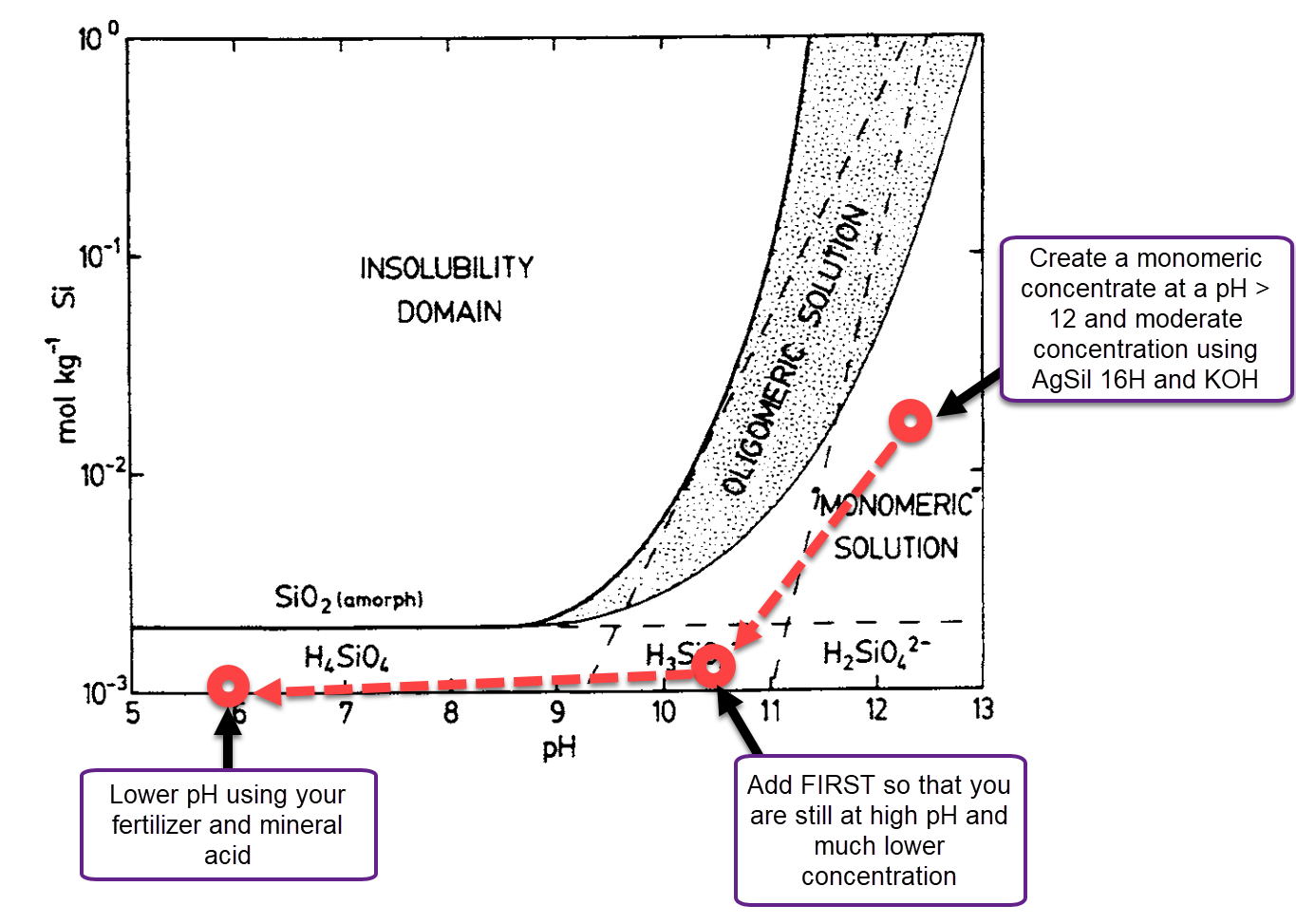
This sums it up and shows how you end up with monosilicic acid in the end if you do things properly with AgSil 16H. A 15g/gal solution of AgSil 16H is equivalent to around 4x10^-2 mol/kg of Si in the chart below. Note the lower red circles should be at around 5x10^-4 mol/kg, but the graph didn’t go low enough. I believe it illustrates the point though!
I have never observed any harm from doing so. Silicon strongly increases trichome strength (reinforces the anchoring points of trichomes to plant structures), so it actually increases quality, in the sense that less trichomes fall off plants when harvesting/drying/curing, so more terpenes and cannabinoids tend to end up in the end product.