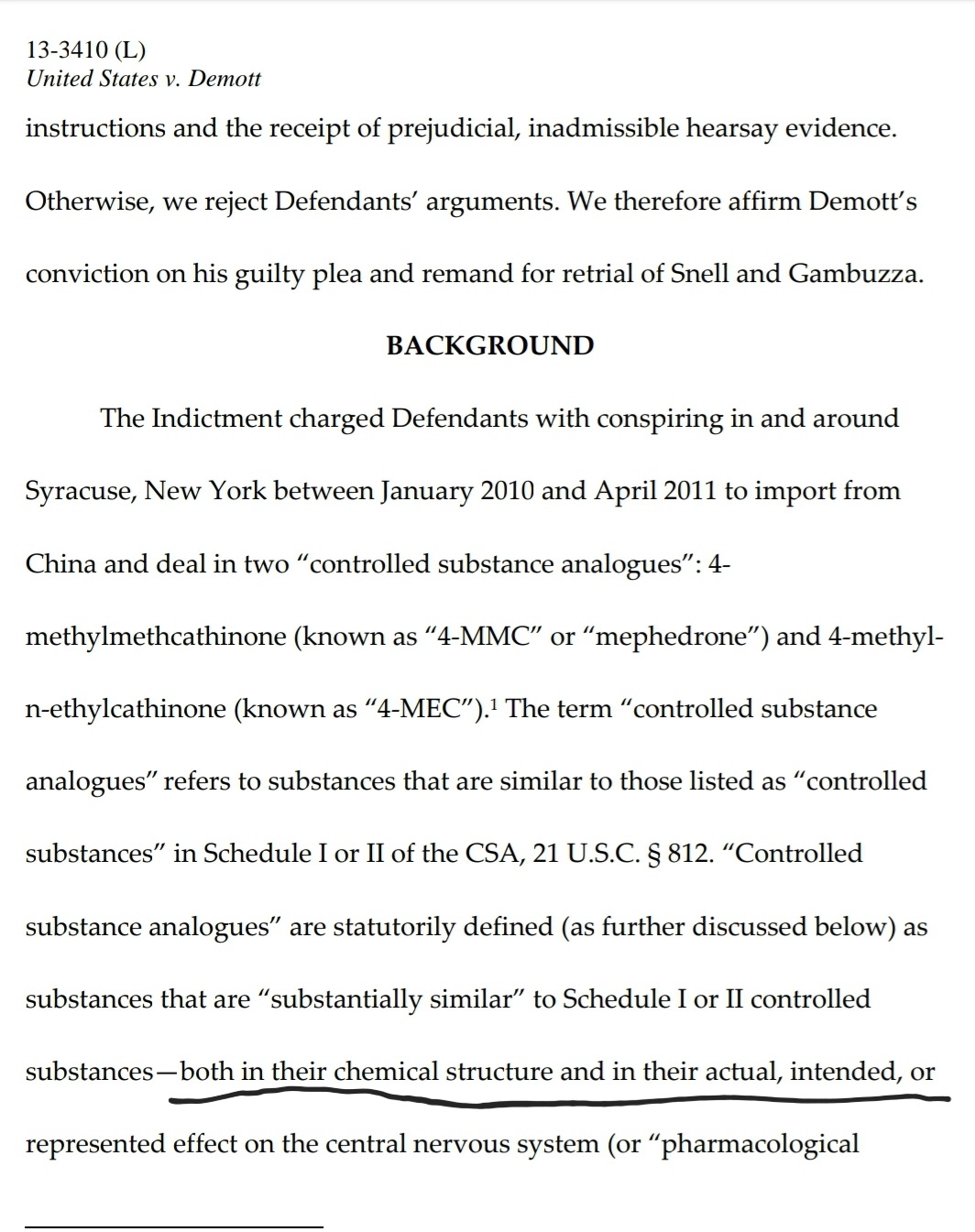
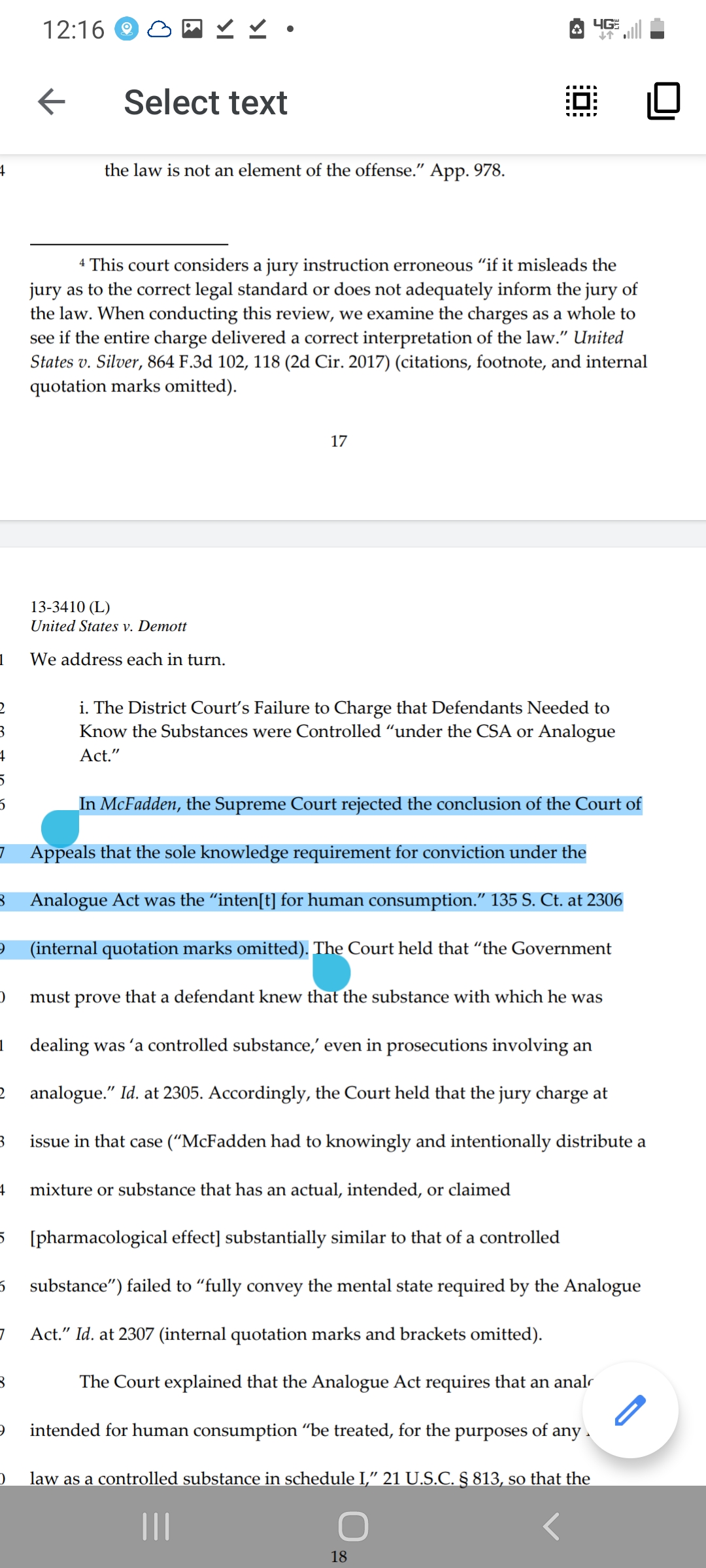
What you just underlined is from breaking down the individual definitions of the definitions of (i) and (ii) that it just mentioned above it and makes ZERO indication that it requires both at the same time and again before that says “the statue addresses chemical structure and pharmacologic effect in separate provisions"
Again, from the paper you just posted, “the statue addresses chemical structure and pharmacologic effect in separate provisions"
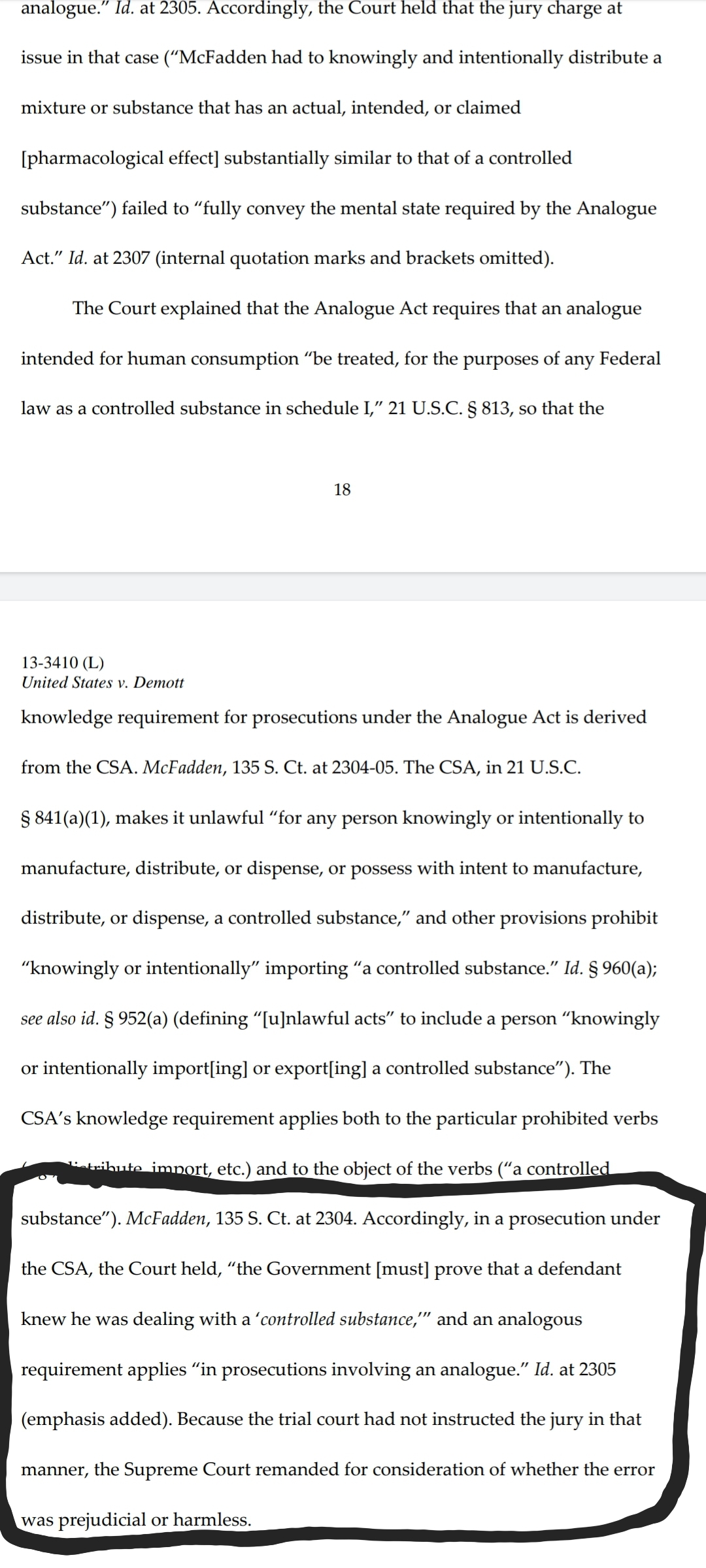
“The Court explained that the Analogue Act requires that an analogue intended for human consumption “be treated, for the purposes of any Federal law as a controlled substance in schedule I,” 21 U.S.C. § 813, so that the knowledge requirement for prosecutions under the Analogue Act is derived from the CSA. McFadden, 135 S. Ct. at 2304‐05. The CSA, in 21 U.S.C. § 841(a)(1), makes it unlawful “for any person knowingly or intentionally to manufacture, distribute, or dispense, or possess with intent to manufacture, distribute, or dispense, a controlled substance,” and other provisions prohibit “knowingly or intentionally” importing “a controlled substance.” Id. § 960(a); see also id. § 952(a) (defining “[u]nlawful acts” to include a person “knowingly or intentionally import[ing] or export[ing] a controlled substance”). The CSA’s knowledge requirement applies both to the particular prohibited verbs (e.g., distribute, import, etc.) and to the object of the verbs (“a controlled substance”). McFadden, 135 S. Ct. at 2304. Accordingly, in a prosecution under the CSA, the Court held, “the Government [must] prove that a defendant knew he was dealing with a ‘controlled substance,’” and an analogous requirement applies “in prosecutions involving an analogue.” Id. at 2305 (emphasis added). Because the trial court had not instructed the jury in that manner, the Supreme Court remanded for consideration of whether the error was prejudicial or harmless.”
—>Accordingly, in a prosecution under the CSA, the --Court held, “the Government [must] prove that a defendant knew he was dealing with a ‘controlled substance,’” and an analogous requirement applies “in prosecutions involving an analogue.”
The analogue act will be ruled as too vague (as it has been several times) when it comes to d8 because the definition of hemp includes isomers and cannabinoids that aren’t d9
They won’t be able to prove we knew we were dealing with a schedule 1 if it falls in the legal definition of hemp with under .3% d9 because it isn’t a controlled substance by definition
I’m retarded? I’m slow? You’re the one reading the sentence incorrectly although granted if your reading it with bias it does sound that way. I don’t know why you’re not quoting the federal analogue act bill itself.
Also a semicolon means to join independent clauses/definitions/provisions under the same group, for example in the FAA bill this is to join subparagraph ( C ) into definitions (i) and (ii) and (iii), the semicolon is used to group it to subparagraph ( C ), not to group the definitions to each other as if they all needed to apply at the same time, it’s to group it to subparagraph ( C ) itself so you can read the bill properly. I don’t know how you work in this industry and legitimately don’t know this information
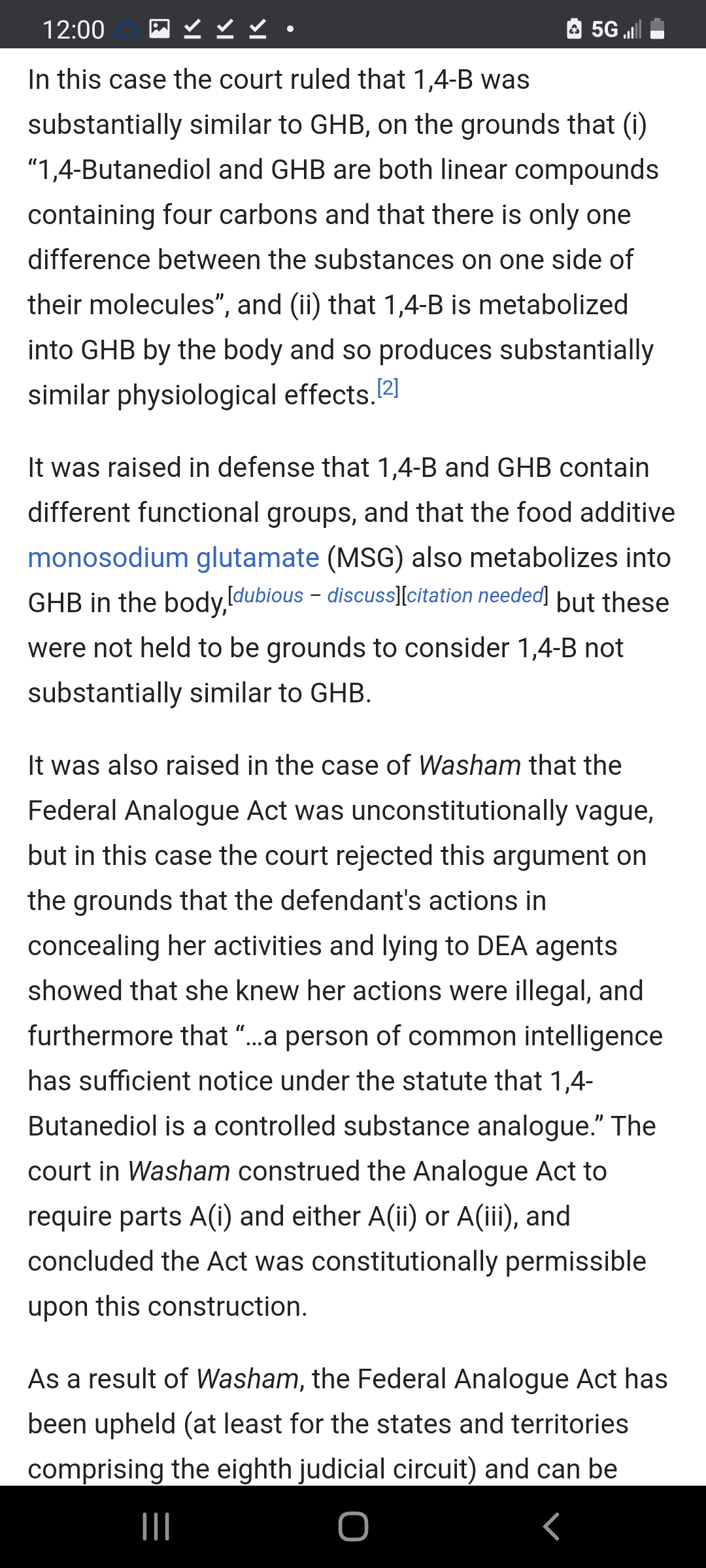
The analogue act will be ruled as too vague (as it has been several times)
Lol holy shit you know what buddy, that is the most ridiculous thing you have stated considering you just posted a case we’re 4 people went to federal prison because of the FAA. You must have completely missed out on the years 2000-2014 as well. Look I don’t want to be an asshole like you’re being, I’m not name calling I’m just trying to help you understand the law so you and others seeing this know the best way to go about doing what your doing. Being ignorant of the law does not save you in court.
The people who had it ruled vague has been 3 cases based on a judges personal opinion, it’s like getting a judge who believes the Cannabis law is unjust or badly written that it does not include Cannabis Indica only Cannabis Sativa and so you’re free because of that judges own personal opinion on how the law was written, those cases are exactly like that but with the FAA, in short, Don’t count on it.
I’ve proven my point and show that you are infact INCORRECT in assuming that any structurally similar chemical can be applied to the FAA without similar or greater effect
That’s not the FAA bill, that’s a badly worded excerpt from a court case that you are misinterpreting, you can read the actual FAA bill that they will quote in a court case against the arrest person and it’s actual legal language in full here:
Here are specifics in terms of "proving human consumption:
Again the semicolon does not imply to group the definitions together beyond the subgroup as you can observe in the subgroup under it.
We can go back and forth all night but I will again say, with AET, DMT and GHB analogue cases they we’re from the personal opinions of a judge about how the FAA was written and getting a judge like that is about as likely as getting a judge to say Cannabis Indica is legal because only Cannabis Sativa is scheduled or that due to the new hemp law that the Cannabis CSA law is now too confusing for the average joe. Cases like that have happened but they don’t happen often, you can’t count on a judge to disagree with how the FAA was written in terms of risking your freedom.
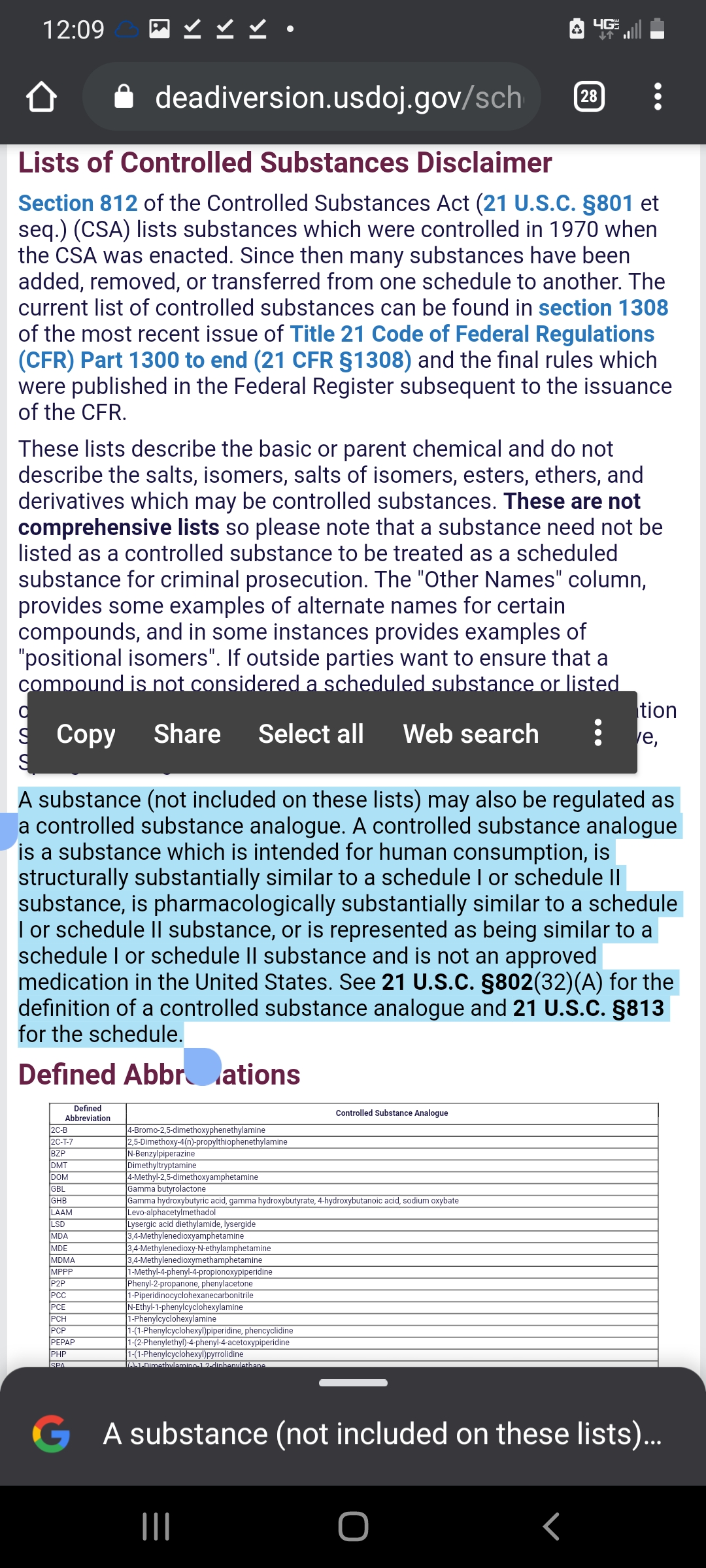
A controlled substance analogue is a substance which is intended for human consumption, is structurally substantially similar to a schedule I or schedule II substance, is pharmacologically substantially similar to a schedule I or schedule II substance, or is represented as being similar to a schedule I or schedule II substance and is not an approved medication in the United States.
Maybe this will help you
Once again it must “intended for human consumption, is structurally substantially similar to a schedule I or schedule II substance, is pharmacologically substantially similar to a schedule I or schedule II substance, or is represented as being similar to a schedule I or schedule II substance and is not an approved medication in the United States.”
Could you atleast bother to read things? If you read what I sent you then you would know the substance in question must be marketed for human consumption or it does not apply in terms of being criminally charged under the FAA.
For example 4-fluromethamphetamine isn’t scheduled in the CSA, you can hold it in your hand without fear of arrest. However if you tell a cop you intend to consume it or you sell it to someone with marketing to consume it then you can be arrested and charged under the FAA for an analogue of methamphetamine.
Lol no it doesn’t at all, what that states is the police did not have enough proof to show that the defendant was selling the analogue for human consumption. Again the FAA only applies when the substance in question was sold specifically for human consumption which I linked you a very good link which shows all the legal ways they can prove that.