Coolest coolant contacting hottest vapor would be COcurrent heat exchange - which is not the more common practice for heat exchangers. The most common configuration for a heat exchanger is countercurrent (which is what AI’s document is showing) - cocurrent heat exchange is generally used for very specific modes of operation since its decidedly the less efficient configuration for heat exchange. That is to say, there is no reason to configure the less efficient mode of operation (co-current) unless there is a purpose to doing so (like if you’re trying to minimize condensate subcooling, for instance). I’ve attached a diagram and heat profile:
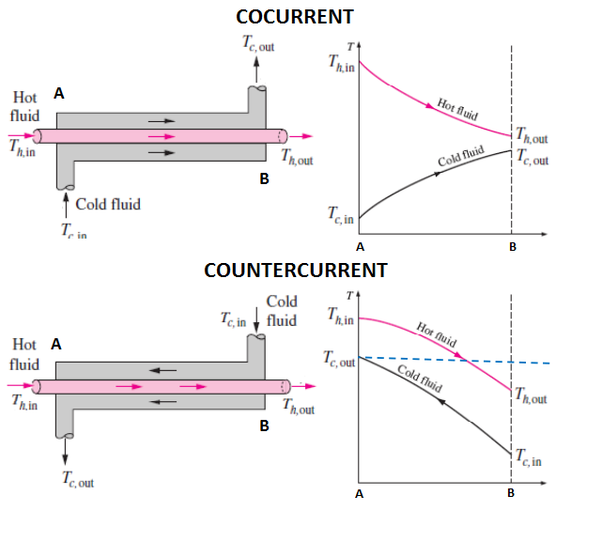
Heat transfer is actually going to be proportional to the delta T at any given point along that length of heat exchanger. In co-current you see the two streams pinch together and the delta T becomes smaller and smaller over the length of exchanger, right? Whereas with countercurrent the delta T remains much more constant over the full length of the exchanger. The implication here is that along that path length, heat exchange begins to drop off in co-current as you approach that pinch point. There is actually a technique used to size heat exchangers in industry called pinch-point analysis that relies heavily to this effect. Countercurrent maximizes the usefulness of your heat exchange surface area by maximizing the productive heat exchange along the full path length of the exchanger.
Yes, visually it may be appealing because the bubbles are purged from the lines faster, but a chiller with adequate flow rate should overcome this. Consider this visual - you set the rotovap up co-current (coldest fluid at bottom of coil, hottest vapor at bottom of coil, both travel upwards) then along that length of coil the glassware is getting warmer and warmer the higher up you go. That is to say, the glass at the top of the coil where fluid is exiting is now warmer than the glass at the bottom of the cool where fluid is entering. Now picture an excited lil’ superheated solvent vapor molecule under vacuum traveling upwards that has somehow not been condensed in that first few inches of contact with the coldest available heat exchange surface…if all the glassware that molecule is going to contact along its pathway up is warmer and warmer…what chance does it actually have to condense on warmer glass (with ever diminishing delta T) before it escapes the condenser and enters the vacuum system? Will that lil’ molecule exchange enough heat to condense before the heat exchange drops off? Maybe, but maybe not. With all else constant, you have a better chance of condensing that molecule if the coldest fluid is the very last thing that excited lil’ molecule sees before exiting the condensing section.
Do I think this particularly matters on a rotovap of all things? Barely, I think if your chiller is big enough you’ll hardly notice a difference. But again it is a definitive truism that countercurrent is the more efficient and therefore common heat exchange configuration than cocurrent - and countercurrent here is the configuration where the inlets are on opposite sides of the heat exchanger (hot vapor enters bottom, cold fluid enters top).